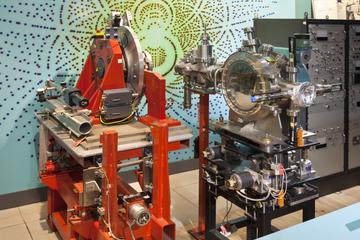
Items from the decommissioned Synchrotron Radiation Source (SRS) Laboratory at Daresbury


 This image is released under a CC BY-NC-SA 4.0
Licence
This image is released under a CC BY-NC-SA 4.0
Licence
License this image for commercial use at Science and Society Picture Library
LicenseThis image is released under a CC BY-NC-SA 4.0
Licence
License this image for commercial use at Science and Society Picture Library
License
Science Museum Group Collection
© The Board of Trustees of the Science Museum
Science Museum Group Collection
© The Board of Trustees of the Science Museum
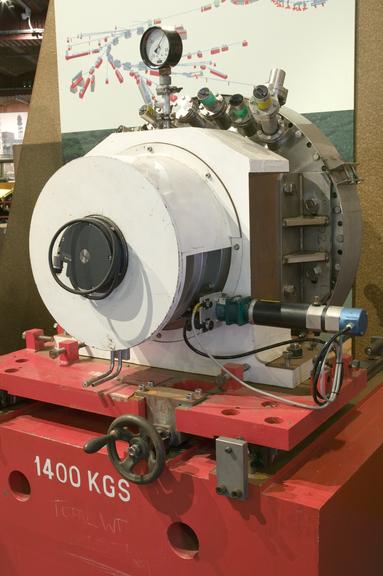
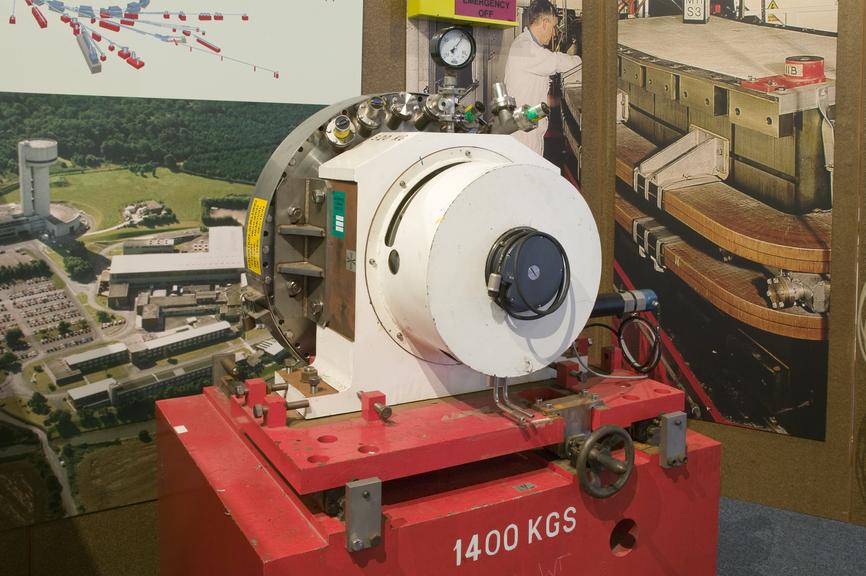
Collection of items from the decommissioned Synchrotron Radiation Source (SRS) Laboratory at Daresbury.
The Daresbury Synchrotron Radiation Source (SRS) was the world’s first dedicated X-ray synchrotron radiation source – a large scientific facility used by hundreds of scientists in their research.
A synchrotron is a type of circular particle accelerator, a machine that accelerates subatomic particles and focusses them into a beam, which scientists can use for experiments. The centrepiece of the SRS was a giant metal storage ring 30 metres in diameter, with beamlines arranged around the outside of the ring for scientists to set up their experiments on. Electrons travelled around inside the ring at almost the speed of light, accelerated and controlled by electromagnets. The intense x-ray light from the electrons was channelled through the beamlines into scientific experiments.
Scientists used the intense x-ray light from the SRS for many different experiments, particularly to understand the underlying molecular structure of materials, chemicals and biological samples.
The SRS was commissioned at the Daresbury Laboratory in Cheshire in 1981 and replaced an earlier experimental synchrotron named NINA (Northern Institutes Nuclear Accelerator). After 27 years of operation the SRS was decommissioned in 2008.
Beamline 16.5 of the Synchrotron Radiation Laboratory
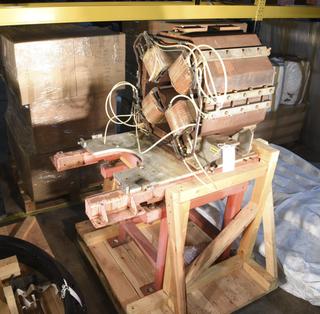
F-Quadrapole electromagnet from the storage ring of the Synchrotron Radiation Laboratory
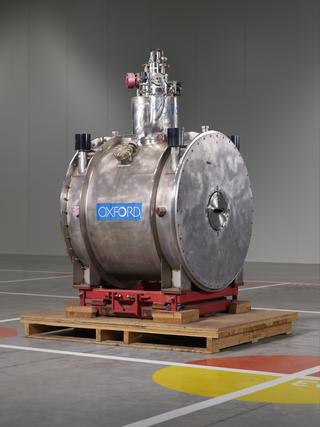
Wiggler electromagnet and support stand from the storage ring of the Synchrotron Radiation Laboratory
Details
Related Objects
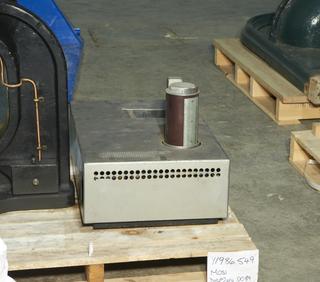
Infracord Spectrophotometer
Calibration or testing device

Microscope Eyeshield