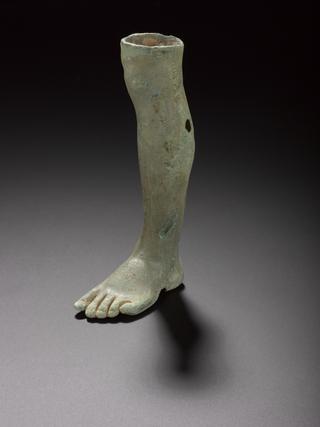
Votive left foot
- Made:
- 200 BCE - 200 CE in Roman Empire
- maker:
- Unknown
Votive left foot, terracotta, hollow at top and base, probably, Roman, 200BC-200AD
Votive offerings are those left in sacred places to ask for, or express gratitude for, healing. They are often made in the shape of the affected body part. Some are bespoke pieces, cast in expensive metals such as bronze. Others are mass-produced from cheaper materials such as terracotta and wax. Although it originated in earlier cultures, the phenomenon thrived in Ancient Roman Italy between 400 and 100 BC. It persists today in many faiths, including Christianity and Hinduism. Votives in the shape of feet may have represented a journey, or pilgrimage to the holy site.
Details
- Category:
- Classical & Medieval Medicine
- Collection:
- Sir Henry Wellcome's Museum Collection
- Object Number:
- A636088
- Materials:
- terracotta
- Measurements:
-
overall: 150 mm x 94 mm x 222 mm, 1.32 kg
- type:
- votive foot
- credit:
- Loan, Wellcome Trust