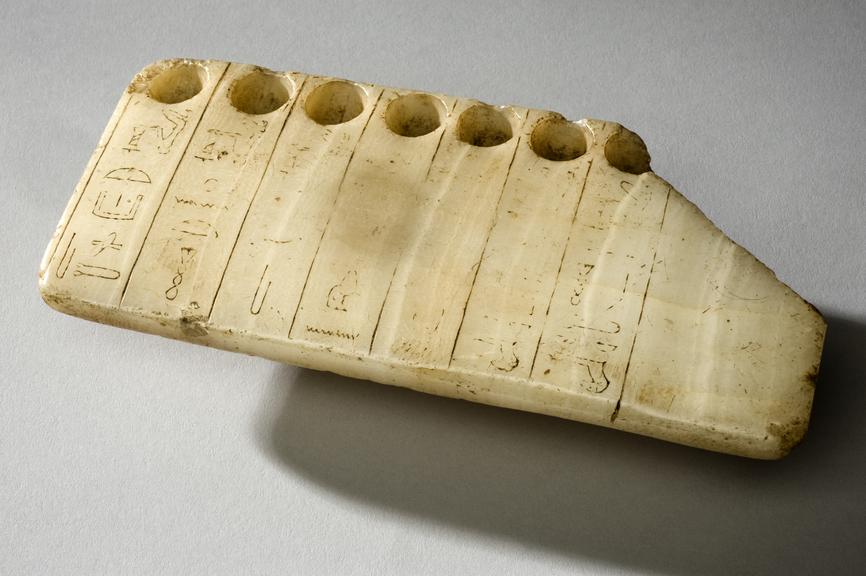
Stone slab with seven wells for sacred oils, Egypt, 2040 - 1782 BCE
- Made:
- 2040 - 1782 BCE in Egypt
- maker:
- Unknown


 This image is released under a CC BY-NC-SA 4.0
Licence
This image is released under a CC BY-NC-SA 4.0
Licence
License this image for commercial use at Science and Society Picture Library
LicenseThis image is released under a CC BY-NC-SA 4.0
Licence
License this image for commercial use at Science and Society Picture Library
LicenseThis image is released under a CC BY-NC-SA 4.0
Licence
License this image for commercial use at Science and Society Picture Library
LicenseThis image is released under a CC BY-NC-SA 4.0
Licence
License this image for commercial use at Science and Society Picture Library
LicenseThis image is released under a CC BY-NC-SA 4.0
Licence
License this image for commercial use at Science and Society Picture Library
LicenseThis image is released under a CC BY-NC-SA 4.0
Licence
License this image for commercial use at Science and Society Picture Library
LicenseThis image is released under a CC BY-NC-SA 4.0
Licence
License this image for commercial use at Science and Society Picture Library
LicenseThis image is released under a CC BY-NC-SA 4.0
Licence
License this image for commercial use at Science and Society Picture Library
LicenseThis image is released under a CC BY-NC-SA 4.0
Licence
License this image for commercial use at Science and Society Picture Library
LicenseThis image is released under a CC BY-NC-SA 4.0
Licence
License this image for commercial use at Science and Society Picture Library
License
Science Museum Group
© The Board of Trustees of the Science Museum
Science Museum Group
© The Board of Trustees of the Science Museum
Science Museum Group
© The Board of Trustees of the Science Museum
Science Museum Group
© The Board of Trustees of the Science Museum
Science Museum Group
© The Board of Trustees of the Science Museum
Science Museum Group
© The Board of Trustees of the Science Museum
Science Museum Group
© The Board of Trustees of the Science Museum
Science Museum Group
© The Board of Trustees of the Science Museum
Science Museum Group
© The Board of Trustees of the Science Museum
Aragonite slab with 7 holes for cosmetic ointments
Science Museum Group Collection
© The Board of Trustees of the Science Museum
Aragonite or alabaster slab with seven circular wells labelled in hieroglyphics, one for each of the sacred oils used in ancient Egyptian funerary and religious rituals, Egyptian, 2040 BCE – 1782 BCE
This stone tablet was made in Egypt around 4000 years ago. Each of its seven sections, divided by incised vertical lines, contains a small depression to hold a drop of one of the seven sacred oils used during embalming and ceremonies for the dead. The most important of these was the Opening of the Mouth ritual, performed on mummified bodies and statues to restore the deceased's senses and enable them to function in the afterlife. Each division is labelled with the name of the relevant oil in hieroglyphics. The wearing on the slab suggests it was heavily used.
Details
- Category:
- Classical & Medieval Medicine
- Collection:
- Sir Henry Wellcome's Museum Collection
- Object Number:
- A634883
- Materials:
- aragonite
- Measurements:
-
overall: 17 mm x 198 mm x 84 mm, 0.534 kg
- type:
- ointment slab
- credit:
- Sotheby's