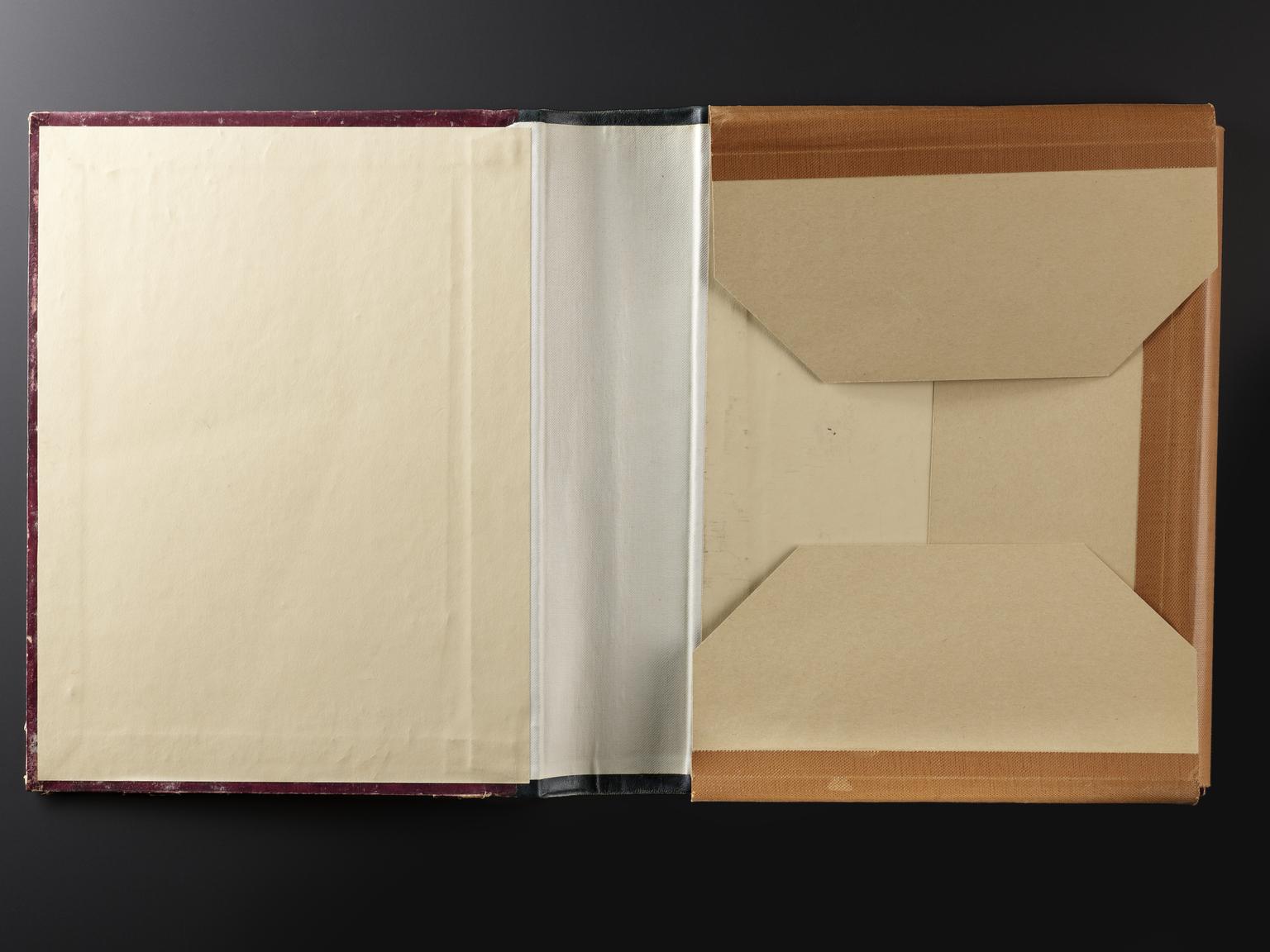
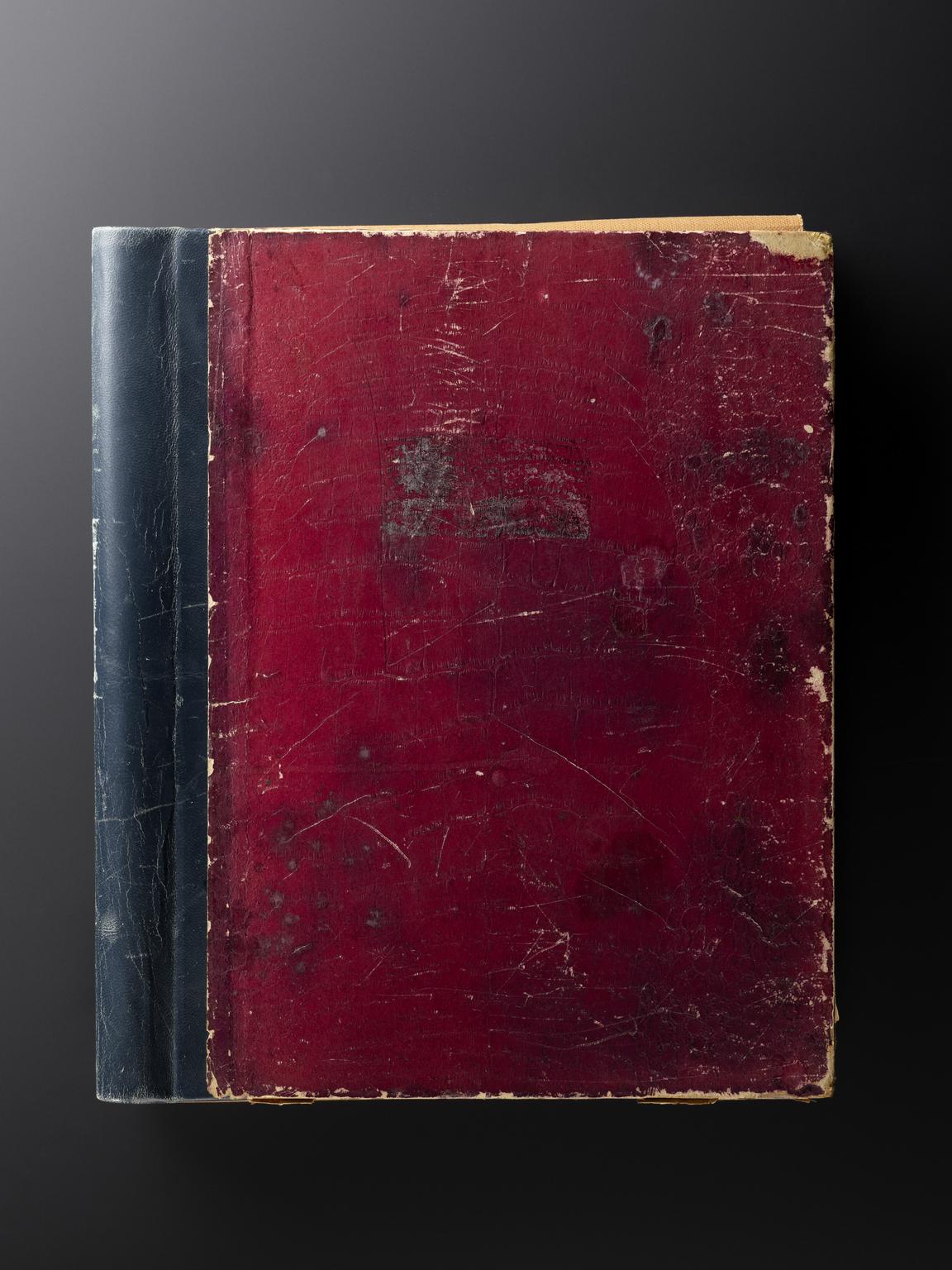
Folder of 22 drawings of lantern slide studies by F Percy Smith

Made:
c. 1915 in unknown
maker:
Unknown

Folder of 22 drawings of lantern slide studies by F Percy Smith.

Frank Percy Smith was born in London in 1880. He was keen to exploit the educational possibilities of film and began working for Charles Urban, who had been impressed with his photograph of a bluebottle's tongue. During his time working for Urban he produced numerous scientific films, most notably The Balancing Bluebottle (also known as The Acrobatic Fly) and the Kinemacolor production The Birth of a Flower (both 1910).

During the First World War, Smith made a series of films depicting battles through animated maps and worked as a Naval photographer. When the war was over he turned to comedy with The Bedtime Stories of Archie the Ant (1925), featuring insect characters in a natural environment. However it was the series 'Secrets of Nature' he made for British Instructional Films which allowed him to go back to the educational possibilities of documentary film. Blending nature photography with painstaking laboratory work, Smith and his team produced a steady stream of titles embracing nature's minutiae, from the life cycle of a sweet pea to the 'home-wrecking' tendencies of the cuckoo. Beginning in 1922, the series continued into the 1930s and the sound era, with commentary working equally well as inter-titles.

Smith was a true pioneer, inventing original methods for time lapse and micro cinematography, involving all kinds of home-made devices, including alarms all over his home to wake him up in the middle of the night if the film in the camera needed changing. With endless patience, he could spend up to two and a half years completing a film. He also had the popular touch, with the happy knack (as he put it himself) of being able to feed his audience "the powder of instruction in the jam of entertainment".

Details

Category:
Cinematography
Object Number:
2026-31
Materials:
paper (fibre product)
Measurements:
overall: 335 mm x 270 mm x 35 mm,
type:
lantern slide studies

Parts

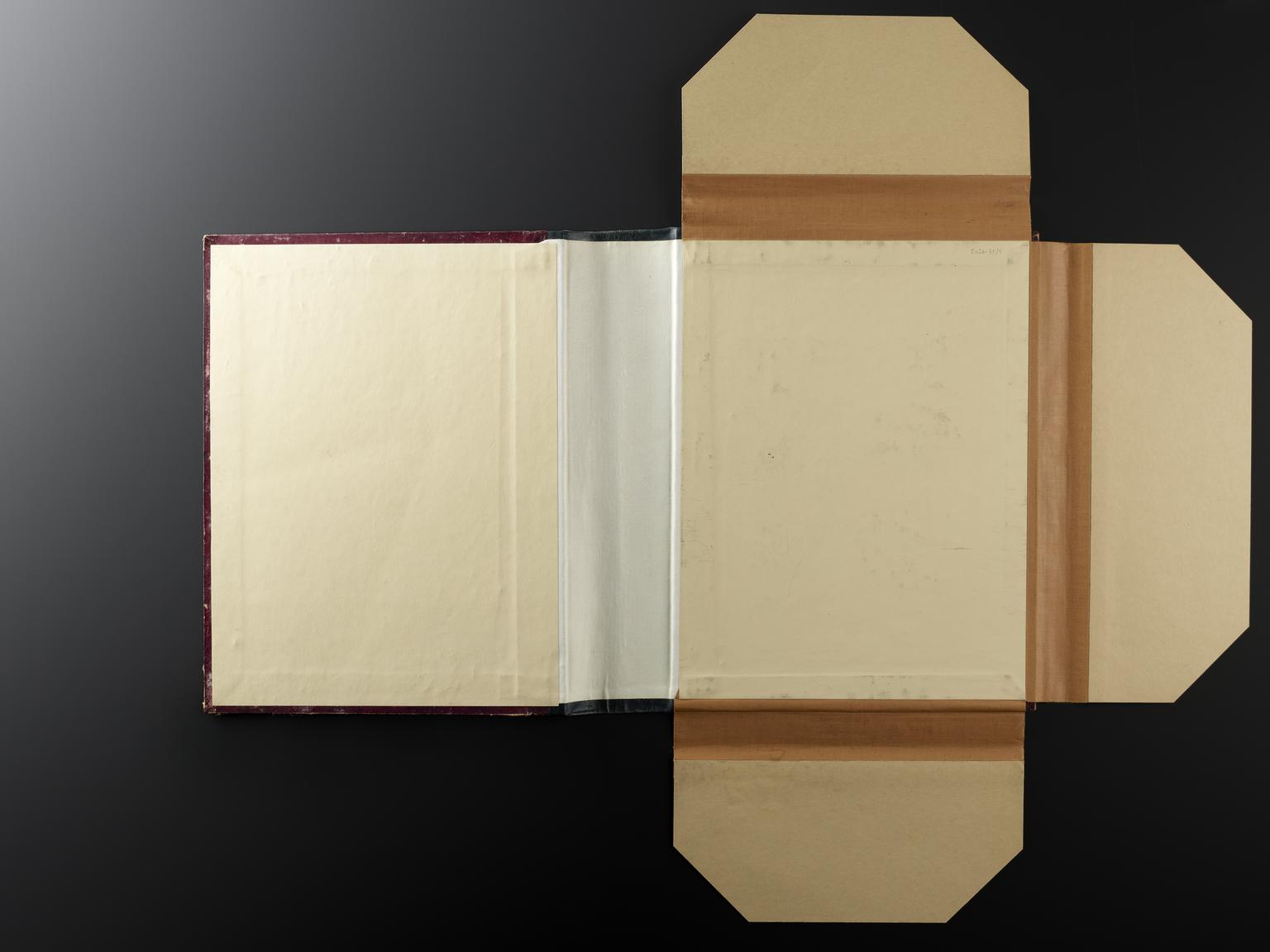
Folder for drawings of lantern slide studies by F Percy Smith.

Folder for drawings of lantern slide studies by F Percy Smith.

Folder for drawings of lantern slide studies by F Percy Smith.

More

Frank Percy Smith was born in London in 1880. He was keen to exploit the educational possibilities of film and began working for Charles Urban, who had been impressed with his photograph of a bluebottle's tongue. During his time working for Urban he produced numerous scientific films, most notably The Balancing Bluebottle (also known as The Acrobatic Fly) and the Kinemacolor production The Birth of a Flower (both 1910).

During the First World War, Smith made a series of films depicting battles through animated maps and worked as a Naval photographer. When the war was over he turned to comedy with The Bedtime Stories of Archie the Ant (1925), featuring insect characters in a natural environment. However it was the series 'Secrets of Nature' he made for British Instructional Films which allowed him to go back to the educational possibilities of documentary film. Blending nature photography with painstaking laboratory work, Smith and his team produced a steady stream of titles embracing nature's minutiae, from the life cycle of a sweet pea to the 'home-wrecking' tendencies of the cuckoo. Beginning in 1922, the series continued into the 1930s and the sound era, with commentary working equally well as inter-titles.

Smith was a true pioneer, inventing original methods for time lapse and micro cinematography, involving all kinds of home-made devices, including alarms all over his home to wake him up in the middle of the night if the film in the camera needed changing. With endless patience, he could spend up to two and a half years completing a film. He also had the popular touch, with the happy knack (as he put it himself) of being able to feed his audience "the powder of instruction in the jam of entertainment".

Measurements:
overall: 335 mm x 270 mm x 35 mm,
Materials:
paper (fibre product) and cardboard
Object Number:
2026-31/1
type:
folder
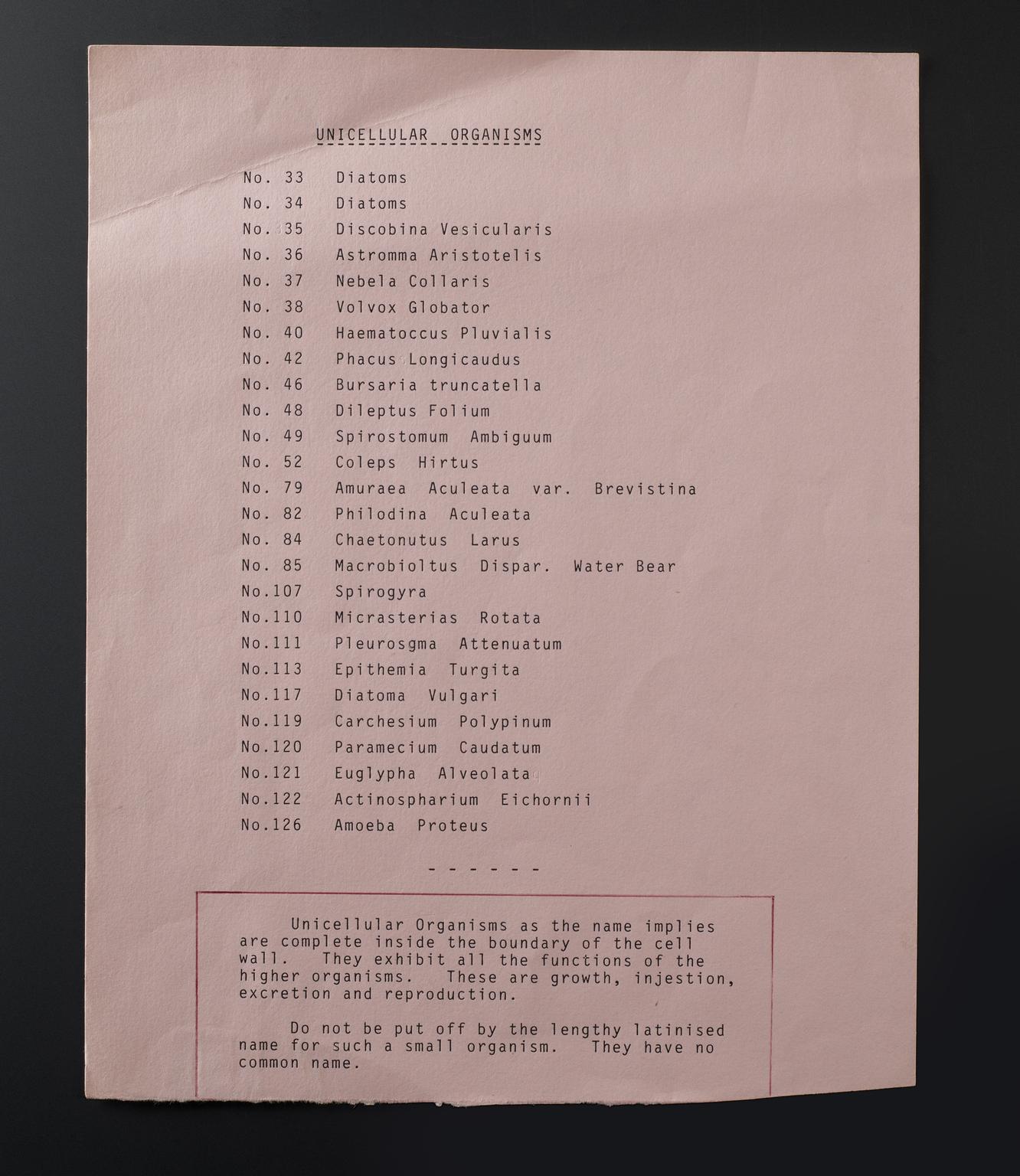
Typed listing for drawings of lantern slides by F Percy Smith, entitled Unicellular organisms, on A4 pink paper.

Typed listing for drawings of lantern slides by F Percy Smith

Typed listing for drawings of lantern slides by F Percy Smith, entitled Unicellular organisms, on A4 pink paper.

More

Frank Percy Smith was born in London in 1880. He was keen to exploit the educational possibilities of film and began working for Charles Urban, who had been impressed with his photograph of a bluebottle's tongue. During his time working for Urban he produced numerous scientific films, most notably The Balancing Bluebottle (also known as The Acrobatic Fly) and the Kinemacolor production The Birth of a Flower (both 1910).

During the First World War, Smith made a series of films depicting battles through animated maps and worked as a Naval photographer. When the war was over he turned to comedy with The Bedtime Stories of Archie the Ant (1925), featuring insect characters in a natural environment. However it was the series 'Secrets of Nature' he made for British Instructional Films which allowed him to go back to the educational possibilities of documentary film. Blending nature photography with painstaking laboratory work, Smith and his team produced a steady stream of titles embracing nature's minutiae, from the life cycle of a sweet pea to the 'home-wrecking' tendencies of the cuckoo. Beginning in 1922, the series continued into the 1930s and the sound era, with commentary working equally well as inter-titles.

Smith was a true pioneer, inventing original methods for time lapse and micro cinematography, involving all kinds of home-made devices, including alarms all over his home to wake him up in the middle of the night if the film in the camera needed changing. With endless patience, he could spend up to two and a half years completing a film. He also had the popular touch, with the happy knack (as he put it himself) of being able to feed his audience "the powder of instruction in the jam of entertainment".

Measurements:
overall: 255 mm x 203 mm
Materials:
paper (fibre product)
Object Number:
2026-31/2
type:
document
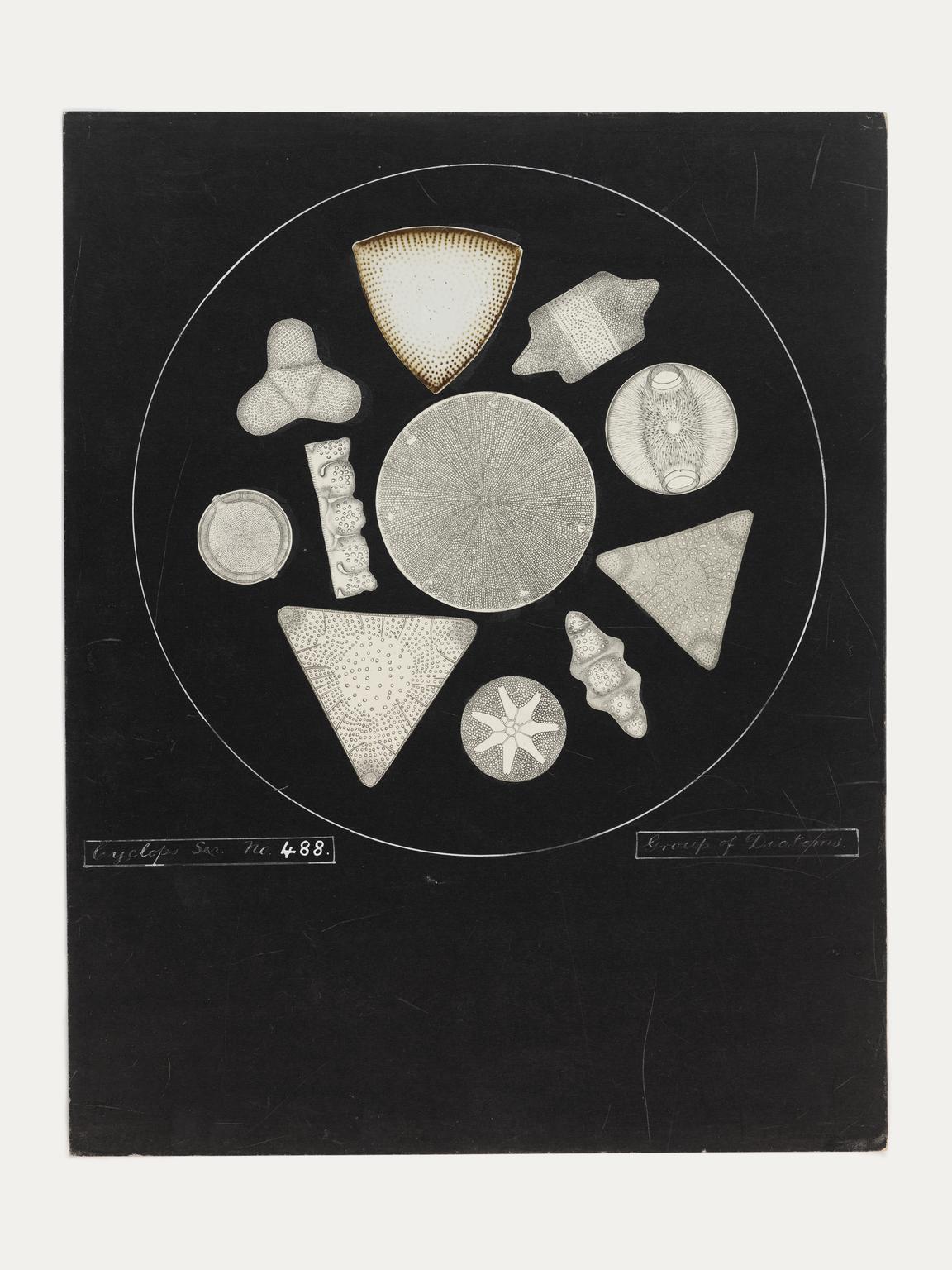
Drawing of Diatoms (no. 33) from lantern slide study by F Percy Smith, c 1915.

Drawing of Diatoms (no. 33) from lantern slide study by F Percy Smith

Drawing of Diatoms (no. 33) from lantern slide study by F Percy Smith, c 1915.

More

Diatoms are a form of single celled algae that can be found in most acquatic habitats, they are the only organisms on earth whose cell walls are made of silica.

Frank Percy Smith was born in London in 1880. He was keen to exploit the educational possibilities of film and began working for Charles Urban, who had been impressed with his photograph of a bluebottle's tongue. During his time working for Urban he produced numerous scientific films, most notably The Balancing Bluebottle (also known as The Acrobatic Fly) and the Kinemacolor production The Birth of a Flower (both 1910).

During the First World War, Smith made a series of films depicting battles through animated maps and worked as a Naval photographer. When the war was over he turned to comedy with The Bedtime Stories of Archie the Ant (1925), featuring insect characters in a natural environment. However it was the series 'Secrets of Nature' he made for British Instructional Films which allowed him to go back to the educational possibilities of documentary film. Blending nature photography with painstaking laboratory work, Smith and his team produced a steady stream of titles embracing nature's minutiae, from the life cycle of a sweet pea to the 'home-wrecking' tendencies of the cuckoo. Beginning in 1922, the series continued into the 1930s and the sound era, with commentary working equally well as inter-titles.

Smith was a true pioneer, inventing original methods for time lapse and micro cinematography, involving all kinds of home-made devices, including alarms all over his home to wake him up in the middle of the night if the film in the camera needed changing. With endless patience, he could spend up to two and a half years completing a film. He also had the popular touch, with the happy knack (as he put it himself) of being able to feed his audience "the powder of instruction in the jam of entertainment".

Measurements:
overall: 305 mm x 238 mm
Materials:
paper (fibre product)
Object Number:
2026-31/3
type:
drawing
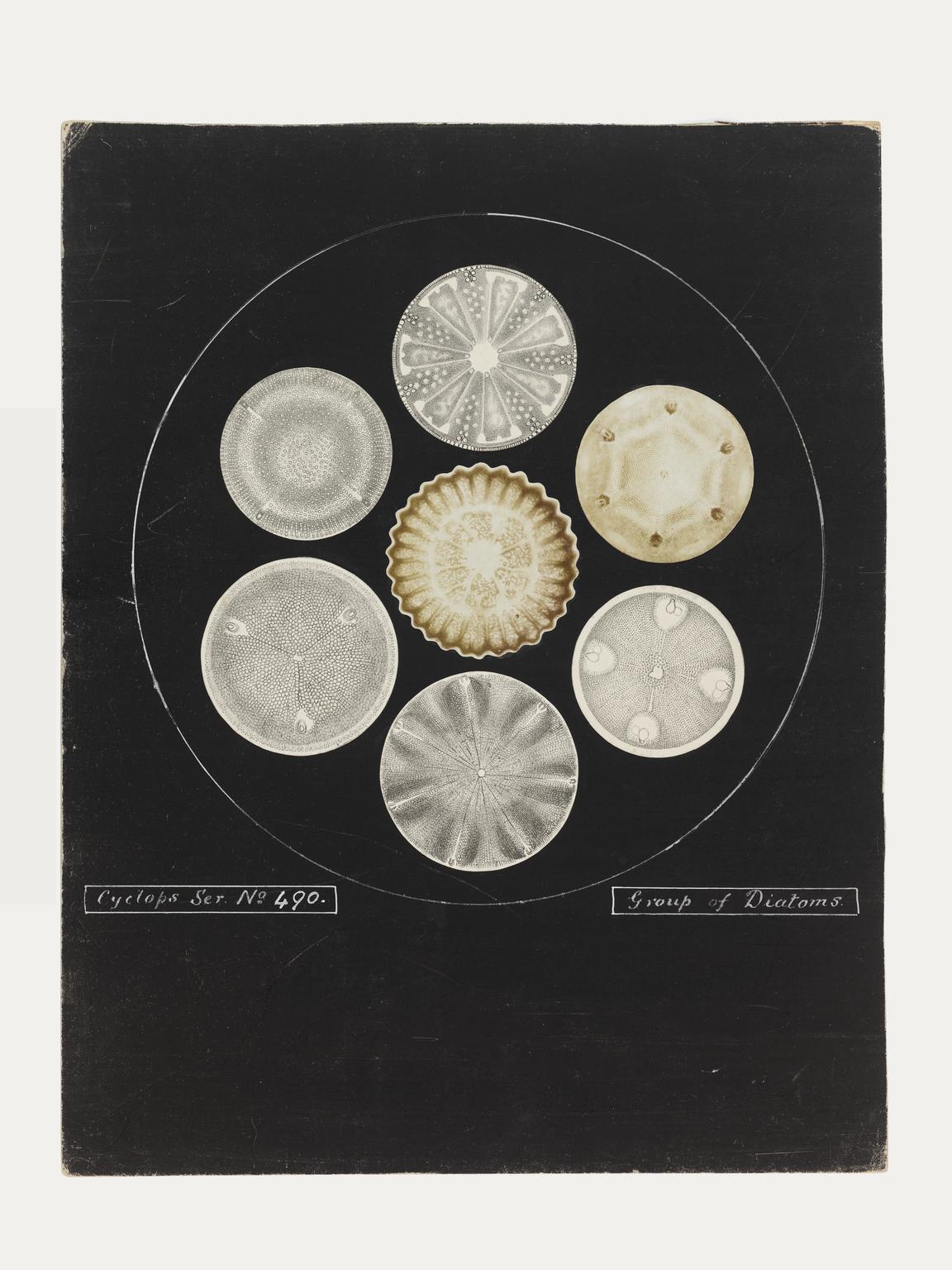
Drawing of Diatoms (no. 34) from lantern slide study by F Percy Smith, c.1915.

Drawing of Diatoms (no. 34) from lantern slide study by F Percy Smith

Drawing of Diatoms (no. 34) from lantern slide study by F Percy Smith, c.1915.

More

Diatoms are a form of single celled algae that can be found in most acquatic habitats, they are the only organisms on earth whose cell walls are made of silica.

Frank Percy Smith was born in London in 1880. He was keen to exploit the educational possibilities of film and began working for Charles Urban, who had been impressed with his photograph of a bluebottle's tongue. During his time working for Urban he produced numerous scientific films, most notably The Balancing Bluebottle (also known as The Acrobatic Fly) and the Kinemacolor production The Birth of a Flower (both 1910).

During the First World War, Smith made a series of films depicting battles through animated maps and worked as a Naval photographer. When the war was over he turned to comedy with The Bedtime Stories of Archie the Ant (1925), featuring insect characters in a natural environment. However it was the series 'Secrets of Nature' he made for British Instructional Films which allowed him to go back to the educational possibilities of documentary film. Blending nature photography with painstaking laboratory work, Smith and his team produced a steady stream of titles embracing nature's minutiae, from the life cycle of a sweet pea to the 'home-wrecking' tendencies of the cuckoo. Beginning in 1922, the series continued into the 1930s and the sound era, with commentary working equally well as inter-titles.

Smith was a true pioneer, inventing original methods for time lapse and micro cinematography, involving all kinds of home-made devices, including alarms all over his home to wake him up in the middle of the night if the film in the camera needed changing. With endless patience, he could spend up to two and a half years completing a film. He also had the popular touch, with the happy knack (as he put it himself) of being able to feed his audience "the powder of instruction in the jam of entertainment".

Measurements:
overall: 305 mm x 240 mm
Materials:
paper (fibre product)
Object Number:
2026-31/4
type:
drawing
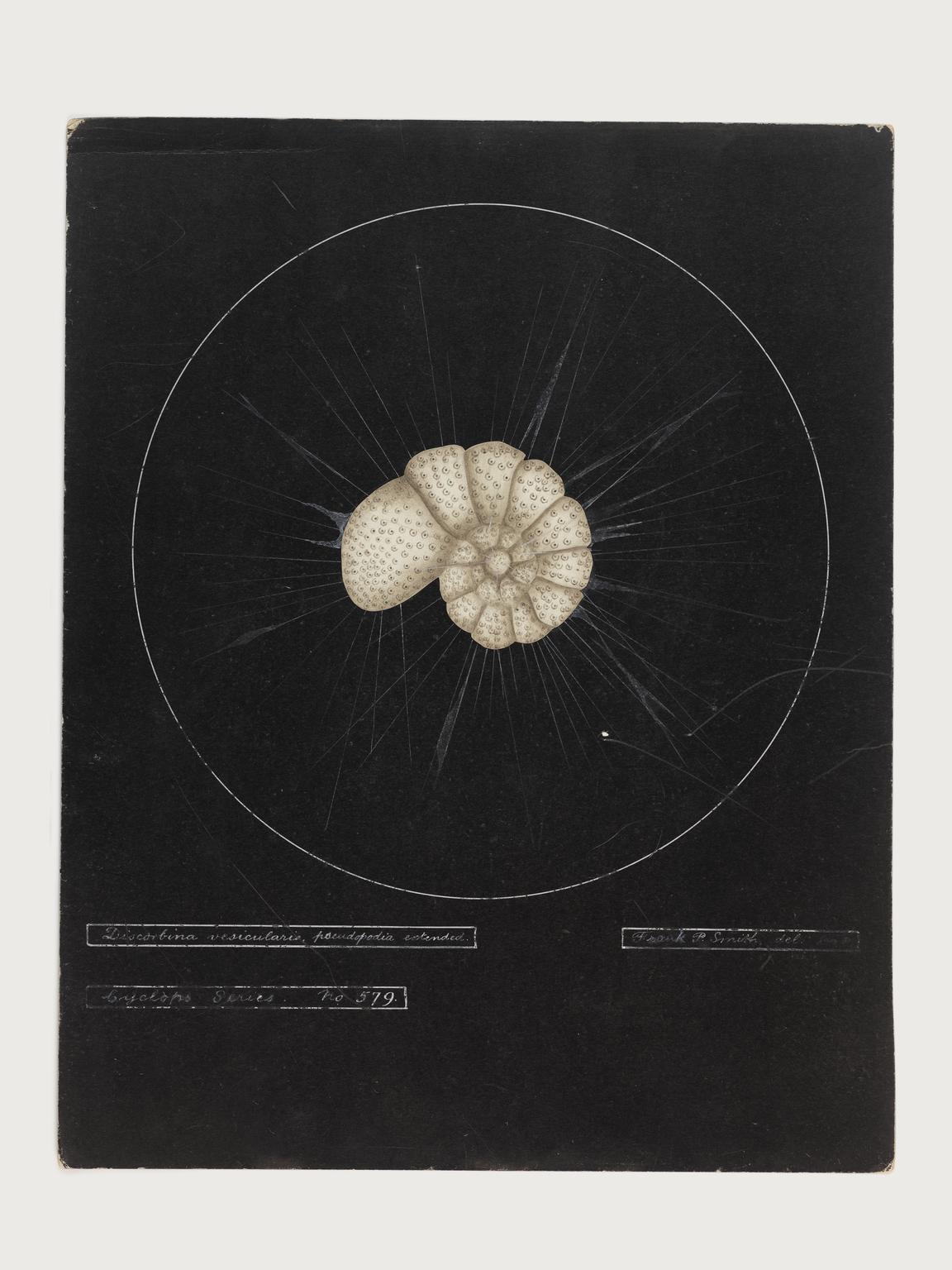
Drawing of Discobina Vesicularis (no. 35) from lantern slide study by F Percy Smith, c. 1915.

Drawing of Discobina Vesicularis (no. 35) from lantern slide study by F Percy Smith

Drawing of Discobina Vesicularis (no. 35) from lantern slide study by F Percy Smith, c. 1915.

More

Frank Percy Smith was born in London in 1880. He was keen to exploit the educational possibilities of film and began working for Charles Urban, who had been impressed with his photograph of a bluebottle's tongue. During his time working for Urban he produced numerous scientific films, most notably The Balancing Bluebottle (also known as The Acrobatic Fly) and the Kinemacolor production The Birth of a Flower (both 1910).

During the First World War, Smith made a series of films depicting battles through animated maps and worked as a Naval photographer. When the war was over he turned to comedy with The Bedtime Stories of

Archie the Ant (1925), featuring insect characters in a natural environment. However it was the series 'Secrets of Nature' he made for British Instructional Films which allowed him to go back to the educational possibilities of documentary film. Blending nature photography with painstaking laboratory work, Smith and his team produced a steady stream of titles embracing nature's minutiae, from the life cycle of a sweet pea to the 'home-wrecking' tendencies of the cuckoo. Beginning in 1922, the series continued into the 1930s and the sound era, with commentary working equally well as inter-titles.

Smith was a true pioneer, inventing original methods for time lapse and micro cinematography, involving all kinds of home-made devices, including alarms all over his home to wake him up in the middle of the night if the film in the camera needed changing. With endless patience, he could spend up to two and a half years completing a film. He also had the popular touch, with the happy knack (as he put it himself) of being able to feed his audience "the powder of instruction in the jam of entertainment".

Measurements:
overall: 305 mm x 240 mm
Materials:
paper (fibre product)
Object Number:
2026-31/5
type:
drawing
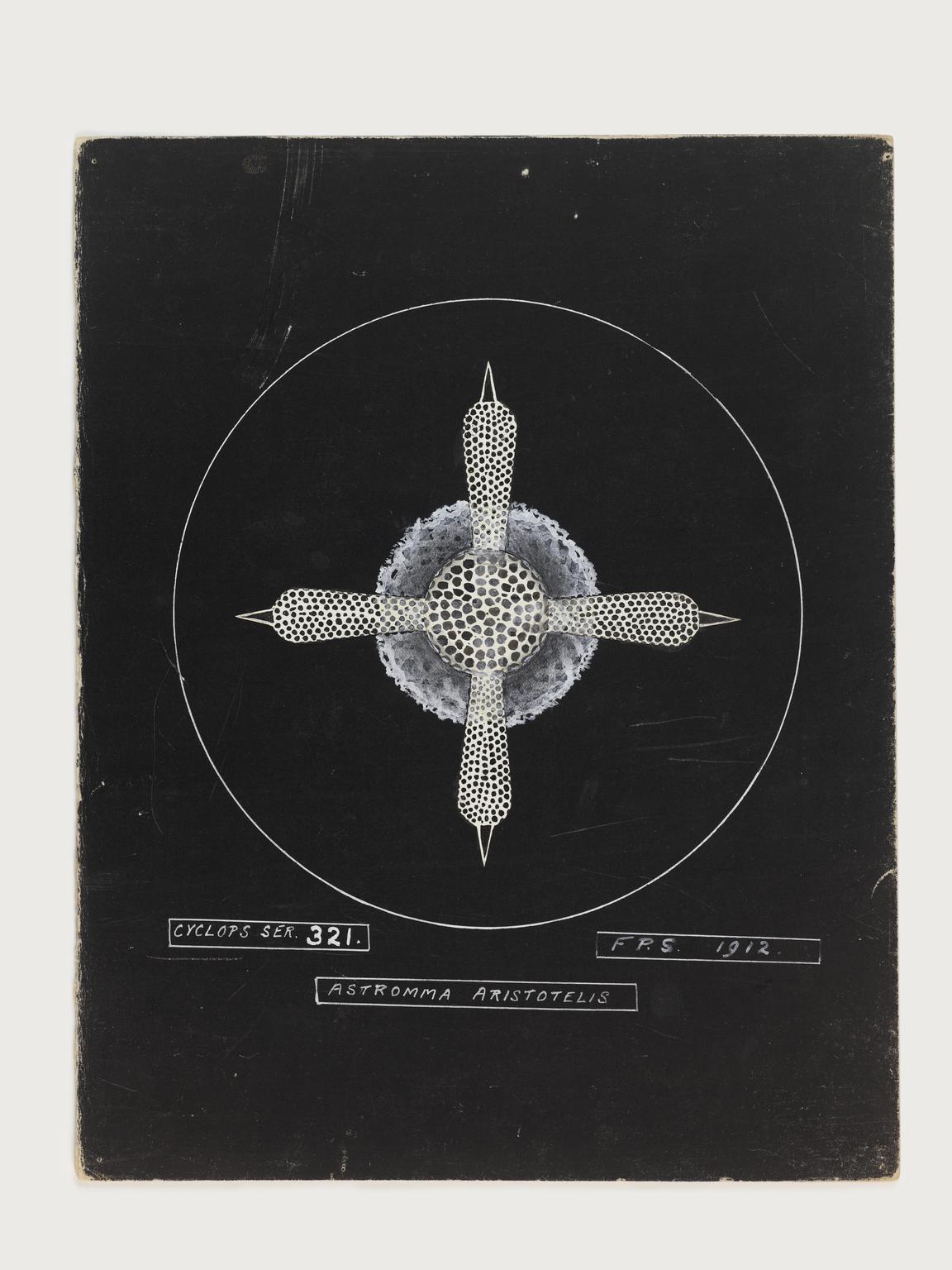
Drawing of Astromma Aristotelis (no. 36) from lantern slide study by F Percy Smith, 1912.

Drawing of Astromma Aristotelis (no. 36) from lantern slide study by F Percy Smith.

Drawing of Astromma Aristotelis (no. 36) from lantern slide study by F Percy Smith, 1912.

More

Astromma Aristotelis is the source of phosphorescence in sea water.

Frank Percy Smith was born in London in 1880. He was keen to exploit the educational possibilities of film and began working for Charles Urban, who had been impressed with his photograph of a bluebottle's tongue. During his time working for Urban he produced numerous scientific films, most notably The Balancing Bluebottle (also known as The Acrobatic Fly) and the Kinemacolor production The Birth of a Flower (both 1910).

During the First World War, Smith made a series of films depicting battles through animated maps and worked as a Naval photographer. When the war was over he turned to comedy with The Bedtime Stories of

Archie the Ant (1925), featuring insect characters in a natural environment. However it was the series 'Secrets of Nature' he made for British Instructional Films which allowed him to go back to the educational possibilities of documentary film. Blending nature photography with painstaking laboratory work, Smith and his team produced a steady stream of titles embracing nature's minutiae, from the life cycle of a sweet pea to the 'home-wrecking' tendencies of the cuckoo. Beginning in 1922, the series continued into the 1930s and the sound era, with commentary working equally well as inter-titles.

Smith was a true pioneer, inventing original methods for time lapse and micro cinematography, involving all kinds of home-made devices, including alarms all over his home to wake him up in the middle of the night if the film in the camera needed changing. With endless patience, he could spend up to two and a half years completing a film. He also had the popular touch, with the happy knack (as he put it himself) of being able to feed his audience "the powder of instruction in the jam of entertainment".

Measurements:
overall: 305 mm x 240 mm
Materials:
paper (fibre product)
Object Number:
2026-31/6
type:
drawing
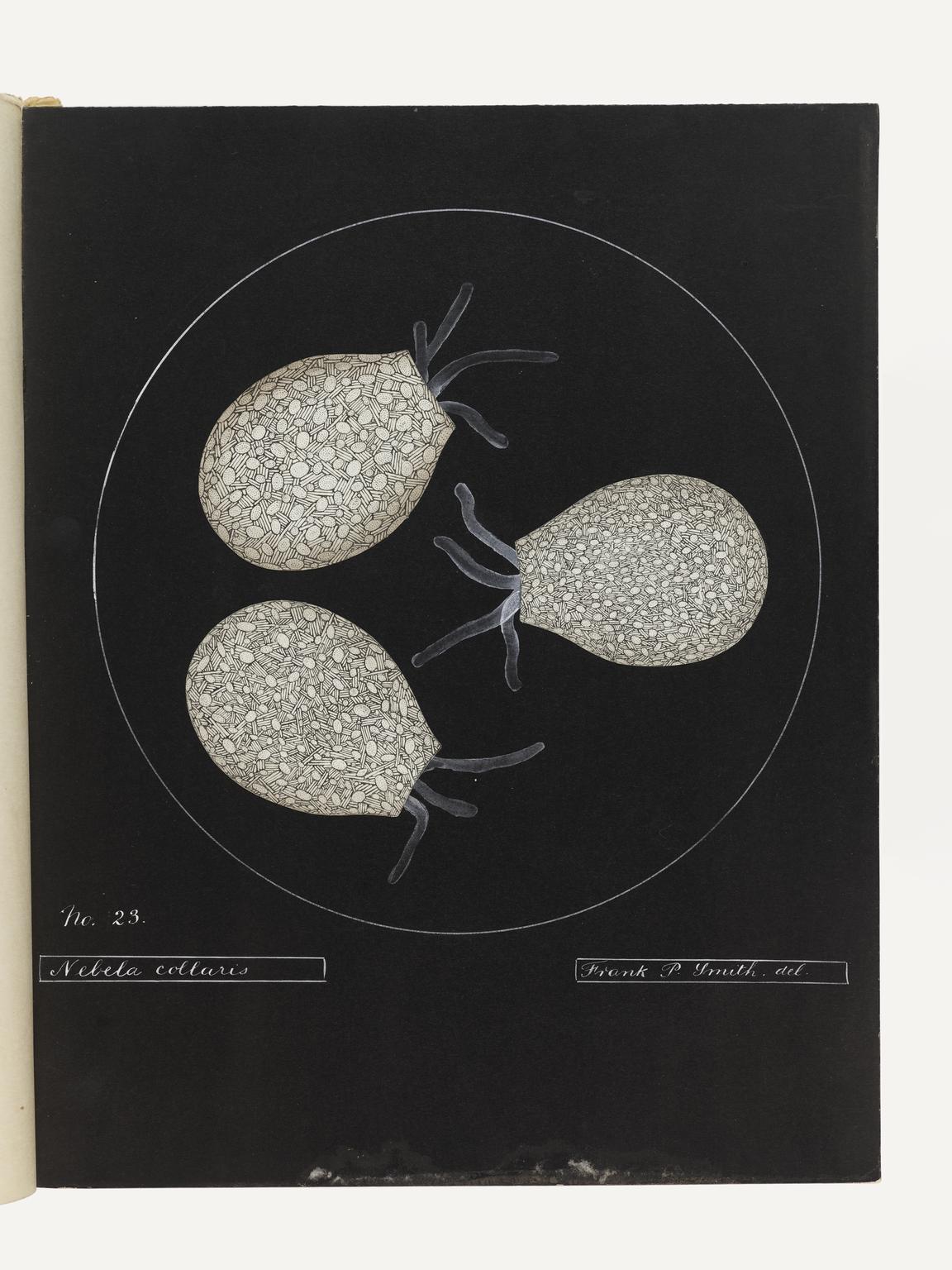
Drawing of Nebela Collaris (no. 37) from lantern slide study by F Percy Smith, with paper cover sheet, c. 1915.

Drawing of Nebela Collaris (no. 37) from lantern slide study by F Percy Smith

Drawing of Nebela Collaris (no. 37) from lantern slide study by F Percy Smith, with paper cover sheet, c. 1915.

More

Nebela is a group of amoeba which have a thin, transparent test (a kind of shell) which protects them from predators. these tests can be generated by the amoeba themselves or constructed from particles of sediment fused with their own secretions.

Frank Percy Smith was born in London in 1880. He was keen to exploit the educational possibilities of film and began working for Charles Urban, who had been impressed with his photograph of a bluebottle's tongue. During his time working for Urban he produced numerous scientific films, most notably The Balancing Bluebottle (also known as The Acrobatic Fly) and the Kinemacolor production The Birth of a Flower (both 1910).

During the First World War, Smith made a series of films depicting battles through animated maps and worked as a Naval photographer. When the war was over he turned to comedy with The Bedtime Stories of

Archie the Ant (1925), featuring insect characters in a natural environment. However it was the series 'Secrets of Nature' he made for British Instructional Films which allowed him to go back to the educational possibilities of documentary film. Blending nature photography with painstaking laboratory work, Smith and his team produced a steady stream of titles embracing nature's minutiae, from the life cycle of a sweet pea to the 'home-wrecking' tendencies of the cuckoo. Beginning in 1922, the series continued into the 1930s and the sound era, with commentary working equally well as inter-titles.

Smith was a true pioneer, inventing original methods for time lapse and micro cinematography, involving all kinds of home-made devices, including alarms all over his home to wake him up in the middle of the night if the film in the camera needed changing. With endless patience, he could spend up to two and a half years completing a film. He also had the popular touch, with the happy knack (as he put it himself) of being able to feed his audience "the powder of instruction in the jam of entertainment".

Measurements:
overall: 305 mm x 240 mm
Materials:
paper (fibre product)
Object Number:
2026-31/7
type:
drawing
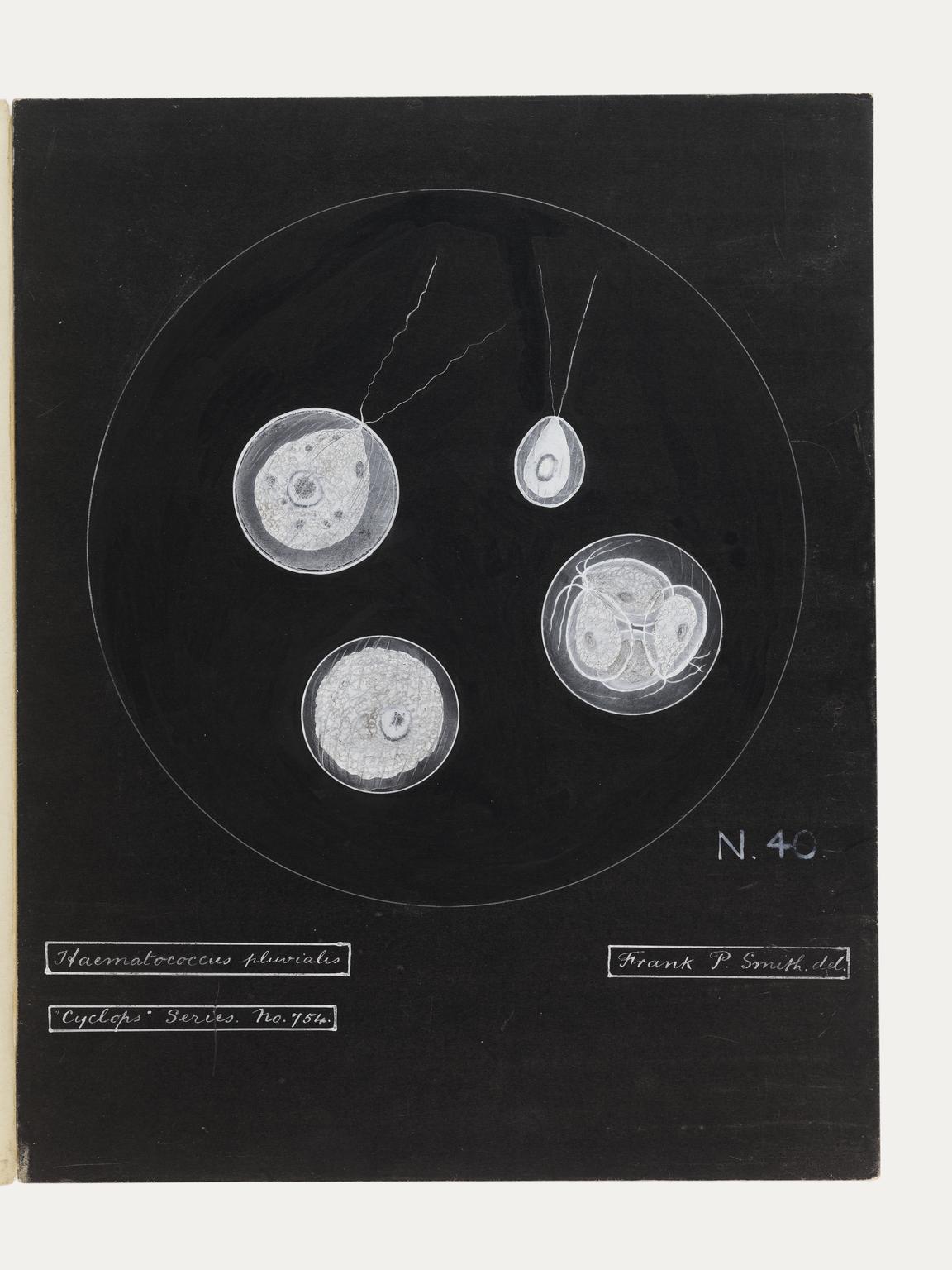
Drawing of Haematococcus Pluvialis (no. 40) from lantern slide study by F Percy Smith, with paper cover sheet, c. 1915.

Drawing of Haematococcus Pluvialis (no. 40) from lantern slide study by F Percy Smith

Drawing of Haematococcus Pluvialis (no. 40) from lantern slide study by F Percy Smith, with paper cover sheet, c. 1915.

More

Haematococcus Pluvialis (also known as Haematococcus lacustris is a freshwater, unicellular micro organism which is a source of natural astaxanthin, an antioxidant.

Frank Percy Smith was born in London in 1880. He was keen to exploit the educational possibilities of film and began working for Charles Urban, who had been impressed with his photograph of a bluebottle's tongue. During his time working for Urban he produced numerous scientific films, most notably The Balancing Bluebottle (also known as The Acrobatic Fly) and the Kinemacolor production The Birth of a Flower (both 1910).

During the First World War, Smith made a series of films depicting battles through animated maps and worked as a Naval photographer. When the war was over he turned to comedy with The Bedtime Stories of

Archie the Ant (1925), featuring insect characters in a natural environment. However it was the series 'Secrets of Nature' he made for British Instructional Films which allowed him to go back to the educational possibilities of documentary film. Blending nature photography with painstaking laboratory work, Smith and his team produced a steady stream of titles embracing nature's minutiae, from the life cycle of a sweet pea to the 'home-wrecking' tendencies of the cuckoo. Beginning in 1922, the series continued into the 1930s and the sound era, with commentary working equally well as inter-titles.

Smith was a true pioneer, inventing original methods for time lapse and micro cinematography, involving all kinds of home-made devices, including alarms all over his home to wake him up in the middle of the night if the film in the camera needed changing. With endless patience, he could spend up to two and a half years completing a film. He also had the popular touch, with the happy knack (as he put it himself) of being able to feed his audience "the powder of instruction in the jam of entertainment".

Measurements:
overall: 305 mm x 240 mm
Materials:
paper (fibre product)
Object Number:
2026-31/8
type:
drawing
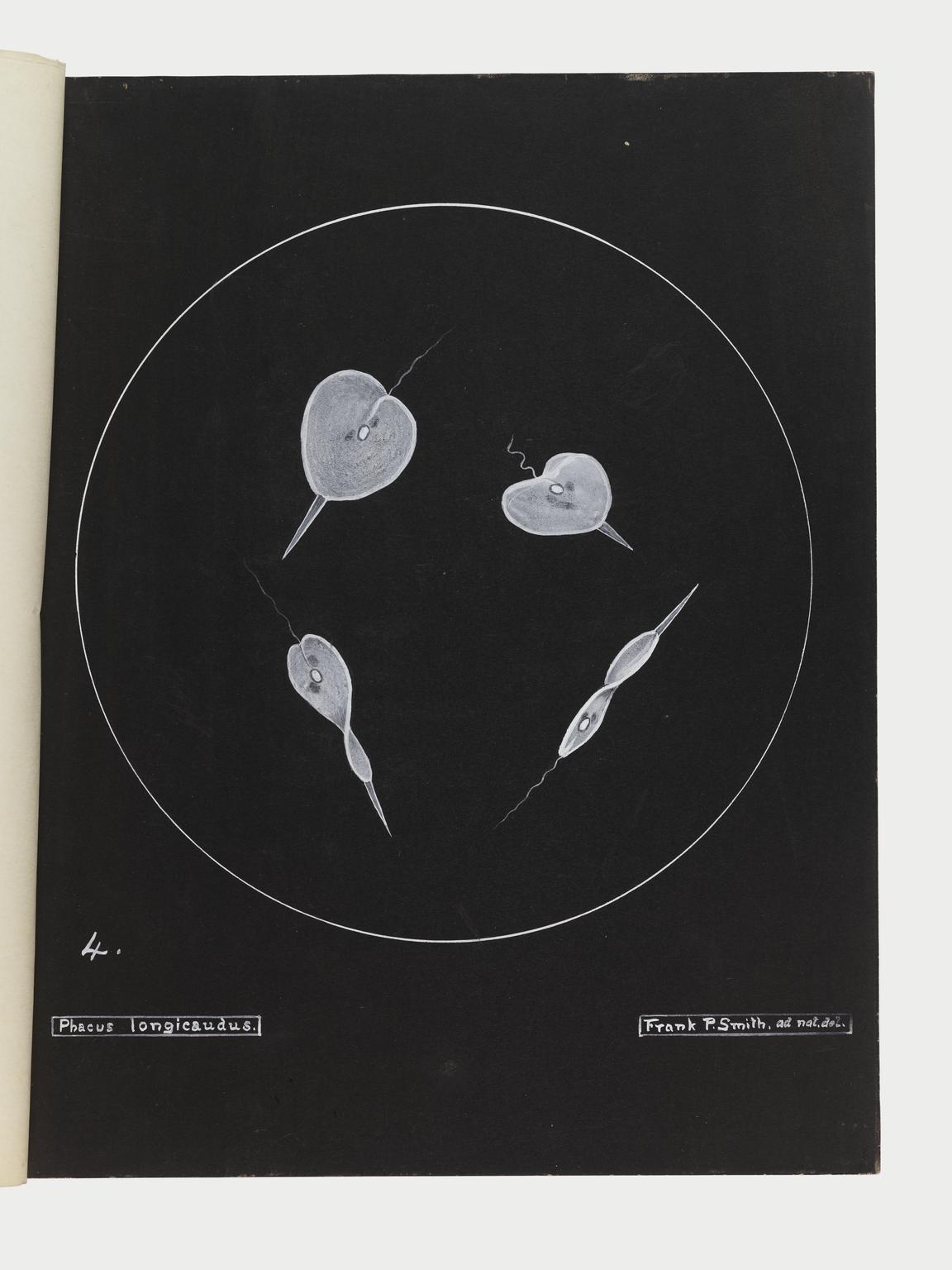
Drawing of Phacus Longicaudus (no. 42) from lantern slide study by F Percy Smith with paper cover sheet, c. 1915.

Drawing of Phacus Longicaudus (no. 42) from lantern slide study by F Percy Smith

Drawing of Phacus Longicaudus (no. 42) from lantern slide study by F Percy Smith with paper cover sheet, c. 1915.

More

Phacus Longicaudus (or Longicauda) is a species of fresh water algae

Frank Percy Smith was born in London in 1880. He was keen to exploit the educational possibilities of film and began working for Charles Urban, who had been impressed with his photograph of a bluebottle's tongue. During his time working for Urban he produced numerous scientific films, most notably The Balancing Bluebottle (also known as The Acrobatic Fly) and the Kinemacolor production The Birth of a Flower (both 1910).

During the First World War, Smith made a series of films depicting battles through animated maps and worked as a Naval photographer. When the war was over he turned to comedy with The Bedtime Stories of

Archie the Ant (1925), featuring insect characters in a natural environment. However it was the series 'Secrets of Nature' he made for British Instructional Films which allowed him to go back to the educational possibilities of documentary film. Blending nature photography with painstaking laboratory work, Smith and his team produced a steady stream of titles embracing nature's minutiae, from the life cycle of a sweet pea to the 'home-wrecking' tendencies of the cuckoo. Beginning in 1922, the series continued into the 1930s and the sound era, with commentary working equally well as inter-titles.

Smith was a true pioneer, inventing original methods for time lapse and micro cinematography, involving all kinds of home-made devices, including alarms all over his home to wake him up in the middle of the night if the film in the camera needed changing. With endless patience, he could spend up to two and a half years completing a film. He also had the popular touch, with the happy knack (as he put it himself) of being able to feed his audience "the powder of instruction in the jam of entertainment".

Measurements:
overall: 305 mm x 240 mm
Materials:
paper (fibre product)
Object Number:
2026-31/9
type:
drawing
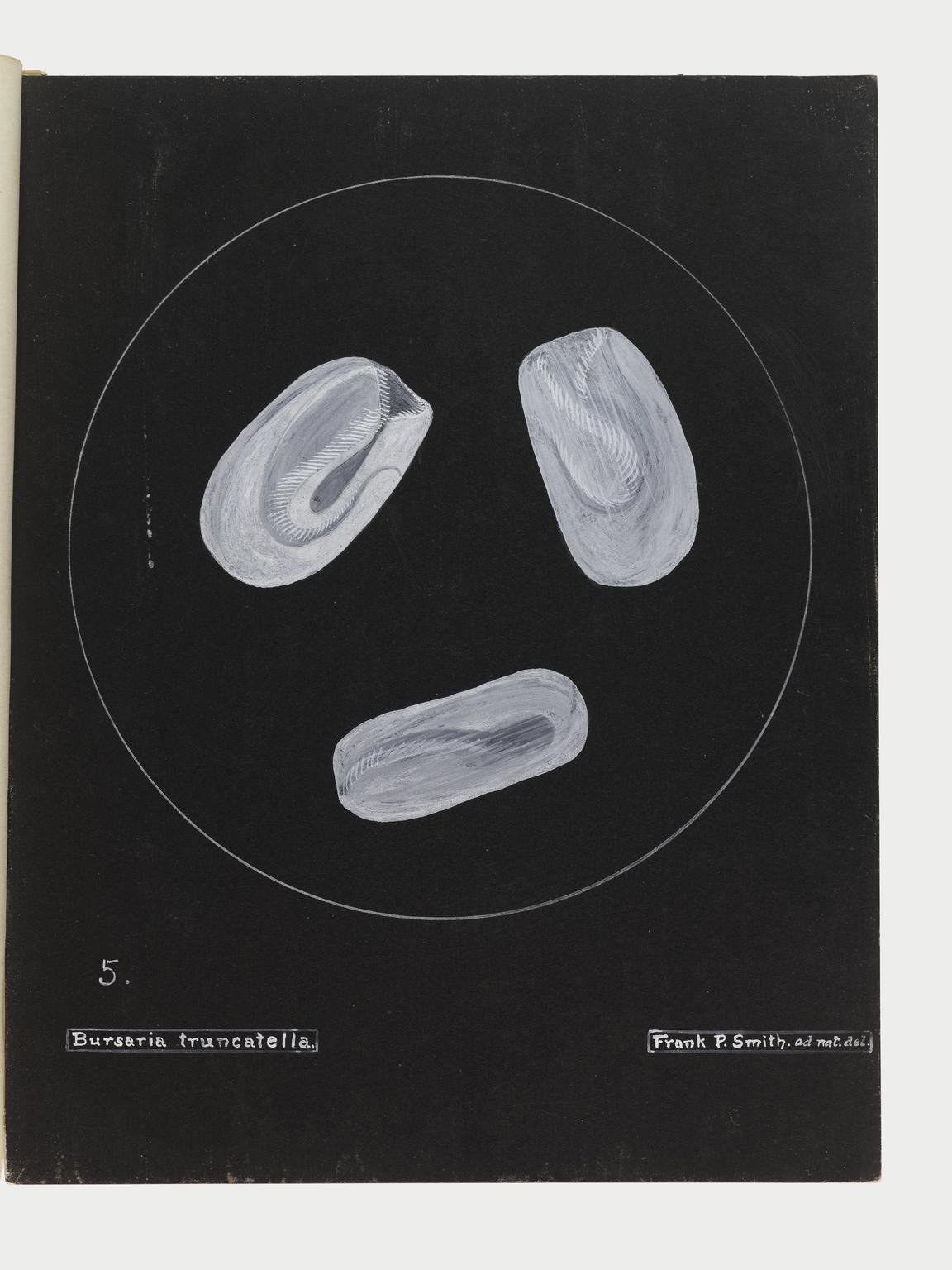
Drawing of Bursaria Truncatella (no. 46) from lantern slide study by F Percy Smith with paper cover sheet, c. 1915.

Drawing of Bursaria Truncatella (no. 46) from lantern slide study by F Percy Smith

Drawing of Bursaria Truncatella (no. 46) from lantern slide study by F Percy Smith with paper cover sheet, c. 1915.

More

Bursaria Truncatella is a single celled organism, which can grow up to 1mm long. They live in freshwater environments and are able to ingest other single celled organisms and algae.

Frank Percy Smith was born in London in 1880. He was keen to exploit the educational possibilities of film and began working for Charles Urban, who had been impressed with his photograph of a bluebottle's tongue. During his time working for Urban he produced numerous scientific films, most notably The Balancing Bluebottle (also known as The Acrobatic Fly) and the Kinemacolor production The Birth of a Flower (both 1910).

During the First World War, Smith made a series of films depicting battles through animated maps and worked as a Naval photographer. When the war was over he turned to comedy with The Bedtime Stories of

Archie the Ant (1925), featuring insect characters in a natural environment. However it was the series 'Secrets of Nature' he made for British Instructional Films which allowed him to go back to the educational possibilities of documentary film. Blending nature photography with painstaking laboratory work, Smith and his team produced a steady stream of titles embracing nature's minutiae, from the life cycle of a sweet pea to the 'home-wrecking' tendencies of the cuckoo. Beginning in 1922, the series continued into the 1930s and the sound era, with commentary working equally well as inter-titles.

Smith was a true pioneer, inventing original methods for time lapse and micro cinematography, involving all kinds of home-made devices, including alarms all over his home to wake him up in the middle of the night if the film in the camera needed changing. With endless patience, he could spend up to two and a half years completing a film. He also had the popular touch, with the happy knack (as he put it himself) of being able to feed his audience "the powder of instruction in the jam of entertainment".

Measurements:
overall: 305 mm x 240 mm
Materials:
paper (fibre product)
Object Number:
2026-31/10
type:
drawing
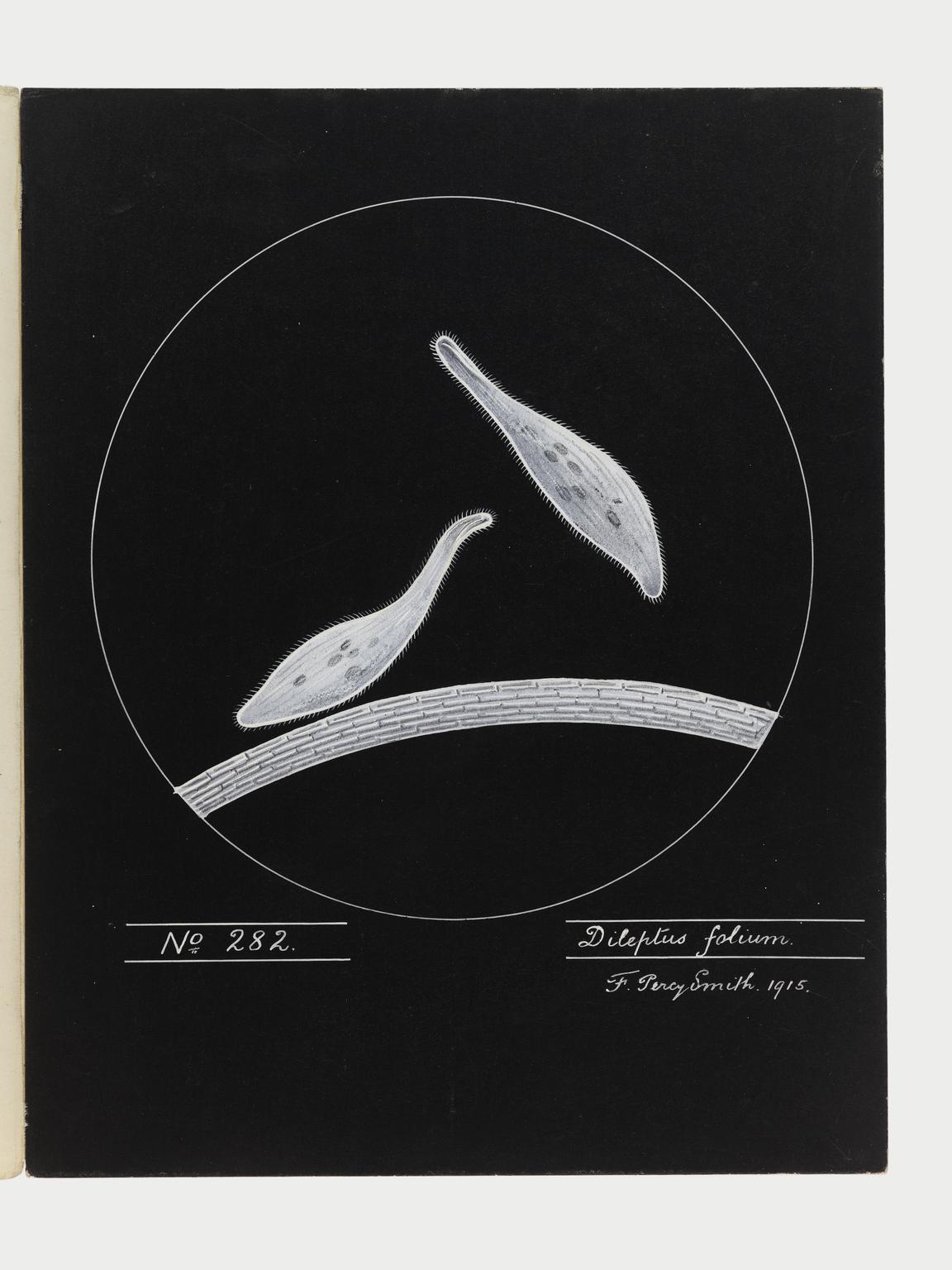
Drawing of Dileptus Folium (no. 48) from lantern slide study by F Percy Smith with paper cover sheet , 1915.

Drawing of Dileptus Folium (no. 48) from lantern slide study by F Percy Smith

Drawing of Dileptus Folium (no. 48) from lantern slide study by F Percy Smith with paper cover sheet , 1915.

More

Dileptus Folium is a unicellular organism whih lives in both fresh and salt water as well as in moses and soils.

Frank Percy Smith was born in London in 1880. He was keen to exploit the educational possibilities of film and began working for Charles Urban, who had been impressed with his photograph of a bluebottle's tongue. During his time working for Urban he produced numerous scientific films, most notably The Balancing Bluebottle (also known as The Acrobatic Fly) and the Kinemacolor production The Birth of a Flower (both 1910).

During the First World War, Smith made a series of films depicting battles through animated maps and worked as a Naval photographer. When the war was over he turned to comedy with The Bedtime Stories of

Archie the Ant (1925), featuring insect characters in a natural environment. However it was the series 'Secrets of Nature' he made for British Instructional Films which allowed him to go back to the educational possibilities of documentary film. Blending nature photography with painstaking laboratory work, Smith and his team produced a steady stream of titles embracing nature's minutiae, from the life cycle of a sweet pea to the 'home-wrecking' tendencies of the cuckoo. Beginning in 1922, the series continued into the 1930s and the sound era, with commentary working equally well as inter-titles.

Smith was a true pioneer, inventing original methods for time lapse and micro cinematography, involving all kinds of home-made devices, including alarms all over his home to wake him up in the middle of the night if the film in the camera needed changing. With endless patience, he could spend up to two and a half years completing a film. He also had the popular touch, with the happy knack (as he put it himself) of being able to feed his audience "the powder of instruction in the jam of entertainment".

Measurements:
overall: 305 mm x 240 mm
Materials:
paper (fibre product)
Object Number:
2026-31/11
type:
drawing
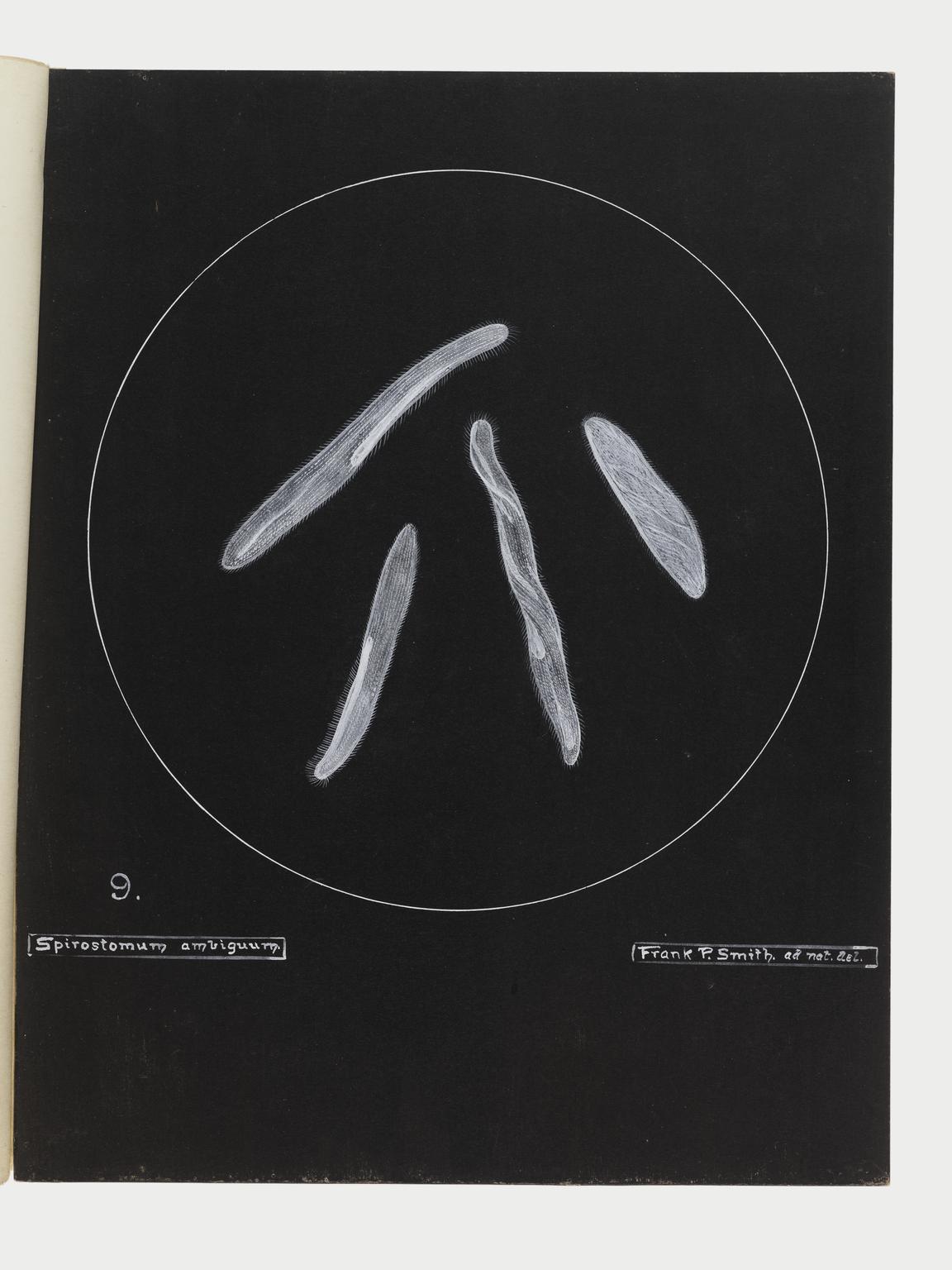
Drawing of Spirostomum Ambiguum (no. 49) from lantern slide study by F Percy Smith with paper cover sheet, c. 1915.

Drawing of Spirostomum Ambiguum (no. 49) from lantern slide study by F Percy Smith

Drawing of Spirostomum Ambiguum (no. 49) from lantern slide study by F Percy Smith with paper cover sheet, c. 1915.

More

Spirostomum Ambiguum is a single celled organism which is mainly found in sediment deposits at the bottom of acquatic habitats.

Frank Percy Smith was born in London in 1880. He was keen to exploit the educational possibilities of film and began working for Charles Urban, who had been impressed with his photograph of a bluebottle's tongue. During his time working for Urban he produced numerous scientific films, most notably The Balancing Bluebottle (also known as The Acrobatic Fly) and the Kinemacolor production The Birth of a Flower (both 1910).

During the First World War, Smith made a series of films depicting battles through animated maps and worked as a Naval photographer. When the war was over he turned to comedy with The Bedtime Stories of

Archie the Ant (1925), featuring insect characters in a natural environment. However it was the series 'Secrets of Nature' he made for British Instructional Films which allowed him to go back to the educational possibilities of documentary film. Blending nature photography with painstaking laboratory work, Smith and his team produced a steady stream of titles embracing nature's minutiae, from the life cycle of a sweet pea to the 'home-wrecking' tendencies of the cuckoo. Beginning in 1922, the series continued into the 1930s and the sound era, with commentary working equally well as inter-titles.

Smith was a true pioneer, inventing original methods for time lapse and micro cinematography, involving all kinds of home-made devices, including alarms all over his home to wake him up in the middle of the night if the film in the camera needed changing. With endless patience, he could spend up to two and a half years completing a film. He also had the popular touch, with the happy knack (as he put it himself) of being able to feed his audience "the powder of instruction in the jam of entertainment".

Measurements:
overall: 305 mm x 240 mm
Materials:
paper (fibre product)
Object Number:
2026-31/12
type:
drawing
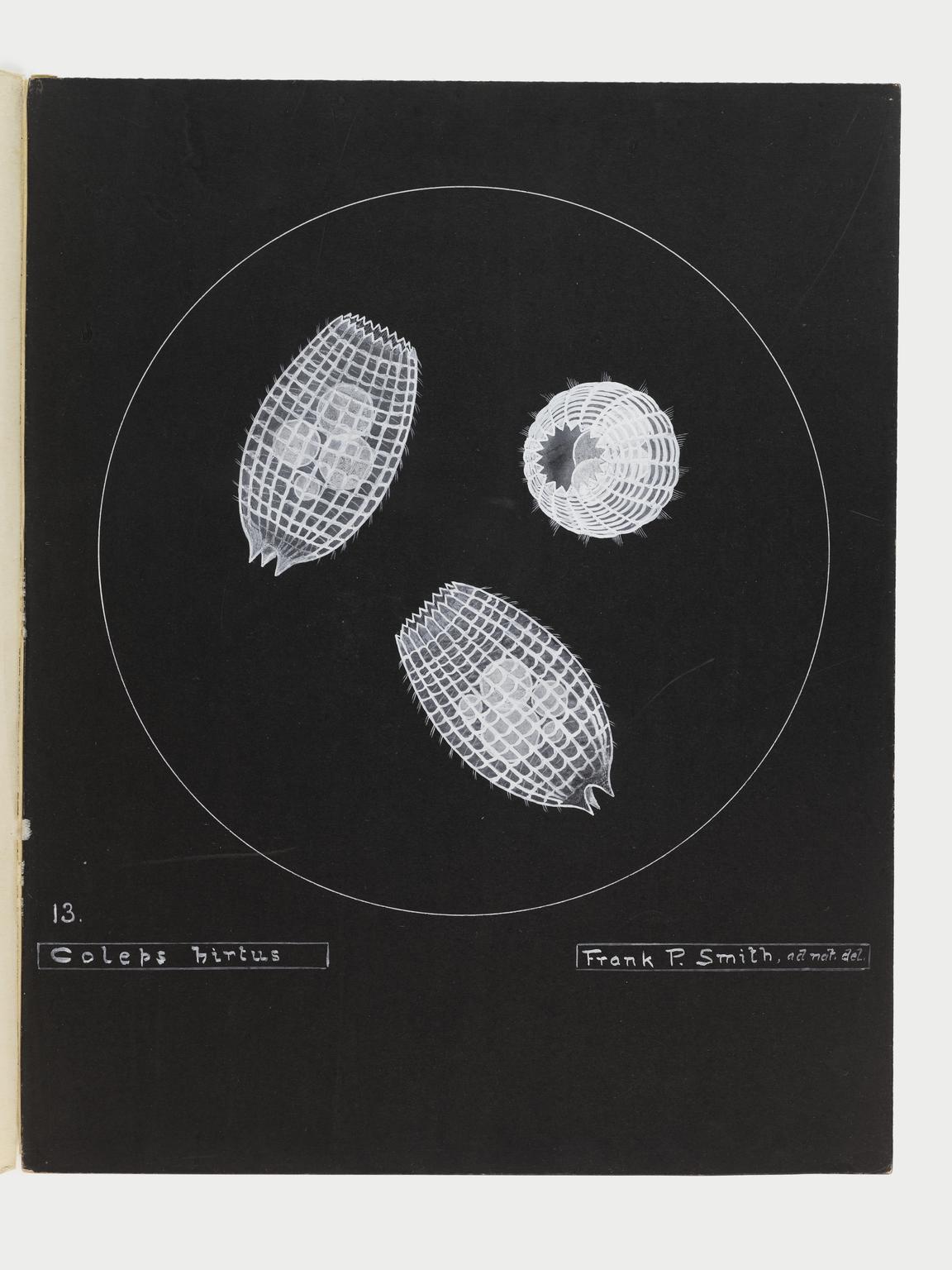
Drawing of Coleps Hirtus (no. 52) from lantern slide study by F Percy Smith with paper cover sheet, c. 1915.

Drawing of Coleps Hirtus (no. 52) from lantern slide study by F Percy Smith

Drawing of Coleps Hirtus (no. 52) from lantern slide study by F Percy Smith with paper cover sheet, c. 1915.

More

Coleps Hirtus is a sinble celled organism which is found in water. It feeds directly on other microbes including bacteria.

Frank Percy Smith was born in London in 1880. He was keen to exploit the educational possibilities of film and began working for Charles Urban, who had been impressed with his photograph of a bluebottle's tongue. During his time working for Urban he produced numerous scientific films, most notably The Balancing Bluebottle (also known as The Acrobatic Fly) and the Kinemacolor production The Birth of a Flower (both 1910).

During the First World War, Smith made a series of films depicting battles through animated maps and worked as a Naval photographer. When the war was over he turned to comedy with The Bedtime Stories of

Archie the Ant (1925), featuring insect characters in a natural environment. However it was the series 'Secrets of Nature' he made for British Instructional Films which allowed him to go back to the educational possibilities of documentary film. Blending nature photography with painstaking laboratory work, Smith and his team produced a steady stream of titles embracing nature's minutiae, from the life cycle of a sweet pea to the 'home-wrecking' tendencies of the cuckoo. Beginning in 1922, the series continued into the 1930s and the sound era, with commentary working equally well as inter-titles.

Smith was a true pioneer, inventing original methods for time lapse and micro cinematography, involving all kinds of home-made devices, including alarms all over his home to wake him up in the middle of the night if the film in the camera needed changing. With endless patience, he could spend up to two and a half years completing a film. He also had the popular touch, with the happy knack (as he put it himself) of being able to feed his audience "the powder of instruction in the jam of entertainment".

Measurements:
overall: 305 mm x 240 mm
Materials:
paper (fibre product)
Object Number:
2026-31/13
type:
drawing
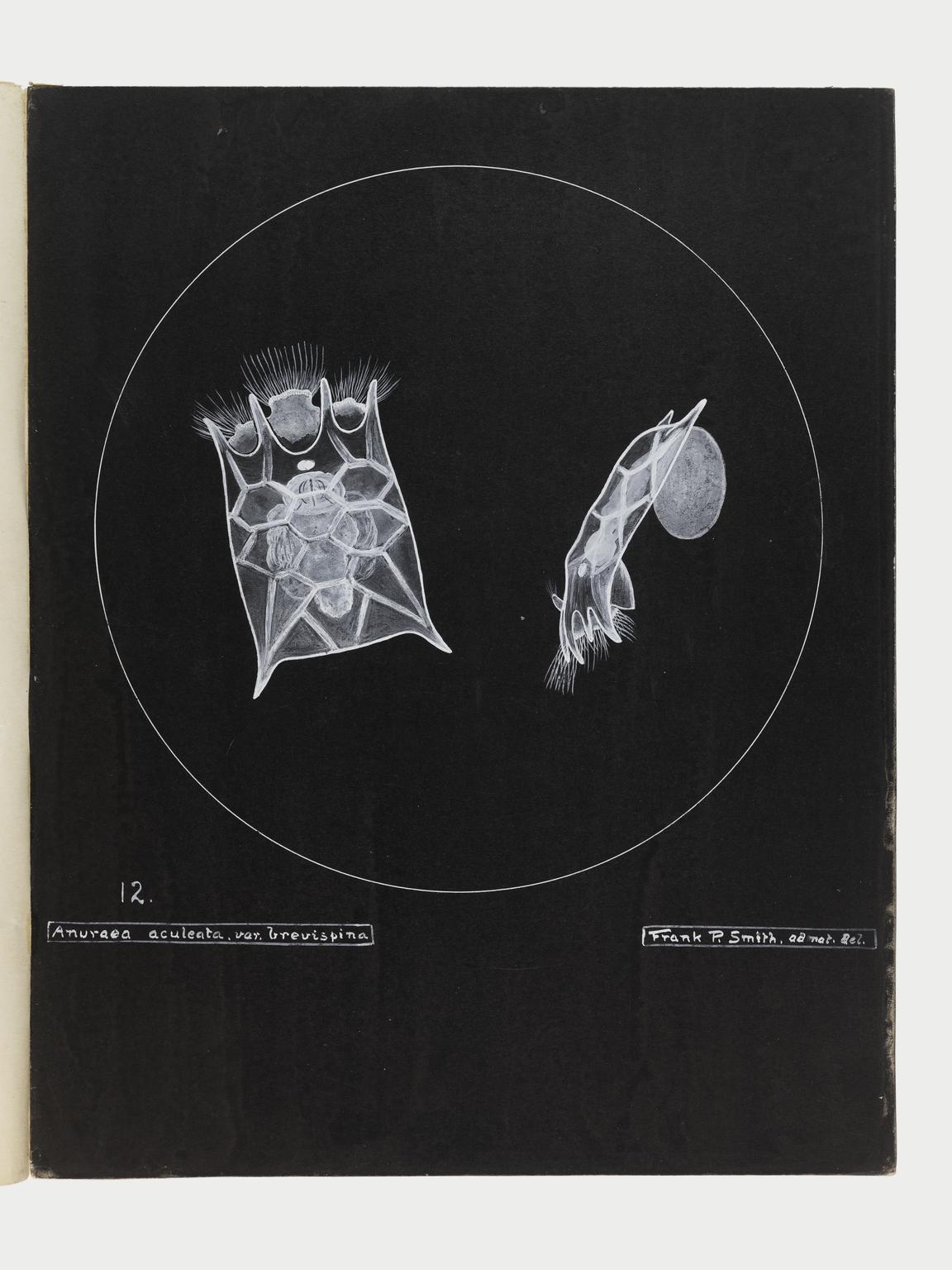
Drawing of Amurea Aculeata var. Brevistina (no. 79) from lantern slide study by F Percy Smith with paper cover sheet, c. 1915.

Drawing of Amurea Aculeata var. Brevistina (no. 79) from lantern slide study by F Percy Smith

Drawing of Amurea Aculeata var. Brevistina (no. 79) from lantern slide study by F Percy Smith with paper cover sheet, c. 1915.

More

Frank Percy Smith was born in London in 1880. He was keen to exploit the educational possibilities of film and began working for Charles Urban, who had been impressed with his photograph of a bluebottle's tongue. During his time working for Urban he produced numerous scientific films, most notably The Balancing Bluebottle (also known as The Acrobatic Fly) and the Kinemacolor production The Birth of a Flower (both 1910).

During the First World War, Smith made a series of films depicting battles through animated maps and worked as a Naval photographer. When the war was over he turned to comedy with The Bedtime Stories of

Archie the Ant (1925), featuring insect characters in a natural environment. However it was the series 'Secrets of Nature' he made for British Instructional Films which allowed him to go back to the educational possibilities of documentary film. Blending nature photography with painstaking laboratory work, Smith and his team produced a steady stream of titles embracing nature's minutiae, from the life cycle of a sweet pea to the 'home-wrecking' tendencies of the cuckoo. Beginning in 1922, the series continued into the 1930s and the sound era, with commentary working equally well as inter-titles.

Smith was a true pioneer, inventing original methods for time lapse and micro cinematography, involving all kinds of home-made devices, including alarms all over his home to wake him up in the middle of the night if the film in the camera needed changing. With endless patience, he could spend up to two and a half years completing a film. He also had the popular touch, with the happy knack (as he put it himself) of being able to feed his audience "the powder of instruction in the jam of entertainment".

Measurements:
overall: 305 mm x 240 mm
Materials:
paper (fibre product)
Object Number:
2026-31/14
type:
drawing
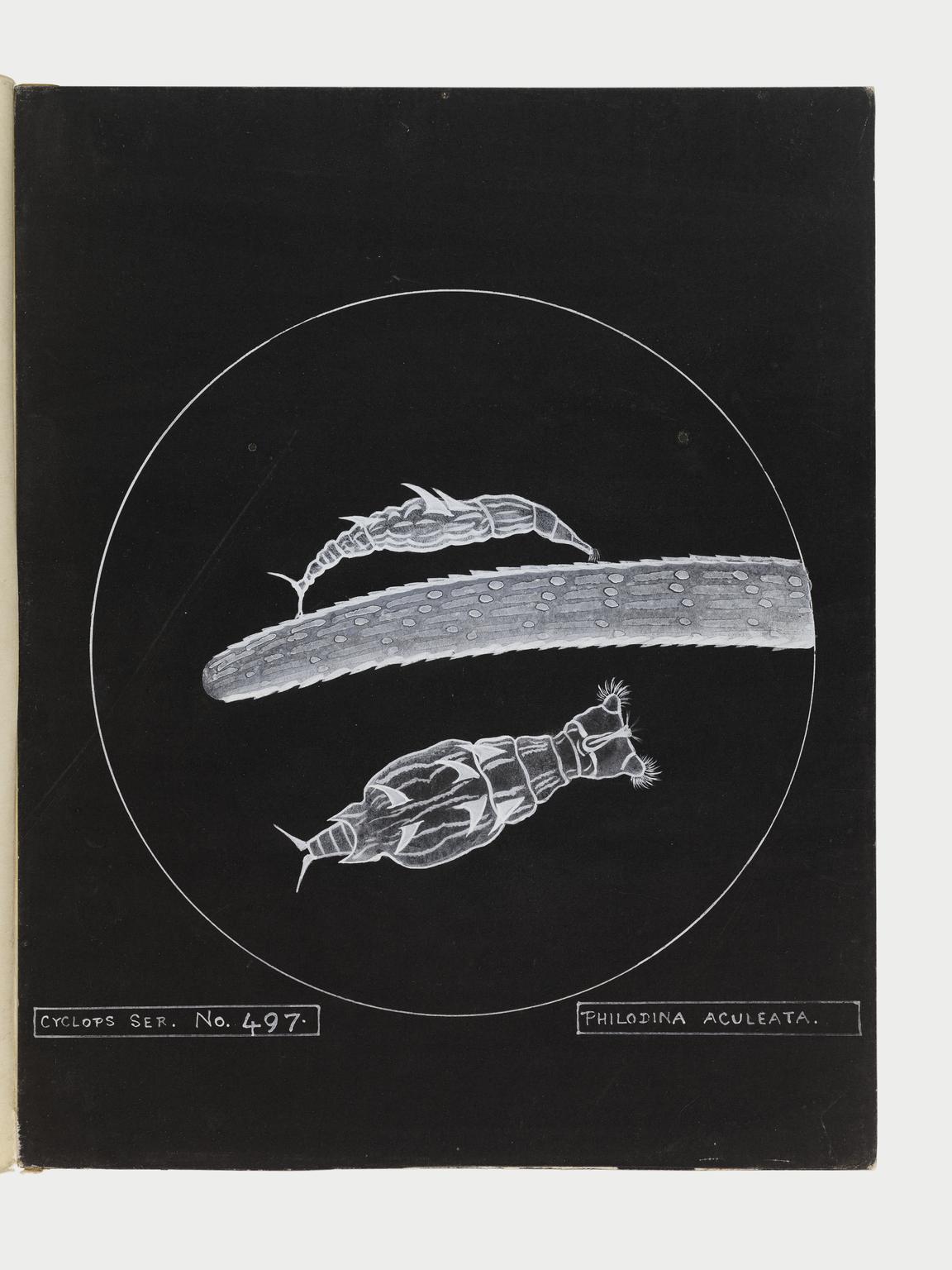
Drawing of Philodina Aculeata (no. 82) from lantern slide study by F Percy Smith with paper cover sheet, c. 1915.

Drawing of Philodina Aculeata (no. 82) from lantern slide study by F Percy Smith

Drawing of Philodina Aculeata (no. 82) from lantern slide study by F Percy Smith with paper cover sheet, c. 1915.

More

Philodina Aculeata (also known as Dissotrocha aculeata) is a microscopic organism which lives in water and damp environments.

Frank Percy Smith was born in London in 1880. He was keen to exploit the educational possibilities of film and began working for Charles Urban, who had been impressed with his photograph of a bluebottle's tongue. During his time working for Urban he produced numerous scientific films, most notably The Balancing Bluebottle (also known as The Acrobatic Fly) and the Kinemacolor production The Birth of a Flower (both 1910).

During the First World War, Smith made a series of films depicting battles through animated maps and worked as a Naval photographer. When the war was over he turned to comedy with The Bedtime Stories of

Archie the Ant (1925), featuring insect characters in a natural environment. However it was the series 'Secrets of Nature' he made for British Instructional Films which allowed him to go back to the educational possibilities of documentary film. Blending nature photography with painstaking laboratory work, Smith and his team produced a steady stream of titles embracing nature's minutiae, from the life cycle of a sweet pea to the 'home-wrecking' tendencies of the cuckoo. Beginning in 1922, the series continued into the 1930s and the sound era, with commentary working equally well as inter-titles.

Smith was a true pioneer, inventing original methods for time lapse and micro cinematography, involving all kinds of home-made devices, including alarms all over his home to wake him up in the middle of the night if the film in the camera needed changing. With endless patience, he could spend up to two and a half years completing a film. He also had the popular touch, with the happy knack (as he put it himself) of being able to feed his audience "the powder of instruction in the jam of entertainment".

Measurements:
overall: 305 mm x 240 mm
Materials:
paper (fibre product)
Object Number:
2026-31/15
type:
drawing
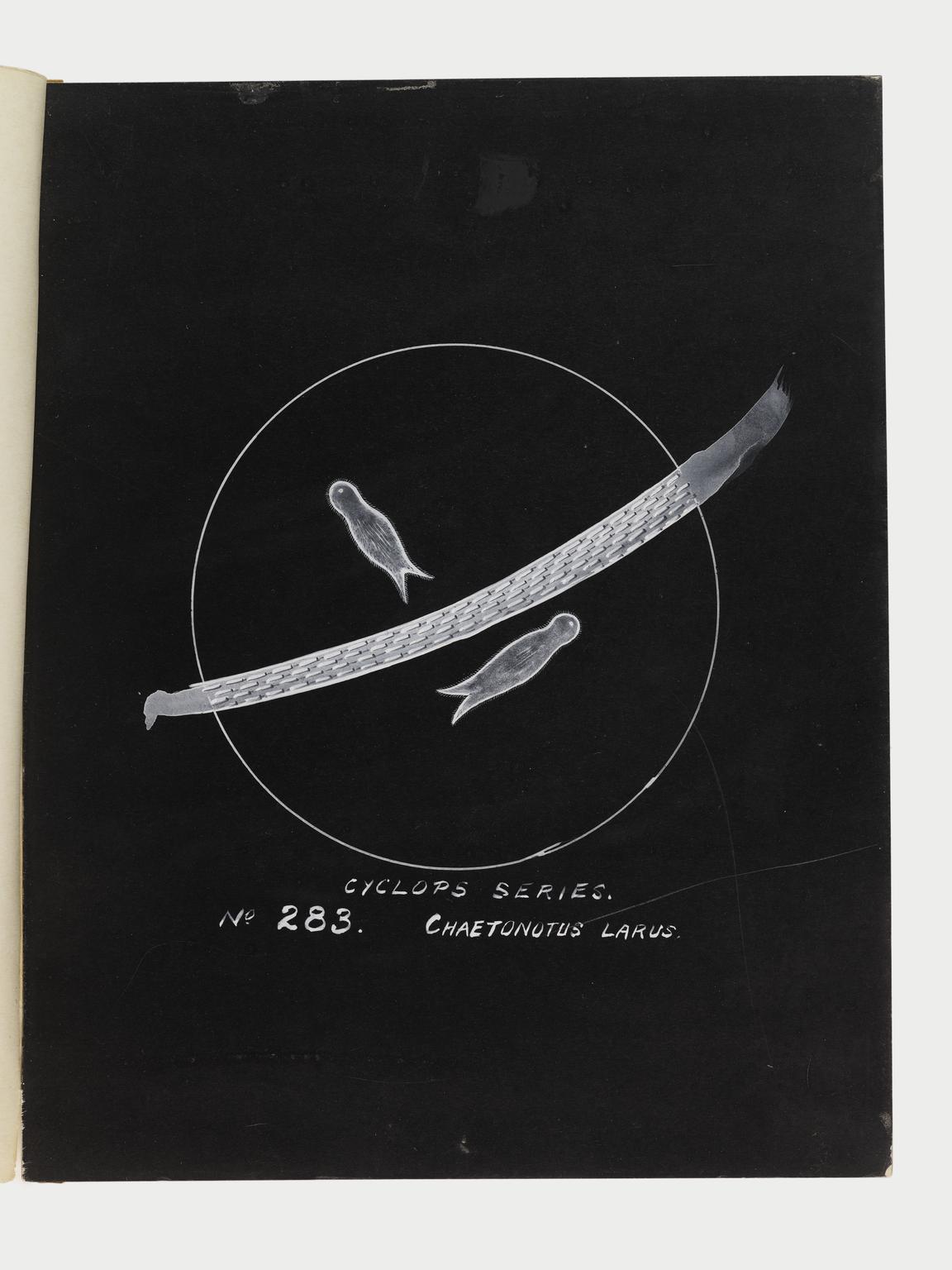
Drawing of Chaetonotus Larus (no. 84) from lantern slide study by F Percy Smith, with paper cover sheet, c. 1915.

Drawing of Chaetonotus Larus (no. 84) from lantern slide study by F Percy Smith

Drawing of Chaetonotus Larus (no. 84) from lantern slide study by F Percy Smith, with paper cover sheet, c. 1915.

More

Chaetonotus Larus is a microscopic organism which lives within freshwater and marine environments, the majority existing residing between particles of sediment or on othe sumberged surfaces.

Frank Percy Smith was born in London in 1880. He was keen to exploit the educational possibilities of film and began working for Charles Urban, who had been impressed with his photograph of a bluebottle's tongue. During his time working for Urban he produced numerous scientific films, most notably The Balancing Bluebottle (also known as The Acrobatic Fly) and the Kinemacolor production The Birth of a Flower (both 1910).

During the First World War, Smith made a series of films depicting battles through animated maps and worked as a Naval photographer. When the war was over he turned to comedy with The Bedtime Stories of

Archie the Ant (1925), featuring insect characters in a natural environment. However it was the series 'Secrets of Nature' he made for British Instructional Films which allowed him to go back to the educational possibilities of documentary film. Blending nature photography with painstaking laboratory work, Smith and his team produced a steady stream of titles embracing nature's minutiae, from the life cycle of a sweet pea to the 'home-wrecking' tendencies of the cuckoo. Beginning in 1922, the series continued into the 1930s and the sound era, with commentary working equally well as inter-titles.

Smith was a true pioneer, inventing original methods for time lapse and micro cinematography, involving all kinds of home-made devices, including alarms all over his home to wake him up in the middle of the night if the film in the camera needed changing. With endless patience, he could spend up to two and a half years completing a film. He also had the popular touch, with the happy knack (as he put it himself) of being able to feed his audience "the powder of instruction in the jam of entertainment".

Measurements:
overall: 305 mm x 240 mm
Materials:
paper (fibre product)
Object Number:
2026-31/16
type:
drawing
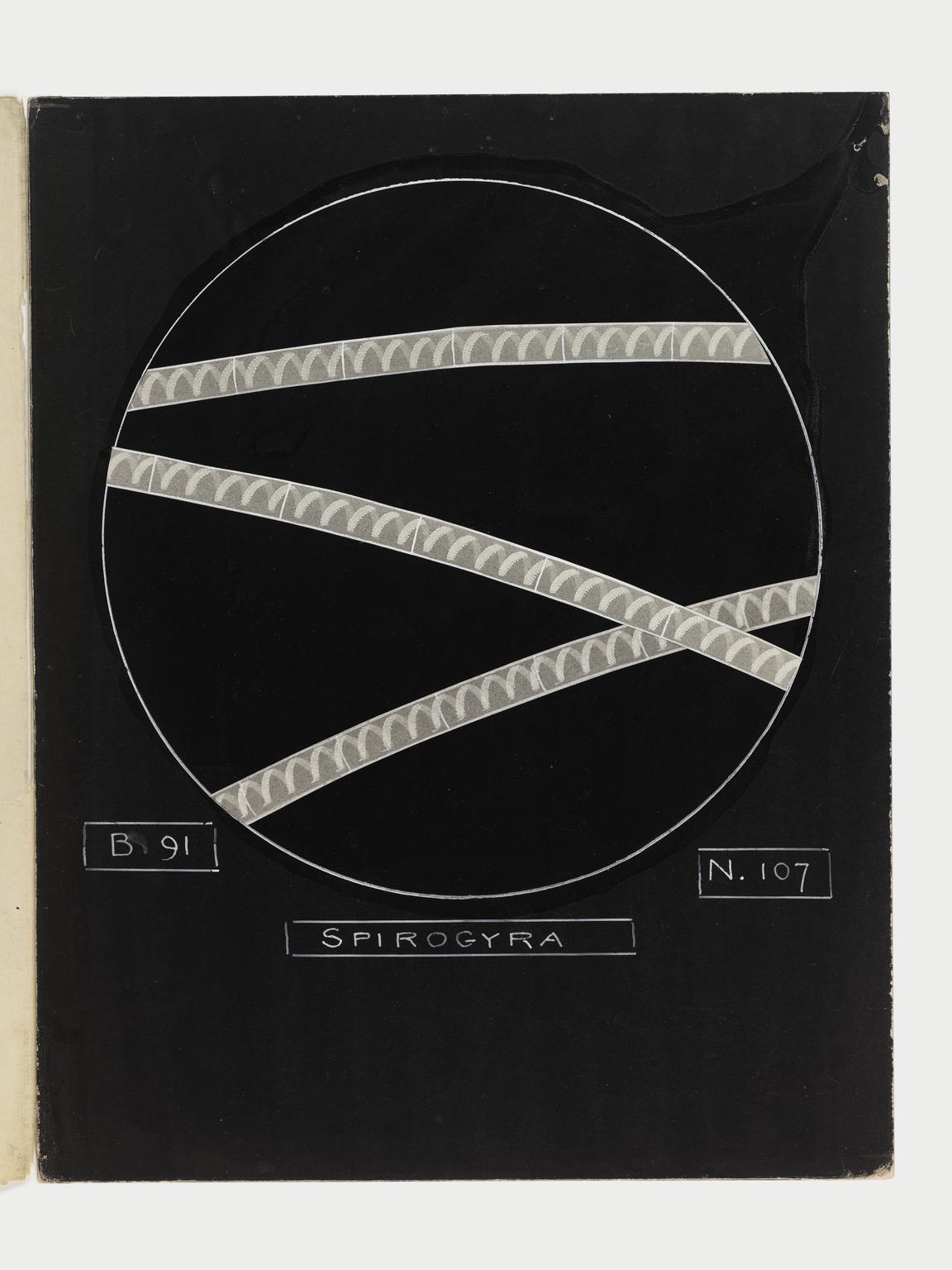
Drawing of Spirogyra (no.107) from lantern slide study by F Percy Smith with paper cover sheet, c. 1915.

Drawing of Spirogyra (no.107) from lantern slide study by F Percy Smith

Drawing of Spirogyra (no.107) from lantern slide study by F Percy Smith with paper cover sheet, c. 1915.

More

Spirogyra is a green algae named for the spiral arrangement of its chloroplasts. Some of it's common names include water silk, mermaid's tresses and blanket weed.

Frank Percy Smith was born in London in 1880. He was keen to exploit the educational possibilities of film and began working for Charles Urban, who had been impressed with his photograph of a bluebottle's tongue. During his time working for Urban he produced numerous scientific films, most notably The Balancing Bluebottle (also known as The Acrobatic Fly) and the Kinemacolor production The Birth of a Flower (both 1910).

During the First World War, Smith made a series of films depicting battles through animated maps and worked as a Naval photographer. When the war was over he turned to comedy with The Bedtime Stories of

Archie the Ant (1925), featuring insect characters in a natural environment. However it was the series 'Secrets of Nature' he made for British Instructional Films which allowed him to go back to the educational possibilities of documentary film. Blending nature photography with painstaking laboratory work, Smith and his team produced a steady stream of titles embracing nature's minutiae, from the life cycle of a sweet pea to the 'home-wrecking' tendencies of the cuckoo. Beginning in 1922, the series continued into the 1930s and the sound era, with commentary working equally well as inter-titles.

Smith was a true pioneer, inventing original methods for time lapse and micro cinematography, involving all kinds of home-made devices, including alarms all over his home to wake him up in the middle of the night if the film in the camera needed changing. With endless patience, he could spend up to two and a half years completing a film. He also had the popular touch, with the happy knack (as he put it himself) of being able to feed his audience "the powder of instruction in the jam of entertainment".

Measurements:
overall: 305 mm x 240 mm
Materials:
paper (fibre product)
Object Number:
2026-31/17
type:
drawing
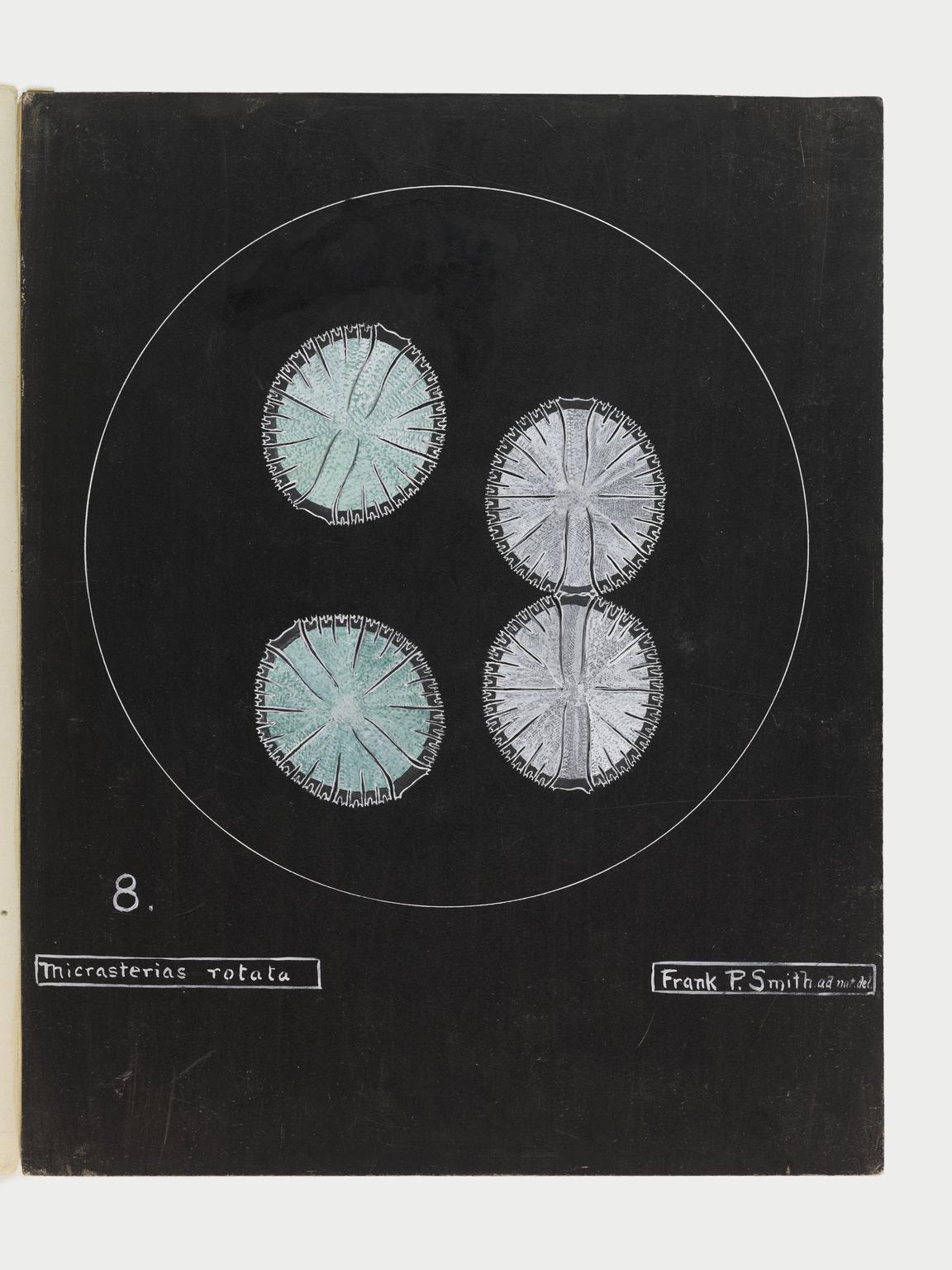
Drawing of Micrasterias Rotata (no. 110) from lantern slide study by F Percy Smith, with paper cover sheet, c. 1915.

Drawing of Micrasterias Rotata (no. 110) from lantern slide study by F Percy Smith

Drawing of Micrasterias Rotata (no. 110) from lantern slide study by F Percy Smith, with paper cover sheet, c. 1915.

More

Micrasterias Rotata is a unicellular green algae which grows in freshwater, particularly lakes and bogs.

Frank Percy Smith was born in London in 1880. He was keen to exploit the educational possibilities of film and began working for Charles Urban, who had been impressed with his photograph of a bluebottle's tongue. During his time working for Urban he produced numerous scientific films, most notably The Balancing Bluebottle (also known as The Acrobatic Fly) and the Kinemacolor production The Birth of a Flower (both 1910).

During the First World War, Smith made a series of films depicting battles through animated maps and worked as a Naval photographer. When the war was over he turned to comedy with The Bedtime Stories of

Archie the Ant (1925), featuring insect characters in a natural environment. However it was the series 'Secrets of Nature' he made for British Instructional Films which allowed him to go back to the educational possibilities of documentary film. Blending nature photography with painstaking laboratory work, Smith and his team produced a steady stream of titles embracing nature's minutiae, from the life cycle of a sweet pea to the 'home-wrecking' tendencies of the cuckoo. Beginning in 1922, the series continued into the 1930s and the sound era, with commentary working equally well as inter-titles.

Smith was a true pioneer, inventing original methods for time lapse and micro cinematography, involving all kinds of home-made devices, including alarms all over his home to wake him up in the middle of the night if the film in the camera needed changing. With endless patience, he could spend up to two and a half years completing a film. He also had the popular touch, with the happy knack (as he put it himself) of being able to feed his audience "the powder of instruction in the jam of entertainment".

Measurements:
overall: 305 mm x 240 mm
Materials:
paper (fibre product)
Object Number:
2026-31/18
type:
drawing
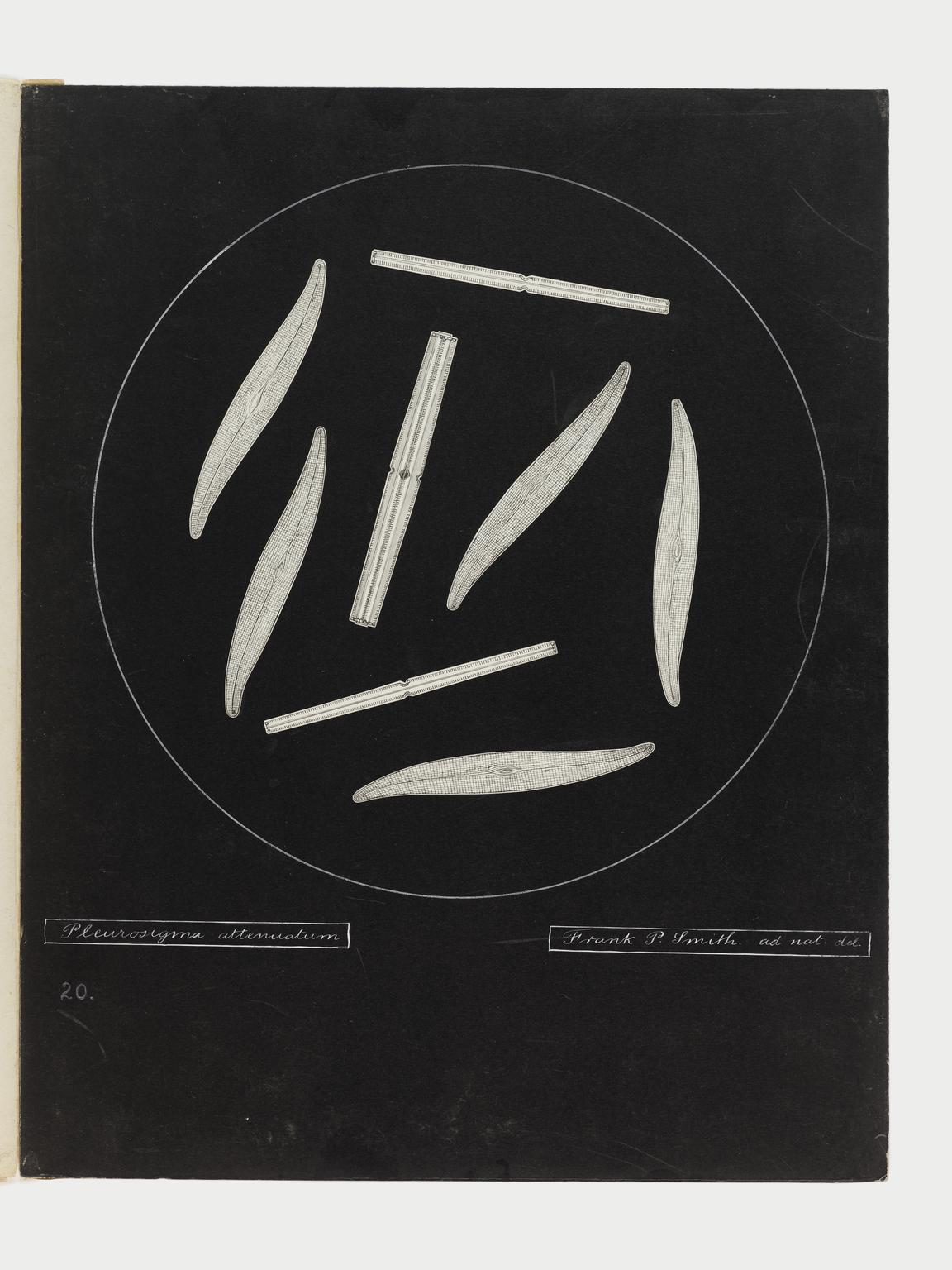
Drawing of Pleurosgma Attenuatum (no. 111) from lantern slide study by F Percy Smith, with paper cover sheet, c. 1915.

Drawing of Pleurosgma Attenuatum (no. 111) from lantern slide study by F Percy Smith

Drawing of Pleurosgma Attenuatum (no. 111) from lantern slide study by F Percy Smith, with paper cover sheet, c. 1915.

More

Frank Percy Smith was born in London in 1880. He was keen to exploit the educational possibilities of film and began working for Charles Urban, who had been impressed with his photograph of a bluebottle's tongue. During his time working for Urban he produced numerous scientific films, most notably The Balancing Bluebottle (also known as The Acrobatic Fly) and the Kinemacolor production The Birth of a Flower (both 1910).

During the First World War, Smith made a series of films depicting battles through animated maps and worked as a Naval photographer. When the war was over he turned to comedy with The Bedtime Stories of

Archie the Ant (1925), featuring insect characters in a natural environment. However it was the series 'Secrets of Nature' he made for British Instructional Films which allowed him to go back to the educational possibilities of documentary film. Blending nature photography with painstaking laboratory work, Smith and his team produced a steady stream of titles embracing nature's minutiae, from the life cycle of a sweet pea to the 'home-wrecking' tendencies of the cuckoo. Beginning in 1922, the series continued into the 1930s and the sound era, with commentary working equally well as inter-titles.

Smith was a true pioneer, inventing original methods for time lapse and micro cinematography, involving all kinds of home-made devices, including alarms all over his home to wake him up in the middle of the night if the film in the camera needed changing. With endless patience, he could spend up to two and a half years completing a film. He also had the popular touch, with the happy knack (as he put it himself) of being able to feed his audience "the powder of instruction in the jam of entertainment".

Measurements:
overall: 305 mm x 240 mm
Materials:
paper (fibre product)
Object Number:
2026-31/19
type:
drawing
Drawing of Pleurosgma Attenuatum (no. 111) from lantern slide study by F Percy Smith, with paper cover sheet, c. 1915.

Drawing of Pleurosgma Attenuatum (no. 111) from lantern slide study by F Percy Smit

Drawing of Pleurosgma Attenuatum (no. 111) from lantern slide study by F Percy Smith, with paper cover sheet, c. 1915.

More

Frank Percy Smith was born in London in 1880. He was keen to exploit the educational possibilities of film and began working for Charles Urban, who had been impressed with his photograph of a bluebottle's tongue. During his time working for Urban he produced numerous scientific films, most notably The Balancing Bluebottle (also known as The Acrobatic Fly) and the Kinemacolor production The Birth of a Flower (both 1910).

During the First World War, Smith made a series of films depicting battles through animated maps and worked as a Naval photographer. When the war was over he turned to comedy with The Bedtime Stories of

Archie the Ant (1925), featuring insect characters in a natural environment. However it was the series 'Secrets of Nature' he made for British Instructional Films which allowed him to go back to the educational possibilities of documentary film. Blending nature photography with painstaking laboratory work, Smith and his team produced a steady stream of titles embracing nature's minutiae, from the life cycle of a sweet pea to the 'home-wrecking' tendencies of the cuckoo. Beginning in 1922, the series continued into the 1930s and the sound era, with commentary working equally well as inter-titles.

Smith was a true pioneer, inventing original methods for time lapse and micro cinematography, involving all kinds of home-made devices, including alarms all over his home to wake him up in the middle of the night if the film in the camera needed changing. With endless patience, he could spend up to two and a half years completing a film. He also had the popular touch, with the happy knack (as he put it himself) of being able to feed his audience "the powder of instruction in the jam of entertainment".

Measurements:
overall: 305 mm x 240 mm
Materials:
paper (fibre product)
Object Number:
2026-31/20
type:
drawing
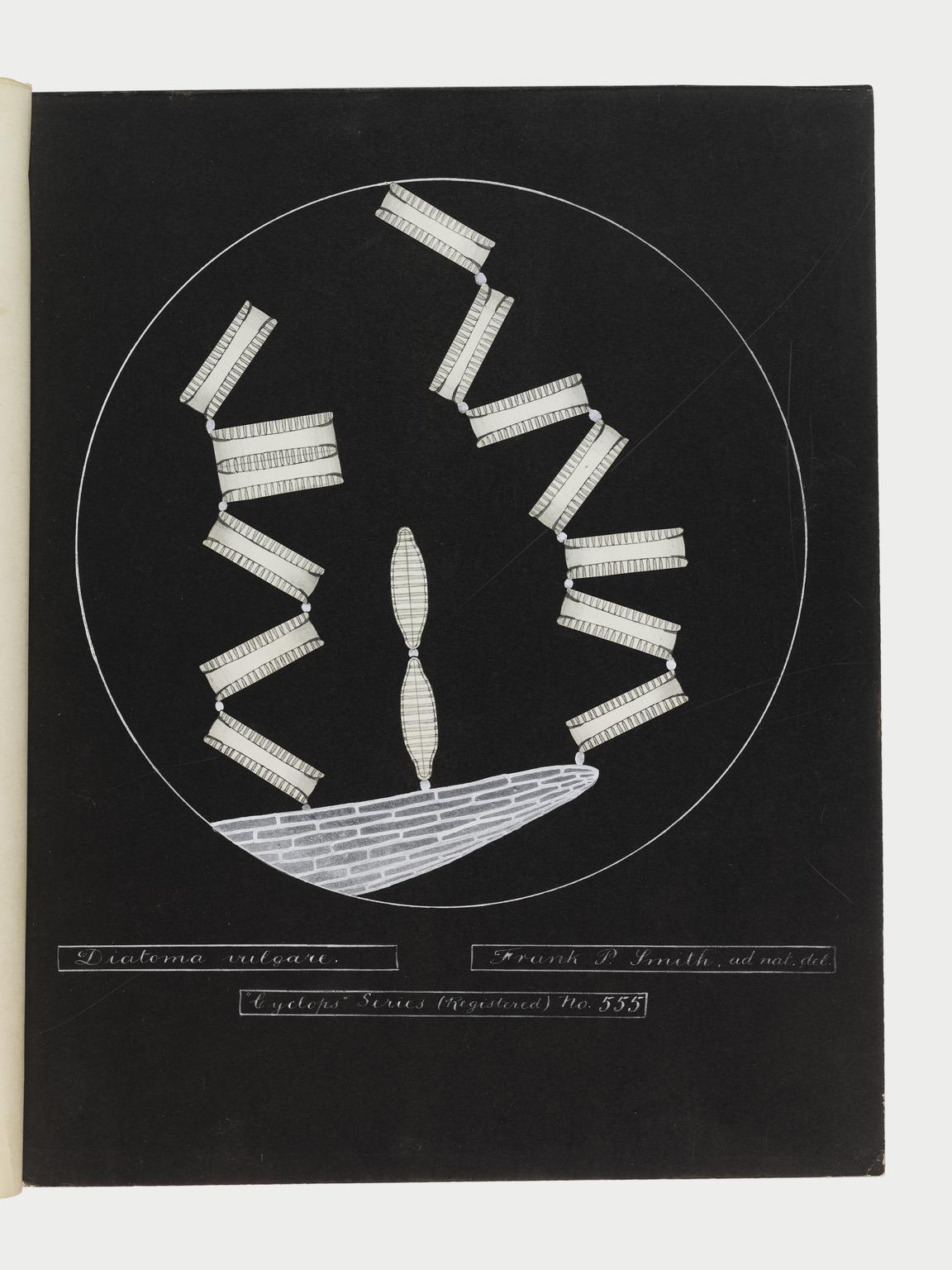
Drawing of Diatoma Vulgari (no. 117) from lantern slide study by F Percy Smith with paper cover sheet, c. 1915.

Drawing of Diatoma Vulgari (no. 117) from lantern slide study by F Percy Smith

Drawing of Diatoma Vulgari (no. 117) from lantern slide study by F Percy Smith with paper cover sheet, c. 1915.

More

Diatoms are a form of single celled algae that can be found in most acquatic habitats, they are the only organisms on earth whose cell walls are made of silica.

Frank Percy Smith was born in London in 1880. He was keen to exploit the educational possibilities of film and began working for Charles Urban, who had been impressed with his photograph of a bluebottle's tongue. During his time working for Urban he produced numerous scientific films, most notably The Balancing Bluebottle (also known as The Acrobatic Fly) and the Kinemacolor production The Birth of a Flower (both 1910).

During the First World War, Smith made a series of films depicting battles through animated maps and worked as a Naval photographer. When the war was over he turned to comedy with The Bedtime Stories of

Archie the Ant (1925), featuring insect characters in a natural environment. However it was the series 'Secrets of Nature' he made for British Instructional Films which allowed him to go back to the educational possibilities of documentary film. Blending nature photography with painstaking laboratory work, Smith and his team produced a steady stream of titles embracing nature's minutiae, from the life cycle of a sweet pea to the 'home-wrecking' tendencies of the cuckoo. Beginning in 1922, the series continued into the 1930s and the sound era, with commentary working equally well as inter-titles.

Smith was a true pioneer, inventing original methods for time lapse and micro cinematography, involving all kinds of home-made devices, including alarms all over his home to wake him up in the middle of the night if the film in the camera needed changing. With endless patience, he could spend up to two and a half years completing a film. He also had the popular touch, with the happy knack (as he put it himself) of being able to feed his audience "the powder of instruction in the jam of entertainment".

Measurements:
overall: 305 mm x 240 mm
Materials:
paper (fibre product)
Object Number:
2026-31/21
type:
drawing
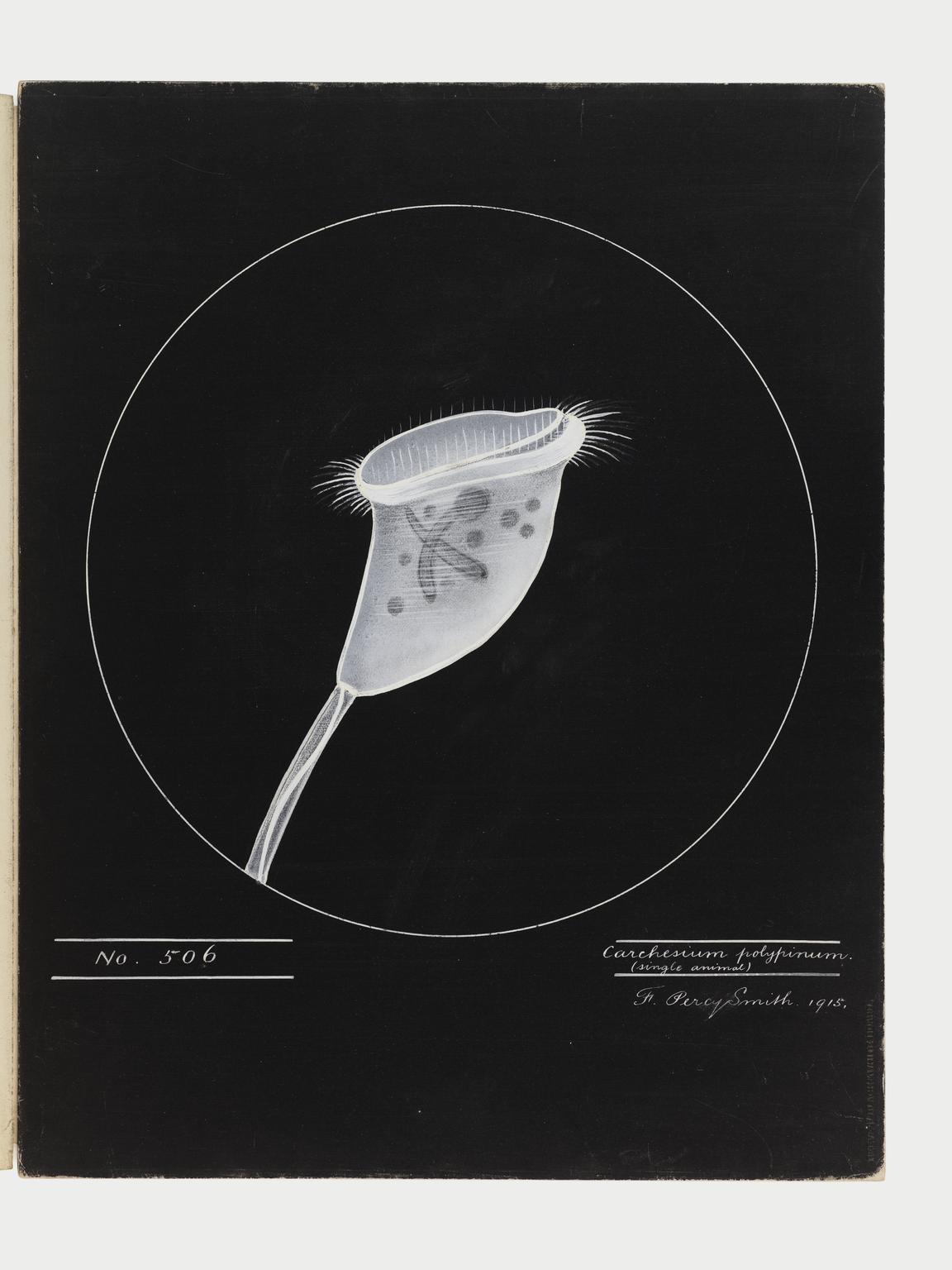
Drawing of Carchesium Polypinum (no. 119) from lantern slide study by F Percy Smith with paper cover sheet, 1915.

Drawing of Carchesium Polypinum (no. 119) from lantern slide study by F Percy Smith

Drawing of Carchesium Polypinum (no. 119) from lantern slide study by F Percy Smith with paper cover sheet, 1915.

More

Carchesium Polypinum are single celled organisms which are found in freshwater ponds and lakes and also in sewage treatment works.

Frank Percy Smith was born in London in 1880. He was keen to exploit the educational possibilities of film and began working for Charles Urban, who had been impressed with his photograph of a bluebottle's tongue. During his time working for Urban he produced numerous scientific films, most notably The Balancing Bluebottle (also known as The Acrobatic Fly) and the Kinemacolor production The Birth of a Flower (both 1910).

During the First World War, Smith made a series of films depicting battles through animated maps and worked as a Naval photographer. When the war was over he turned to comedy with The Bedtime Stories of

Archie the Ant (1925), featuring insect characters in a natural environment. However it was the series 'Secrets of Nature' he made for British Instructional Films which allowed him to go back to the educational possibilities of documentary film. Blending nature photography with painstaking laboratory work, Smith and his team produced a steady stream of titles embracing nature's minutiae, from the life cycle of a sweet pea to the 'home-wrecking' tendencies of the cuckoo. Beginning in 1922, the series continued into the 1930s and the sound era, with commentary working equally well as inter-titles.

Smith was a true pioneer, inventing original methods for time lapse and micro cinematography, involving all kinds of home-made devices, including alarms all over his home to wake him up in the middle of the night if the film in the camera needed changing. With endless patience, he could spend up to two and a half years completing a film. He also had the popular touch, with the happy knack (as he put it himself) of being able to feed his audience "the powder of instruction in the jam of entertainment".

Measurements:
overall: 305 mm x 240 mm
Materials:
paper (fibre product)
Object Number:
2026-31/22
type:
drawing
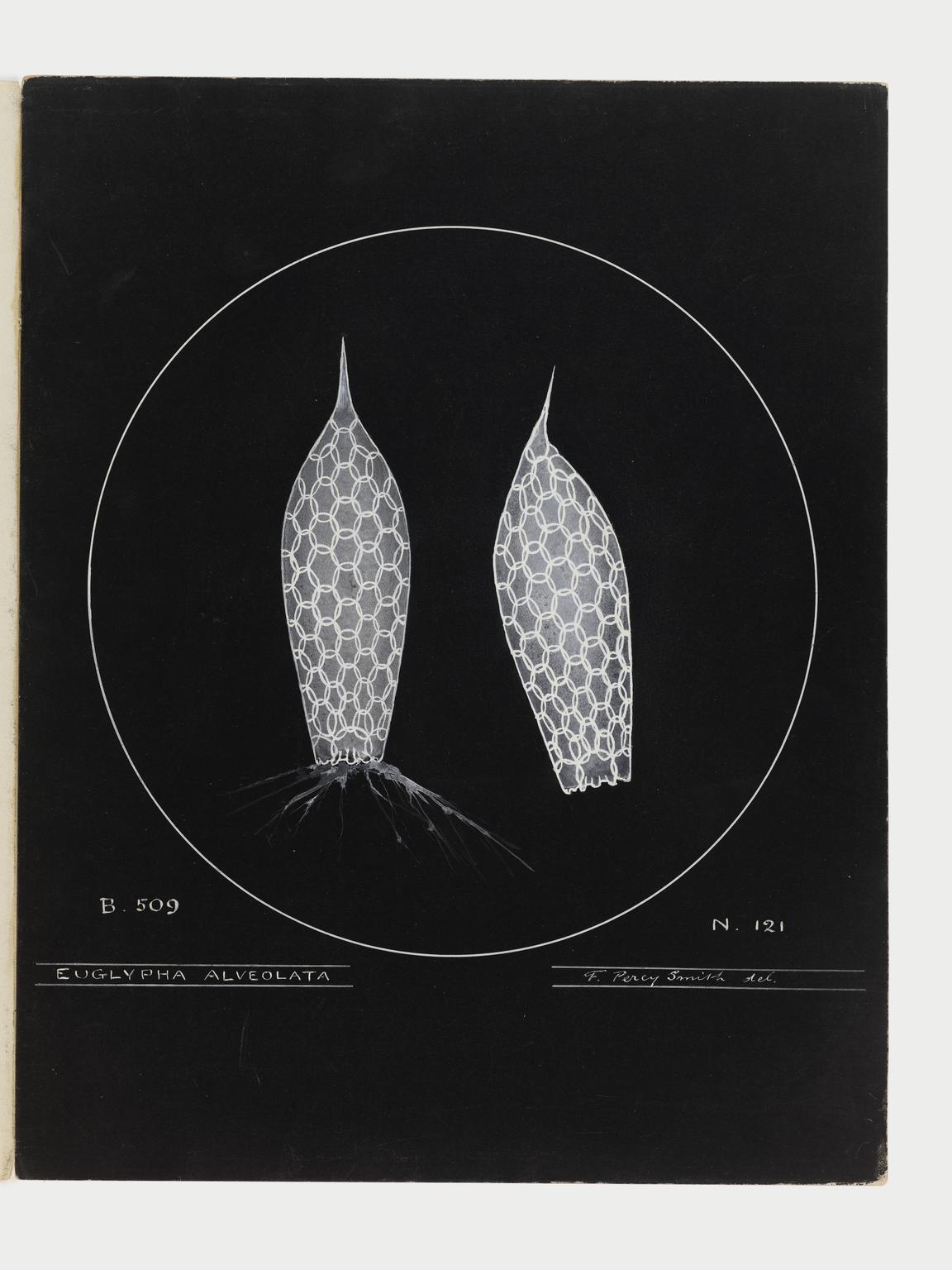
Drawing of Euglypha Alveolata (no. 121) from lantern slide study by F Percy Smith with paper cover sheet, c. 1915.

Drawing of Euglypha Alveolata (no. 121) from lantern slide study by F Percy Smith

Drawing of Euglypha Alveolata (no. 121) from lantern slide study by F Percy Smith with paper cover sheet, c. 1915.

More

Frank Percy Smith was born in London in 1880. He was keen to exploit the educational possibilities of film and began working for Charles Urban, who had been impressed with his photograph of a bluebottle's tongue. During his time working for Urban he produced numerous scientific films, most notably The Balancing Bluebottle (also known as The Acrobatic Fly) and the Kinemacolor production The Birth of a Flower (both 1910).

During the First World War, Smith made a series of films depicting battles through animated maps and worked as a Naval photographer. When the war was over he turned to comedy with The Bedtime Stories of

Archie the Ant (1925), featuring insect characters in a natural environment. However it was the series 'Secrets of Nature' he made for British Instructional Films which allowed him to go back to the educational possibilities of documentary film. Blending nature photography with painstaking laboratory work, Smith and his team produced a steady stream of titles embracing nature's minutiae, from the life cycle of a sweet pea to the 'home-wrecking' tendencies of the cuckoo. Beginning in 1922, the series continued into the 1930s and the sound era, with commentary working equally well as inter-titles.

Smith was a true pioneer, inventing original methods for time lapse and micro cinematography, involving all kinds of home-made devices, including alarms all over his home to wake him up in the middle of the night if the film in the camera needed changing. With endless patience, he could spend up to two and a half years completing a film. He also had the popular touch, with the happy knack (as he put it himself) of being able to feed his audience "the powder of instruction in the jam of entertainment".

Measurements:
overall: 305 mm x 240 mm
Materials:
paper (fibre product)
Object Number:
2026-31/23
type:
drawing
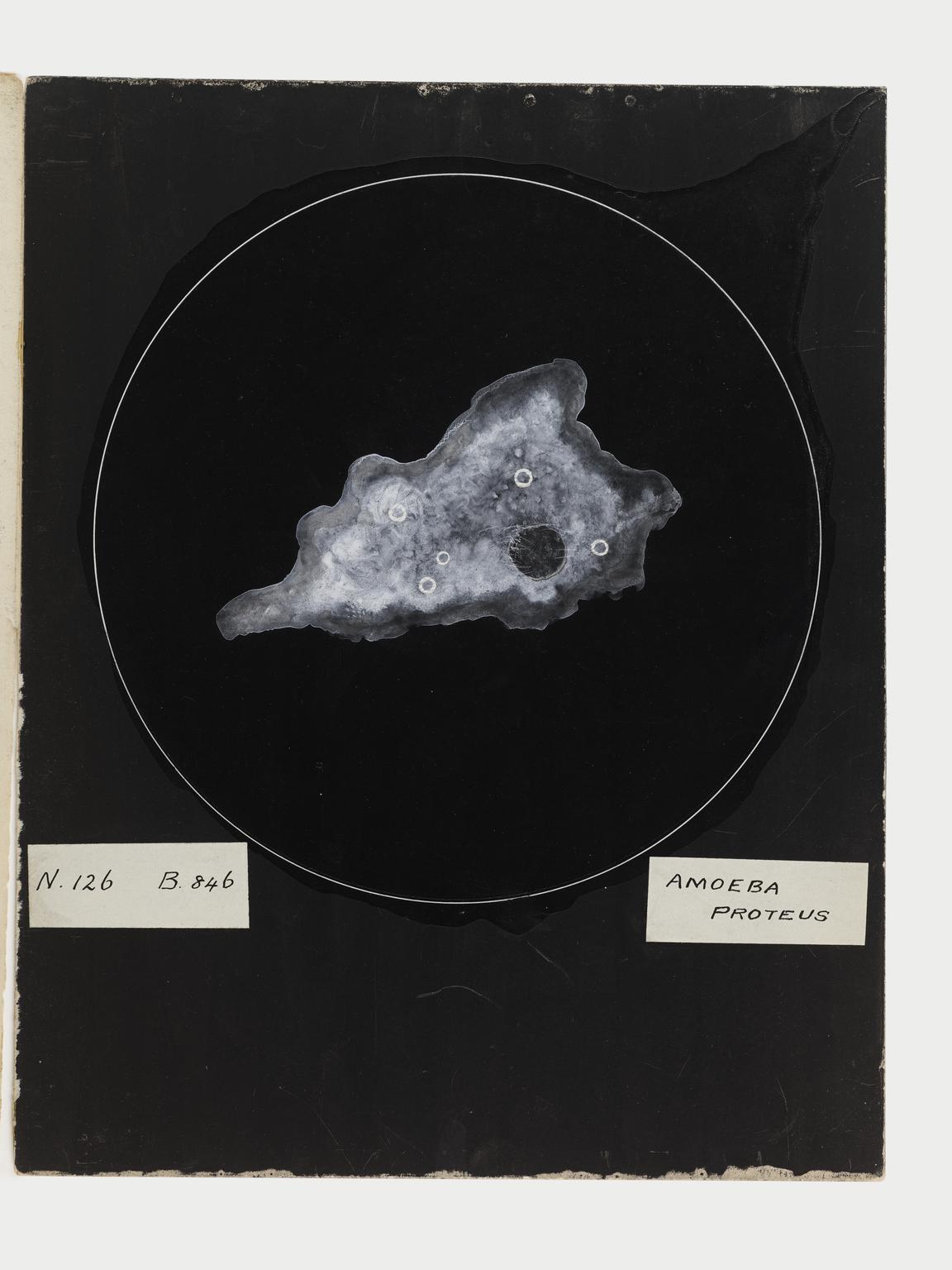
Drawing of Amoeba Proteus (no. 126) from lantern slide study by F Percy Smith with paper cover sheet, c. 1915.

Drawing of Amoeba Proteus (no. 126) from lantern slide study by F Percy Smith

Drawing of Amoeba Proteus (no. 126) from lantern slide study by F Percy Smith with paper cover sheet, c. 1915.

More

Amoeba proteus is a large species of amoeba. It uses extensions called pseudopodia to move and to eat smaller unicellular organisms. Food is enveloped inside the cell's cytoplasm where it is slowly broken down by enzymes. They live in freshwater environments and feed on protozoans, algae and other smaller amoebae.

Frank Percy Smith was born in London in 1880. He was keen to exploit the educational possibilities of film and began working for Charles Urban, who had been impressed with his photograph of a bluebottle's tongue. During his time working for Urban he produced numerous scientific films, most notably The Balancing Bluebottle (also known as The Acrobatic Fly) and the Kinemacolor production The Birth of a Flower (both 1910).

During the First World War, Smith made a series of films depicting battles through animated maps and worked as a Naval photographer. When the war was over he turned to comedy with The Bedtime Stories of

Archie the Ant (1925), featuring insect characters in a natural environment. However it was the series 'Secrets of Nature' he made for British Instructional Films which allowed him to go back to the educational possibilities of documentary film. Blending nature photography with painstaking laboratory work, Smith and his team produced a steady stream of titles embracing nature's minutiae, from the life cycle of a sweet pea to the 'home-wrecking' tendencies of the cuckoo. Beginning in 1922, the series continued into the 1930s and the sound era, with commentary working equally well as inter-titles.

Smith was a true pioneer, inventing original methods for time lapse and micro cinematography, involving all kinds of home-made devices, including alarms all over his home to wake him up in the middle of the night if the film in the camera needed changing. With endless patience, he could spend up to two and a half years completing a film. He also had the popular touch, with the happy knack (as he put it himself) of being able to feed his audience "the powder of instruction in the jam of entertainment".

Measurements:
overall: 305 mm x 240 mm
Materials:
paper (fibre product)
Object Number:
2026-31/24
type:
drawing