Films taken with "Biokam" Amateur Cine Outfit

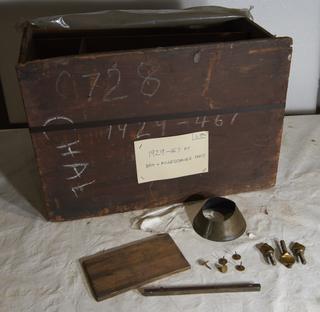
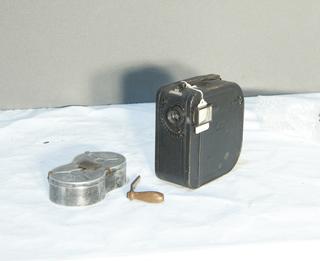
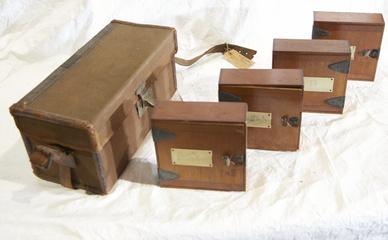
Box of short film reels associated with "Biokam" 17.5mm. combined camera, printer and projector, 1899.

One of the earliest amateur cine devices, the Biokam was demonstrated by T C Hepworth at the London Camera Club on 24th March 1899, where it was advertised as ‘A combined Cinematograph & Snap-Shot Camera, Printer, Projector, Reverser and Enlarger’. It used 17.5mm film with central perforations between frames (like the later 9.5mm film). The film box had two separate compartments, so that two rolls of film could be exposed in succession. The mechanism unit could be converted into a printer, and with the addition of a light source, into a projector. Manufactured by Alfred Darling in Brighton and distributed by the Warwick Trading Company, the full outfit cost eleven guineas (£11.55).
Details

Category:
Cinematography
Object Number:
1937-782/3
Materials:
cellulose nitrate
type:
film reels
credit:
The National Media Museum, Bradford

Parts

Can of unopened positive 17.5mm photographic film for Biokam camera/projector, 25 feet.

Biokam film

Can of unopened positive 17.5mm photographic film for Biokam camera/projector, 25 feet.

More

One of the earliest amateur cine devices, the Biokam was demonstrated by T C Hepworth at the London Camera Club on 24th March 1899, where it was advertised as ‘A combined Cinematograph & Snap-Shot Camera, Printer, Projector, Reverser and Enlarger’. It used 17.5mm film with central perforations between frames (like the later 9.5mm film). The film box had two separate compartments, so that two rolls of film could be exposed in succession. The mechanism unit could be converted into a printer, and with the addition of a light source, into a projector. Manufactured by Alfred Darling in Brighton and distributed by the Warwick Trading Company, the full outfit cost eleven guineas (£11.55).
Materials:
cellulose nitrate
Object Number:
1937-782/3/1
type:
cine film
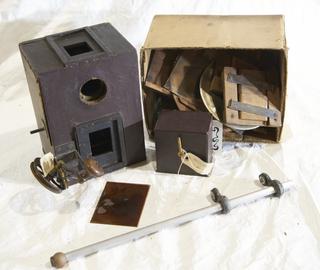
Tin of unopened 17.5mm negative photographic film for Biokam camera/projector, 25 feet.

biokam film

Tin of unopened 17.5mm negative photographic film for Biokam camera/projector, 25 feet.

More

One of the earliest amateur cine devices, the Biokam was demonstrated by T C Hepworth at the London Camera Club on 24th March 1899, where it was advertised as ‘A combined Cinematograph & Snap-Shot Camera, Printer, Projector, Reverser and Enlarger’. It used 17.5mm film with central perforations between frames (like the later 9.5mm film). The film box had two separate compartments, so that two rolls of film could be exposed in succession. The mechanism unit could be converted into a printer, and with the addition of a light source, into a projector. Manufactured by Alfred Darling in Brighton and distributed by the Warwick Trading Company, the full outfit cost eleven guineas (£11.55).
Materials:
cellulose nitrate
Object Number:
1937-782/3/2
type:
cine film
Tin of opened, but unused 17.5mm positive photographic film for Biokam camera/projector, 25 feet.

Biokam film

Tin of opened, but unused 17.5mm positive photographic film for Biokam camera/projector, 25 feet.

More

One of the earliest amateur cine devices, the Biokam was demonstrated by T C Hepworth at the London Camera Club on 24th March 1899, where it was advertised as ‘A combined Cinematograph & Snap-Shot Camera, Printer, Projector, Reverser and Enlarger’. It used 17.5mm film with central perforations between frames (like the later 9.5mm film). The film box had two separate compartments, so that two rolls of film could be exposed in succession. The mechanism unit could be converted into a printer, and with the addition of a light source, into a projector. Manufactured by Alfred Darling in Brighton and distributed by the Warwick Trading Company, the full outfit cost eleven guineas (£11.55).
Materials:
cellulose nitrate
Object Number:
1937-782/3/3
type:
cine film
Tin containing a reel of exposed 17.5mm positive film for the Biokam camera/projector. 25 feet of film showing a crowd gathering in a park.

Biokam film

Tin containing a reel of exposed 17.5mm positive film for the Biokam camera/projector. 25 feet of film showing a crowd gathering in a park.

More

One of the earliest amateur cine devices, the Biokam was demonstrated by T C Hepworth at the London Camera Club on 24th March 1899, where it was advertised as ‘A combined Cinematograph & Snap-Shot Camera, Printer, Projector, Reverser and Enlarger’. It used 17.5mm film with central perforations between frames (like the later 9.5mm film). The film box had two separate compartments, so that two rolls of film could be exposed in succession. The mechanism unit could be converted into a printer, and with the addition of a light source, into a projector. Manufactured by Alfred Darling in Brighton and distributed by the Warwick Trading Company, the full outfit cost eleven guineas (£11.55).

Materials:
cellulose nitrate
Object Number:
1937-782/3/4
type:
cine film
Tin containing reel of 17.5mm positive film for the Biokam camera/projector. Number 2008 written on the lid. 25 feet of film showing a man wearing a suit and smoking a pipe.

Biokam film

Tin containing reel of 17.5mm positive film for the Biokam camera/projector. Number 2008 written on the lid. 25 feet of film showing a man wearing a suit and smoking a pipe.

More

One of the earliest amateur cine devices, the Biokam was demonstrated by T C Hepworth at the London Camera Club on 24th March 1899, where it was advertised as ‘A combined Cinematograph & Snap-Shot Camera, Printer, Projector, Reverser and Enlarger’. It used 17.5mm film with central perforations between frames (like the later 9.5mm film). The film box had two separate compartments, so that two rolls of film could be exposed in succession. The mechanism unit could be converted into a printer, and with the addition of a light source, into a projector. Manufactured by Alfred Darling in Brighton and distributed by the Warwick Trading Company, the full outfit cost eleven guineas (£11.55).

Materials:
cellulose nitrate
Object Number:
1937-782/3/5
type:
cine film
Tin containing a reel of 17.5mm positive film for the Biokam camera/projector. Number 1012 written on lid of tin. 25 feet of film showing a rural train station.

Biokam film

Tin containing a reel of 17.5mm positive film for the Biokam camera/projector. Number 1012 written on lid of tin. 25 feet of film showing a rural train station.

More

One of the earliest amateur cine devices, the Biokam was demonstrated by T C Hepworth at the London Camera Club on 24th March 1899, where it was advertised as ‘A combined Cinematograph & Snap-Shot Camera, Printer, Projector, Reverser and Enlarger’. It used 17.5mm film with central perforations between frames (like the later 9.5mm film). The film box had two separate compartments, so that two rolls of film could be exposed in succession. The mechanism unit could be converted into a printer, and with the addition of a light source, into a projector. Manufactured by Alfred Darling in Brighton and distributed by the Warwick Trading Company, the full outfit cost eleven guineas (£11.55).

Materials:
cellulose nitrate
Object Number:
1937-782/3/6
type:
cine film
Tin containing reel of 17.5mm positive film for the Biokam camera/projector. Number 1007 and title 'Carpenter and Cook' written on the lid, 25 feet. Possibly the film The Carpenter and the Cook, 1900, Warwick Trading Company.

Biokam film: Carpenter and Cook

Tin containing reel of 17.5mm positive film for the Biokam camera/projector. Number 1007 and title 'Carpenter and Cook' written on the lid, 25 feet. Possibly the film The Carpenter and the Cook, 1900, Warwick Trading Company.

More

One of the earliest amateur cine devices, the Biokam was demonstrated by T C Hepworth at the London Camera Club on 24th March 1899, where it was advertised as ‘A combined Cinematograph & Snap-Shot Camera, Printer, Projector, Reverser and Enlarger’. It used 17.5mm film with central perforations between frames (like the later 9.5mm film). The film box had two separate compartments, so that two rolls of film could be exposed in succession. The mechanism unit could be converted into a printer, and with the addition of a light source, into a projector. Manufactured by Alfred Darling in Brighton and distributed by the Warwick Trading Company, the full outfit cost eleven guineas (£11.55).

Materials:
cellulose nitrate
Object Number:
1937-782/3/7
type:
cine film
Tin containing an unused reel of photographic film for the Biokam camera/projector. Number 2005 and 'Falls of Shin' written on the lid.

Biokam film: Falls of Shin

Tin containing an unused reel of photographic film for the Biokam camera/projector. Number 2005 and 'Falls of Shin' written on the lid.

More

One of the earliest amateur cine devices, the Biokam was demonstrated by T C Hepworth at the London Camera Club on 24th March 1899, where it was advertised as ‘A combined Cinematograph & Snap-Shot Camera, Printer, Projector, Reverser and Enlarger’. It used 17.5mm film with central perforations between frames (like the later 9.5mm film). The film box had two separate compartments, so that two rolls of film could be exposed in succession. The mechanism unit could be converted into a printer, and with the addition of a light source, into a projector. Manufactured by Alfred Darling in Brighton and distributed by the Warwick Trading Company, the full outfit cost eleven guineas (£11.55).

Materials:
cellulose nitrate
Object Number:
1937-782/3/8
type:
cine film
Reel of 17.5mm negative film for the Biokam camera/projector showing a cockatoo on a perch.

Biokam film

Reel of 17.5mm negative film for the Biokam camera/projector showing a cockatoo on a perch.

More

One of the earliest amateur cine devices, the Biokam was demonstrated by T C Hepworth at the London Camera Club on 24th March 1899, where it was advertised as ‘A combined Cinematograph & Snap-Shot Camera, Printer, Projector, Reverser and Enlarger’. It used 17.5mm film with central perforations between frames (like the later 9.5mm film). The film box had two separate compartments, so that two rolls of film could be exposed in succession. The mechanism unit could be converted into a printer, and with the addition of a light source, into a projector. Manufactured by Alfred Darling in Brighton and distributed by the Warwick Trading Company, the full outfit cost eleven guineas (£11.55).

Materials:
cellulose nitrate
Object Number:
1937-782/3/9
type:
cine film