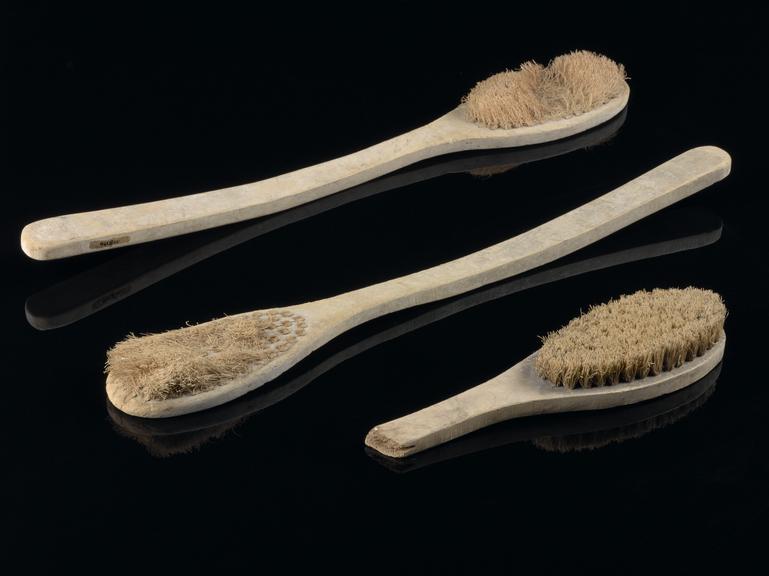
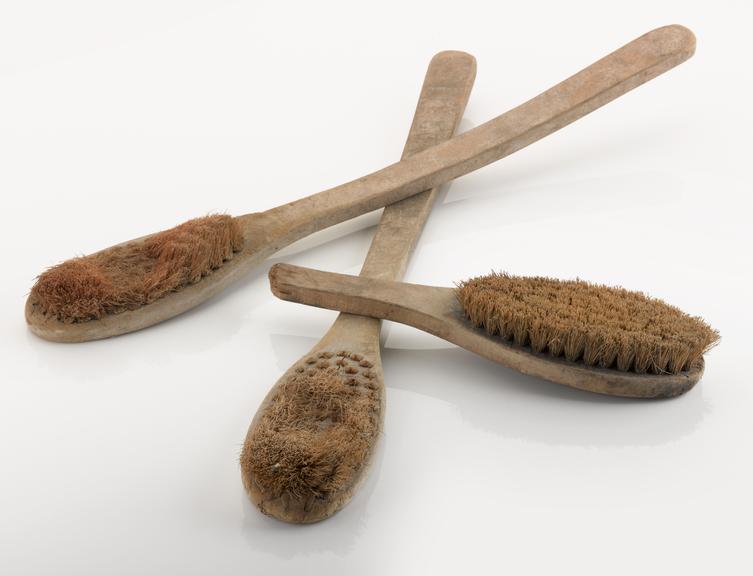
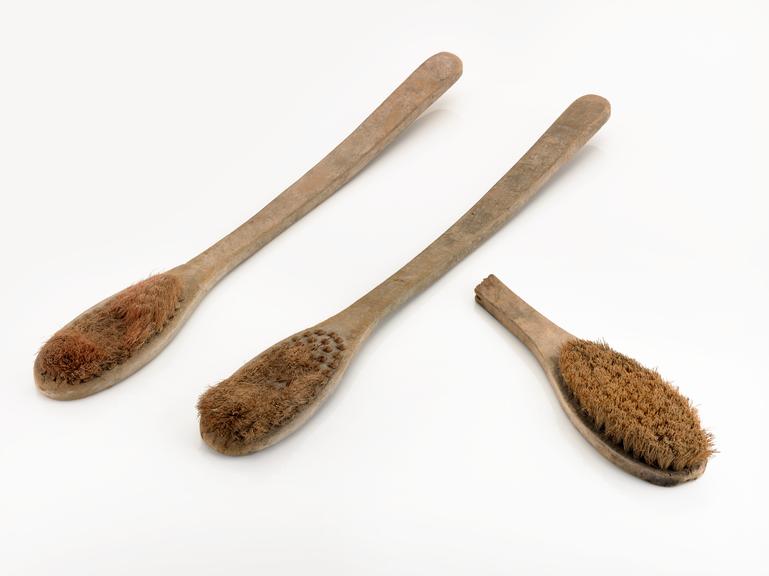
Brush used for bathing in public bathhouse
- Made:
- 1920-1950


 This image is released under a CC BY-NC-SA 4.0
Licence
This image is released under a CC BY-NC-SA 4.0
Licence
License this image for commercial use at Science and Society Picture Library
LicenseThis image is released under a CC BY-NC-SA 4.0
Licence
License this image for commercial use at Science and Society Picture Library
LicenseThis image is released under a CC BY-NC-SA 4.0
Licence
License this image for commercial use at Science and Society Picture Library
License
Science Museum Group Collection
© The Board of Trustees of the Science Museum
Science Museum Group Collection
© The Board of Trustees of the Science Museum
Science Museum Group Collection
© The Board of Trustees of the Science Museum
Brush with flattened bristles and long wooden handle, used for bathing in public bathhouse, possibly the Cheshire Street public baths and laundry in Bethnal Green, East London, 20th century.
The second half of the 19th century saw significant improvements in public health provision in Britain, which was driven by the passing of a number of key pieces of legislation. Built during 1898-99, the opening of the public baths and laundry at the junction of Cheshire Street and Abbey Street in Bethnal Green, London, coincided with the introduction of the second Baths and Washhouses Act. This amended the pioneering first Act of 1846 which had empowered local authorities to build public bathing and laundry facilities for the working classes through the use of local rates and government loans.
At the end of the 19th century, Bethnal Green in East London was considered a ‘slum’. An impoverished, densely packed area with poor quality, unsanitary housing. As such, the new baths and laundry became a very popular amenity, well-used by the local population. The building was designed by the architect R. Stephen Ayling – who specialised in social and community buildings – with the entrance to the baths in Cheshire Street and the laundry entrance in the then adjacent Abbey Street. For a small fee, people could have a warm bath in one part of the building or wash their clothes in another. This well-worn scrubbing brush was likely to have been provided in bathing cubicles for communal use.
After several decades serving the community, improvements in household washing and bathing facilities led to decreasing demand for the facilities and they closed in the 1970s. Part of the building then became home to the Repton Boxing Club – considered Britain's oldest amateur boxing gym
Details
- Category:
- Public Health & Hygiene
- Object Number:
- 2016-503/3
- Materials:
- wood (unidentified)
- type:
- brushes
- credit:
- Museum of London
Related Objects
Ski mask part of Personal Protective Equipment
Double headed vaccination lancet
Child's bib printed with "MMR is safe, tell your friends"
Vial containing 'Rouvax' Vaccine
