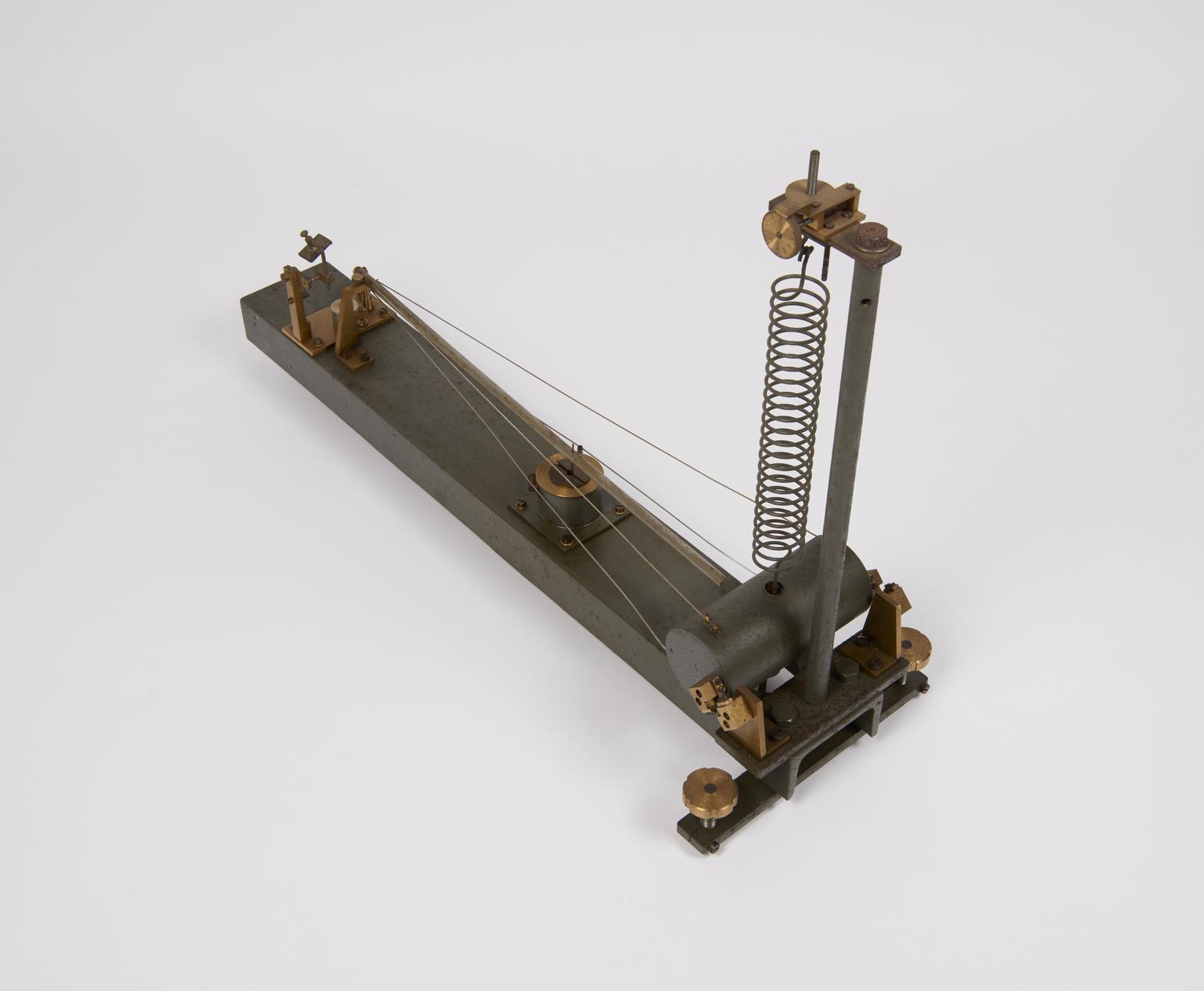
Short-period vertical seismometer used at Kew Observatory

Made:
1939 in Kew

Short-period vertical seismometer (SPV) with viscous coupling used at Kew Observatory, by F J Scrase and A W Lee, 1939. This instrument was designed to record the vertical component of short-period waves from minor local earthquakes in the UK, complementing Kew’s two Wood-Anderson instruments (see 1974-539) that recorded the horizontal components. The instrument had a free period of 1.5 seconds, was direct recording with optical registration, had a static magnification of 3000 and a damping constant of close to 1.

Kew Observatory was one of Britain’s main seismological observing sites between 1925 and 1964. Initially the observatory was equipped with a Golitsyn (Galitzin) seismograph (object no 1966-94), transferred from Eskdalemuir Observatory in Scotland, that recorded all three components of motion of earthquake waves. The Golitsyn was designed to maximise the amplification of long-period waves – ones from distant earthquakes that had travelled through Earth’s interior. However, it gave poor records of earthquakes originating locally. The Wood-Anderson instruments (made in Kew's workshops) were installed to provide records of the short-period waves from minor local tremors, and the SPV (also made in the workshop) completed the set so that vertical motion could also be captured. It was designed to give sharp records of P wave onsets – the compressional waves that are the first to arrive at a seismograph after an earthquake.

The SPV continued to be used at Kew to provide records of tremors in southern England, even after Kew’s seismological function was transferred back to Eskdalemuir in 1964. The instrument’s records were published in Met Office records between 1951 and 1969.
Details

Category:
Geophysics
Object Number:
1974-541
type:
seismograph
credit:
Kew Observatory

Parts

Short-period vertical seismometer used at Kew Observatory

Short-period vertical seismometer used at Kew Observatory

Main parts of short-period vertical seismometer (SPV) with viscous coupling used at Kew Observatory, by F J Scrase and A W Lee, 1939. This instrument was designed to record the vertical component of short-period waves from minor local earthquakes in the UK, complementing Kew’s two Wood-Anderson instruments (see 1974-539) that recorded the horizontal components. The instrument had a free period of 1.5 seconds, was direct recording with optical registration, had a static magnification of 3000 and a damping constant of close to 1.

More

Kew Observatory was one of Britain’s main seismological observing sites between 1925 and 1964. Initially the observatory was equipped with a Golitsyn (Galitzin) seismograph (object no 1966-94), transferred from Eskdalemuir Observatory in Scotland, that recorded all three components of motion of earthquake waves. The Golitsyn was designed to maximise the amplification of long-period waves – ones from distant earthquakes that had travelled through Earth’s interior. However, it gave poor records of earthquakes originating locally. The Wood-Anderson instruments (made in Kew's workshops) were installed to provide records of the short-period waves from minor local tremors, and the SPV (also made in the workshop) completed the set so that vertical motion could also be captured. It was designed to give sharp records of P wave onsets – the compressional waves that are the first to arrive at a seismograph after an earthquake.

The SPV continued to be used at Kew to provide records of tremors in southern England, even after Kew’s seismological function was transferred back to Eskdalemuir in 1964. The instrument’s records were published in Met Office records between 1951 and 1969.

Object Number:
1974-541/1
type:
seismograph
Image ©
The Board of Trustees of the Science Museum
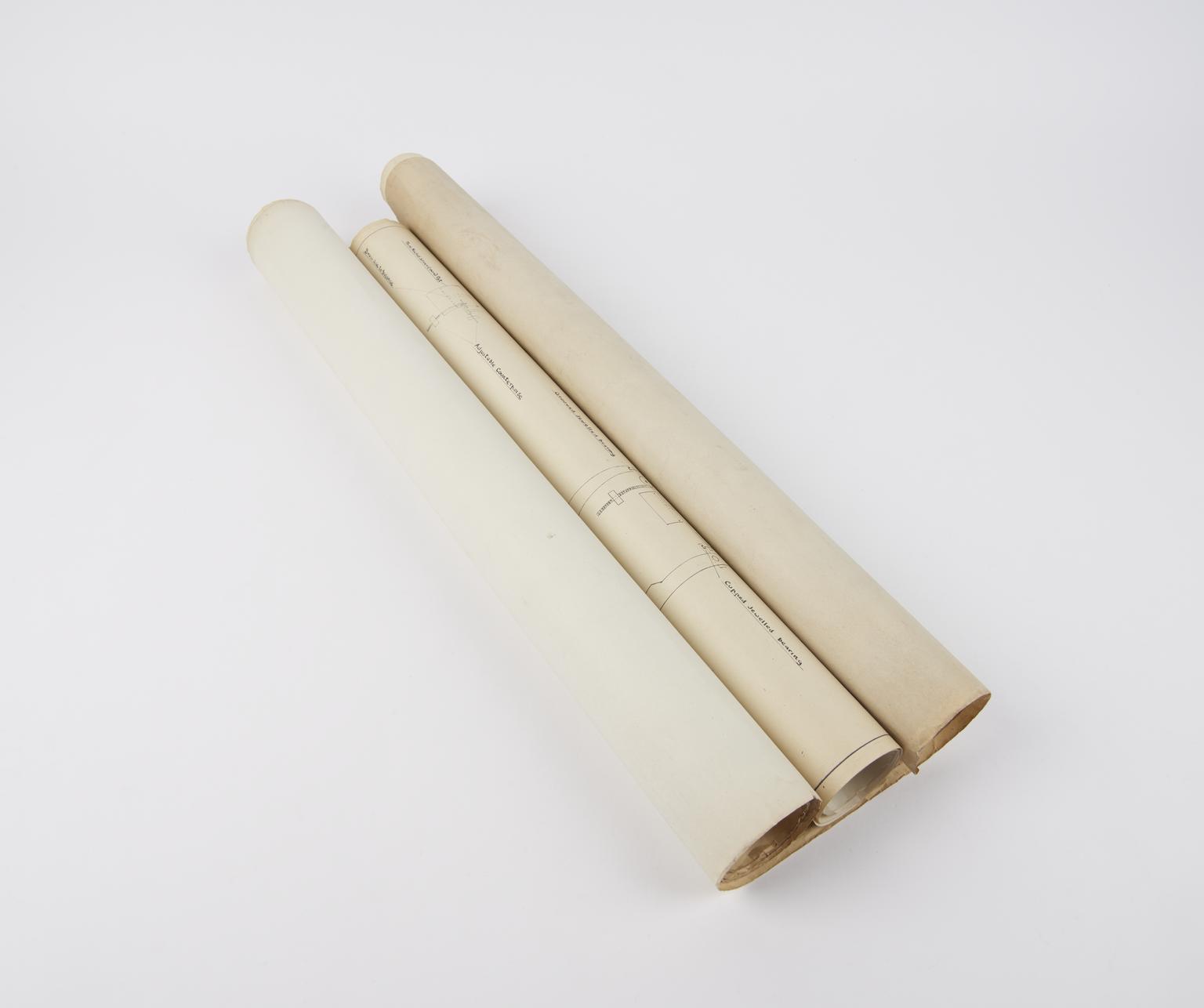
Technical drawing of short-period vertical seismometer

Technical drawing of short-period vertical seismometer

Technical drawings of short-period vertical seismometer (SPV) used at Kew Observatory, approved by A W Lee, 1939. This instrument was designed to record the vertical component of short-period waves from minor local earthquakes in the UK, complementing Kew’s two Wood-Anderson instruments (see 1974-539) that recorded the horizontal components. The instrument had a free period of 1.5 seconds, was direct recording with optical registration, had a static magnification of 3000 and a damping constant of close to 1.

More

Kew Observatory was one of Britain’s main seismological observing sites between 1925 and 1964. Initially the observatory was equipped with a Golitsyn (Galitzin) seismograph (object no 1966-94), transferred from Eskdalemuir Observatory in Scotland, that recorded all three components of motion of earthquake waves. The Golitsyn was designed to maximise the amplification of long-period waves – ones from distant earthquakes that had travelled through Earth’s interior. However, it gave poor records of earthquakes originating locally. The Wood-Anderson instruments (made in Kew's workshops) were installed to provide records of the short-period waves from minor local tremors, and the SPV (also made in the workshop) completed the set so that vertical motion could also be captured. It was designed to give sharp records of P wave onsets – the compressional waves that are the first to arrive at a seismograph after an earthquake.

The SPV continued to be used at Kew to provide records of tremors in southern England, even after Kew’s seismological function was transferred back to Eskdalemuir in 1964. The instrument’s records were published in Met Office records between 1951 and 1969.

Materials:
paper (fibre product)
Object Number:
1974-541/2
type:
drawings
Image ©
The Board of Trustees of the Science Museum
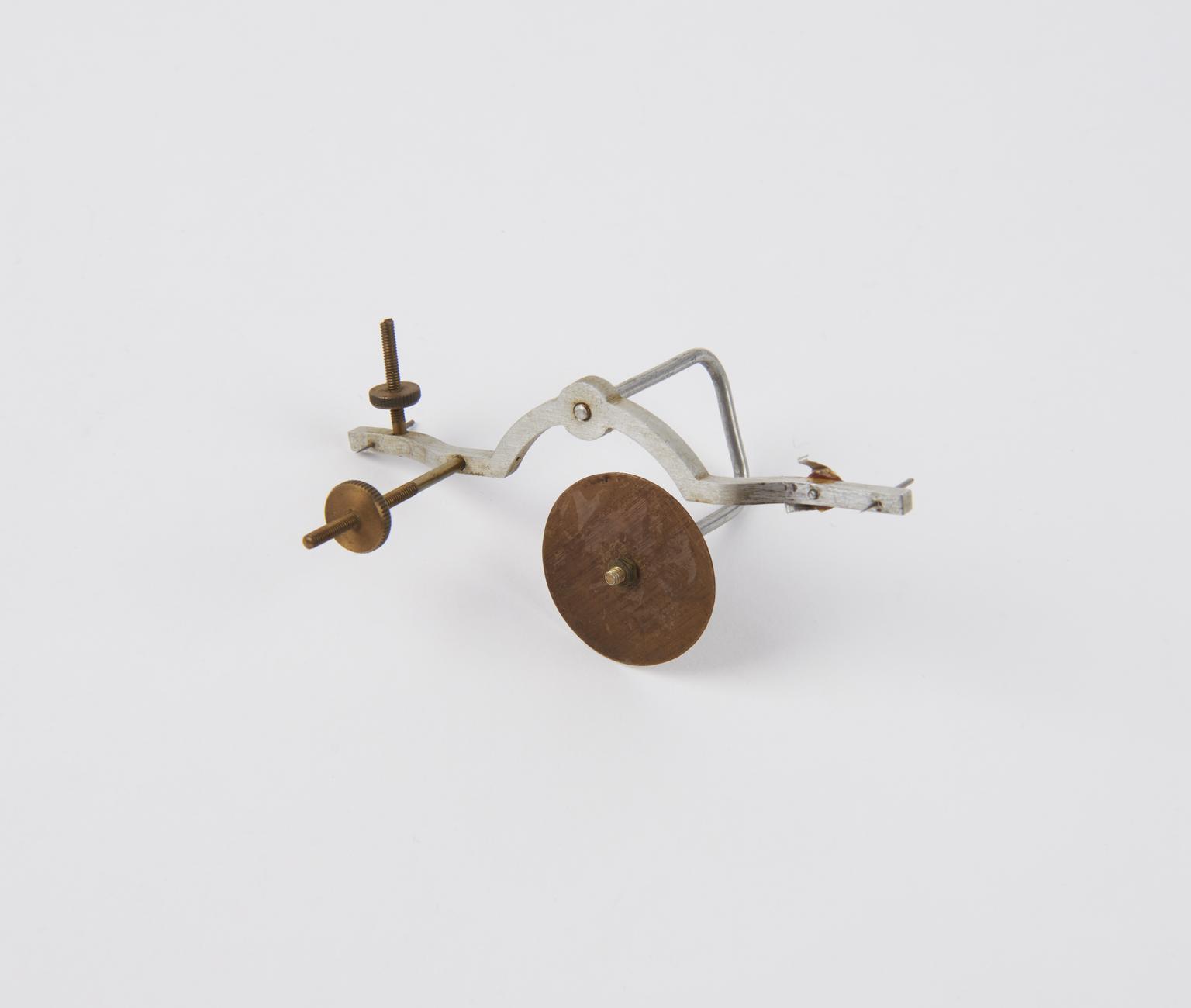
Adjustable counterpoise from short-period vertical seismometer

Adjustable counterpoise from short-period vertical seismometer

Adjustable counterpoise from the viscous coupling mechanism of short-period vertical seismometer (SPV) used at Kew Observatory, by F J Scrase, 1938. This instrument was designed to record the vertical component of short-period waves from minor local earthquakes in the UK, complementing Kew’s two Wood-Anderson instruments (see 1974-539) that recorded the horizontal components. The instrument had a free period of 1.5 seconds, was direct recording with optical registration, had a static magnification of 3000 and a damping constant of close to 1.

More

Kew Observatory was one of Britain’s main seismological observing sites between 1925 and 1964. Initially the observatory was equipped with a Golitsyn (Galitzin) seismograph (object no 1966-94), transferred from Eskdalemuir Observatory in Scotland, that recorded all three components of motion of earthquake waves. The Golitsyn was designed to maximise the amplification of long-period waves – ones from distant earthquakes that had travelled through Earth’s interior. However, it gave poor records of earthquakes originating locally. The Wood-Anderson instruments (made in Kew's workshops) were installed to provide records of the short-period waves from minor local tremors, and the SPV (also made in the workshop) completed the set so that vertical motion could also be captured. It was designed to give sharp records of P wave onsets – the compressional waves that are the first to arrive at a seismograph after an earthquake.

The SPV continued to be used at Kew to provide records of tremors in southern England, even after Kew’s seismological function was transferred back to Eskdalemuir in 1964. The instrument’s records were published in Met Office records between 1951 and 1969.

Materials:
wood (unidentified) and metal (unknown)
Object Number:
1974-541/3
type:
adjustable counterpoise
Image ©
The Board of Trustees of the Science Museum