Pocket sympiesometer, 1839
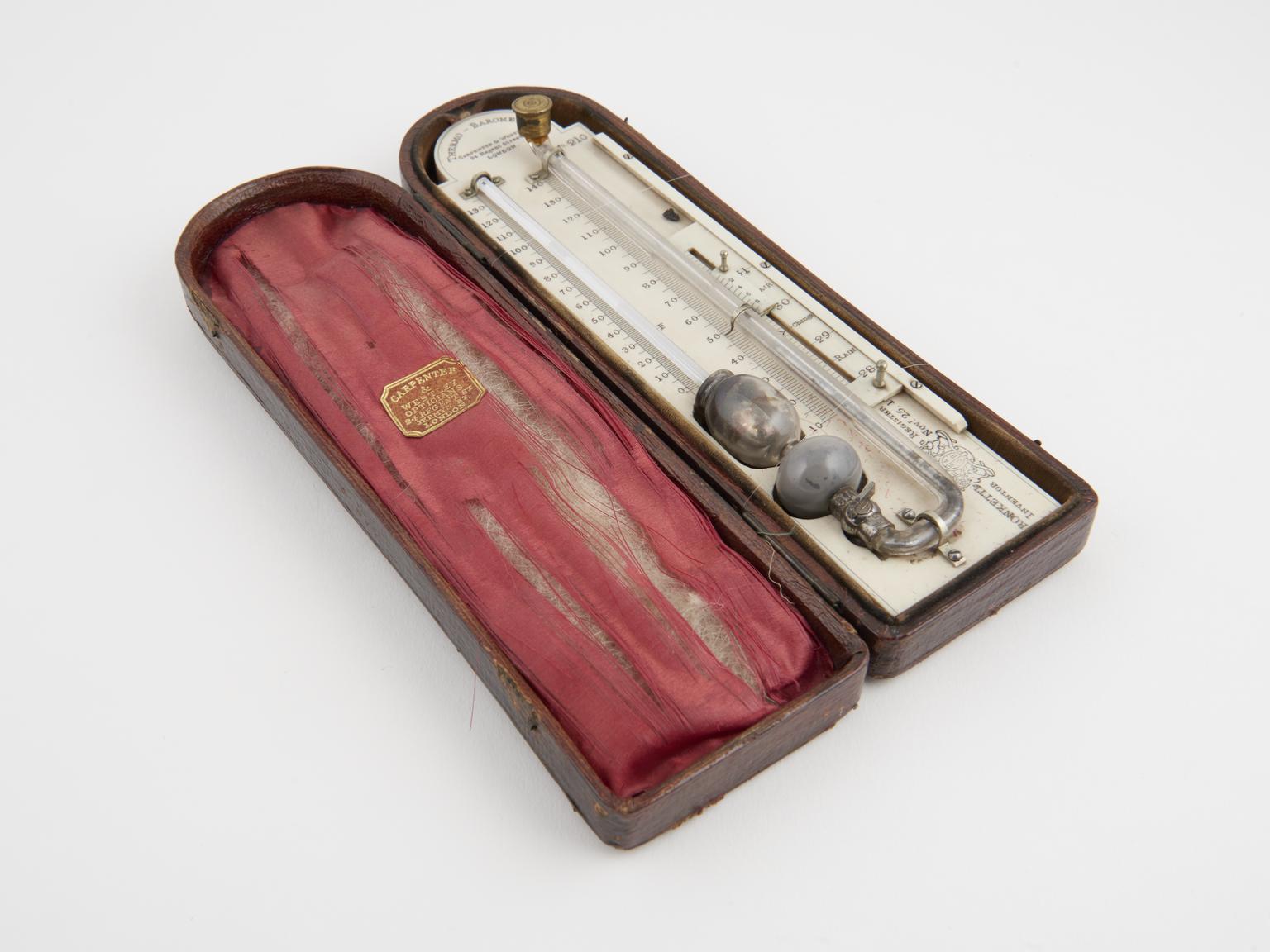
Pocket sympiesometer, invented by John George Harris Ronketti, in leather covered wooden case, made by Carpenter & Westley, 24 Regent Street, London, 1839
More
Mercury barometers needed to have two tubes that were at least 33 inches long, and were generally cumbersome to carry around. To allow for readings of air pressure by a pocket instrument, a much shorter glass tube was doubled back on itself to fit a small case, and the moving agent was a combination of air, spirit and mercury. This example was made by Carpenter and Westley to a design registered by Ronketti in 1839.
- Measurements:
-
overall (closed): 240 mm x 74 mm x 45 mm,
overall (open): 240 mm x 140 mm x 35 mm,
- Materials:
- brass (copper, zinc alloy) , glass , mercury , ivory , wood (unidentified) , leather , paper (fibre product) , silk and wax
- Object Number:
- 1929-962/1
- type:
- sympiesometer
- Image ©
- The Board of Trustees of the Science Museum