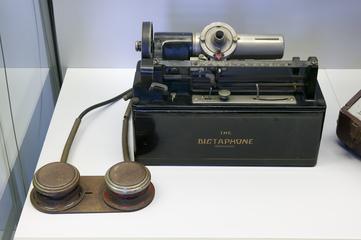
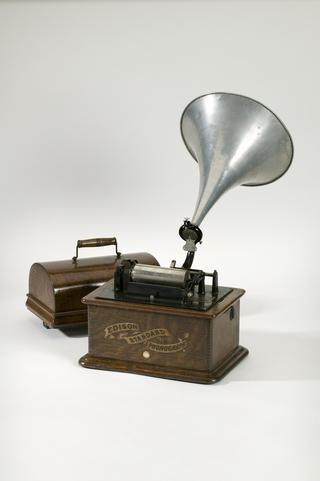
Edison 'Amberola' (Model A) phonograph, 1909.
‘Amberola’ (Model A), Edison cabinet phonograph, by Thomas Edison, United States, 1909
‘Amberola’ (Model A), Edison cabinet phonograph, with 42 cylinders of musical performances, by Thomas Edison, United States, 1880-1922
‘Amberola’ (Model A), Edison cabinet phonograph, by Thomas Edison, United States, 1909

Royal Purple Amberol phonograph cylinder containing ‘Simon the Cellarer’ by Arthur Middleton, Issue Number 29044, associated with an Edison 'Amberola' phonograph, 1912-1929
This is an example of Royal Purple Amberol cylinder, one of the latest designs made by Thomas Edison in the late 1910s. These cylinders were the same as celluloid coated wax as his Blue Amberols, but they were dyed purple and marketed as higher end recordings. They usually stuck to classical and operatic genres, and the songs are said to have been chosen by Thomas Edison himself.
This cylinder is a recording of ‘Simon the Cellarer’, originally written by composer John Liptrot Hatton (1809-1886) & lyricist William Henry Bellamy (1800-1866) in 1860. It is a British comedic tale of Simon and Dame Margery, a drunken pair of singletons considering marriage – but Simon denies Margery’s advances. This cylinder is an American version of the song by Arthur Middleton (1800-1929), an American opera and bass-baritone singer, said to be the house bass for Edison’s National Phonograph Company.
Royal Purple Amberol phonograph cylinder containing ‘Mira, di acerbe lagrime (Il Trovatore – Verdi)’ by Marie Rappold and Taurino Parvis, associated with an Edison 'Amberola' phonograph, 1912-1929
Royal Purple Amberol phonograph cylinder containing ‘Carmena – Vocal Waltz (H Lane Wilson)’ by Alice Verlet, associated with an Edison 'Amberola' phonograph, 1912-1929
Royal Purple Amberol phonograph cylinder containing ‘Solvejgs Vise (Grieg)’ by Marie Tiffany, Issue Number 29060, associated with an Edison 'Amberola' phonograph, 1920
Blue Amberol (Grand Opera) phonograph cylinder containing ‘Non la sospiri (Tosca – Puccini)’ by Maria Labia, Issue Number 28153, associated with an Edison 'Amberola' phonograph, 1913

Blue Amberol (Grand Opera) phonograph cylinder containing ‘Mi Chismano Mimi (La Boheme – Puccini)’ by Lucrezia Bori, associated with an Edison 'Amberola' phonograph, No.28122 1912-1929
Blue Amberol (Concert) phonograph cylinder containing ‘Amore o Grillo (Madam Butterfly – Puccini)’ by Guido Ciccolini and Thomas Chalmers, Issue Number 28278, associated with an Edison ‘Amberola’ phonograph, 1918
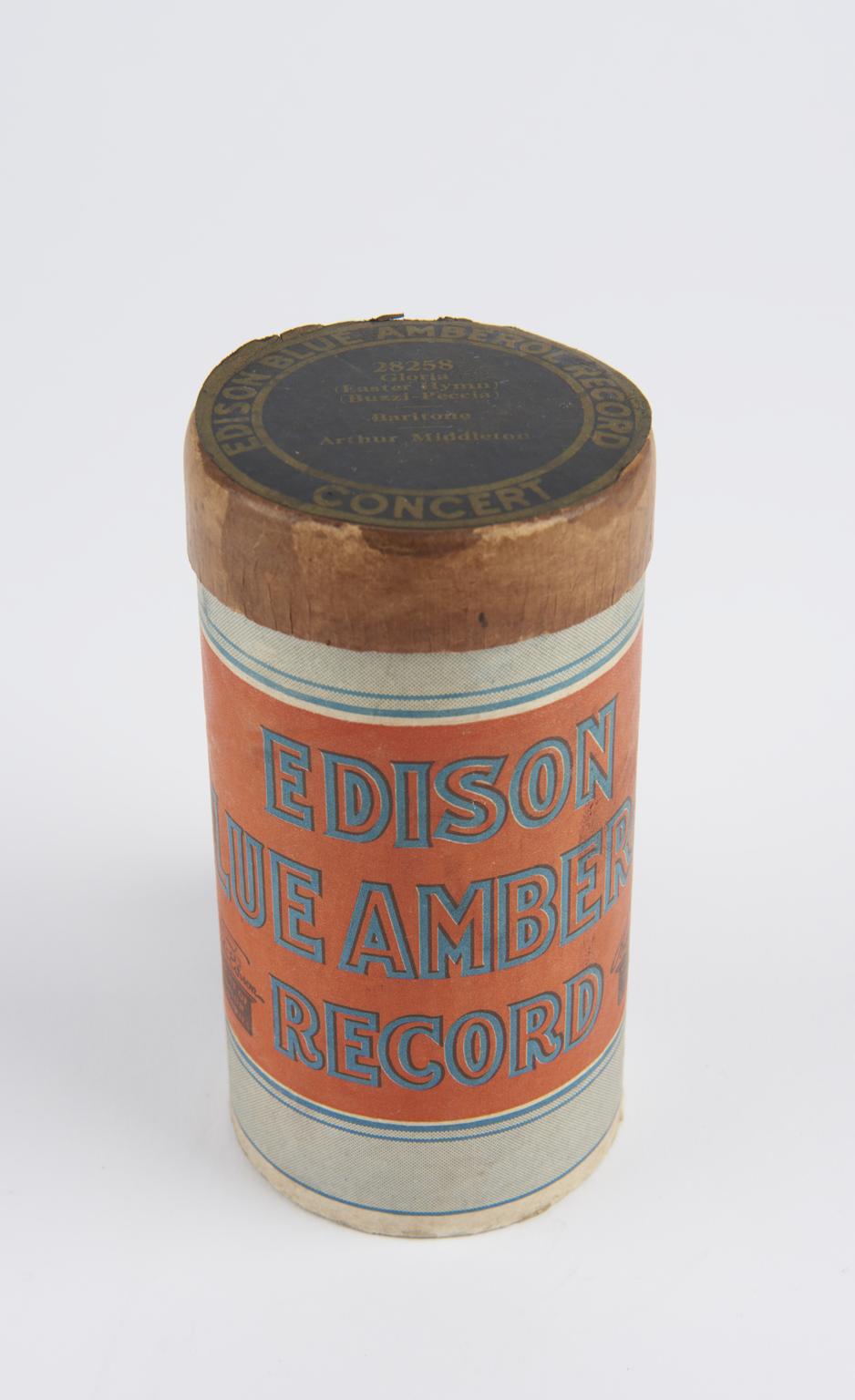
Blue Amberol phonograph cylinder containing ‘Gloria – Easter Hymn (Buzzi – Feccia)’ by Arthur Middleton, Issue Number 28258, associated with an Edison 'Amberola' phonograph, 1917
Blue Amberol (Concert) phonograph cylinder containing ‘Rondo (Dvorak – Op 94)’ by Paula Gruppe, Issue Number 28173, associated with an Edison 'Amberola' phonograph, 1913
Blue Amberol (Concert) phonograph cylinder containing ‘Ernani Involarmi (Ernani – Verdi)’ by Alice Verlet, Issue Number 28245, associated with an Edison 'Amberola' phonograph, 1916
Blue Amberol (Concert) phonograph cylinder containing ‘Oh dry those tears’ by Helen Stanley, Issue Number 28218, associated with an Edison 'Amberola' phonograph, 1915
Blue Amberol (Concert) phonograph cylinder containing ‘Minuet (Beethoven) and Valse Bluette (Drigo)’ by Kathleen Parlow, associated with an Edison 'Amberola' phonograph, 1912-1929
Blue Amberol phonograph cylinder containing ‘Cavalleria Rusticana – Siciliana and Intermesso (Moscagni)’ by American Standard Orchestra, Issue Number 2217, associated with an Edison 'Amberola' phonograph, 1914
Blue Amberol phonograph cylinder containing ‘Romántica – Mazurka (IJ Jorka)’ by José Rocabruna, Issue Number 22140, associated with an Edison 'Amberola' phonograph, 1913
Blue Amberol phonograph cylinder containing ‘Casse Noisette; March & Dance Russe (Pyotr Tschaikowsky)’ by National Military Band, associated with an Edison 'Amberola' phonograph, 1913-1914
Blue Amberol phonograph cylinder containing ‘Morte D’Otello (Otello – Verdi)’ by Florencio Constantino, Issue Number 28140, associated with an Edison 'Amberola' phonograph, 1913
Blue Amberol phonograph cylinder containing ‘The Lost Chord (Sullivan)’ by Reed Miller, Issue Number 2106, associated with an Edison 'Amberola' phonograph, 1913
Blue Amberol phonograph cylinder containing ‘Quinteto Instrumentale’ by J Rocabruna, associated with an Edison 'Amberola' phonograph, 1912-1929
Blue Amberol phonograph cylinder containing ‘The Passing Caravan Patrol’ by New York Military Band, Issue Number 2050, associated with an Edison 'Amberola' phonograph, 1913
Blue Amberol phonograph cylinder containing ‘Santa Claus hides in your Phonograph’ by Harry E Humphrey, Issue Number 4635, associated with an Edison 'Amberola' phonograph, 1922
Blue Amberol phonograph cylinder containing ‘Souvenir (Franz Drdla)’ by Demetrius Constantine Dounis, Issue Number 2010, associated with an Edison 'Amberola' phonograph, 1913
Amberol phonograph cylinder containing ‘Washington Post – High School Cadets March’ by Sousa’s Band, Issue Number 325, associated with an Edison 'Amberola' phonograph, 1909
Blue Amberol phonograph cylinder containing ‘Lasca (Frank Desprez)’ by Edgar L Davenport, Issue Number 1868, associated with an Edison 'Amberola' phonograph, 1913
Blue Amberol phonograph cylinder containing ‘Let me dream again (Sullivan)’ by Marie Tillotson, associated with an Edison 'Amberola' phonograph, 1912-1929
Blue Amberol phonograph cylinder containing ‘All. De la Symphonic Pastorale’ by Carde Républicsine Band, Issue Number 28128, associated with an Edison 'Amberola' phonograph, 1912-1929
Blue Amberol phonograph cylinder containing ‘Venus Waltz Oh! Oh! Delphine (Ivan Caryll)’ by American Standard Orchestra, Issue Number 1620, associated with an Edison 'Amberola' phonograph, 1913
Blue Amberol phonograph cylinder containing ‘Take a pair of sparking eyes’ by E Pike, Issue Number 28128, associated with an Edison 'Amberola' phonograph, 1912-1929
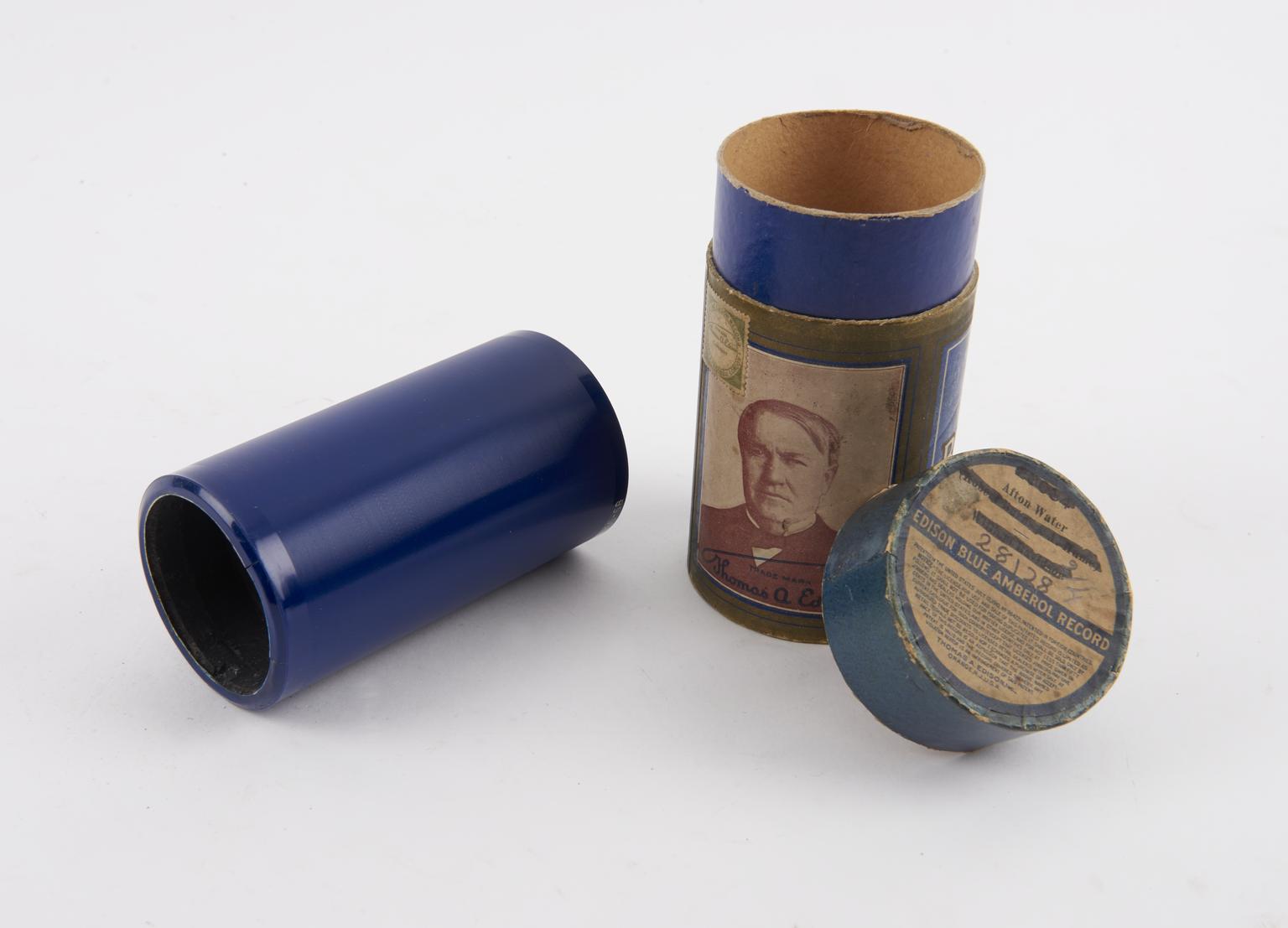
Blue Amberol phonograph cylinder containing ‘Afton Water’ by Christine Miller, Issue Number 28128, associated with an Edison 'Amberola' phonograph, 1912
Thomas Edison’s distinctively blue ‘Amberol’ cylinders were released in 1912 after he acquired the US patent for celluloid phonograph cylinders. They had a plaster-of-paris core with a surface layer of ‘indestructible’ celluloid. Celluloid cylinders offered improved sound quality and were much sturdier than their wax counterparts, which could crack easily and wear down over time. The US patent for celluloid cylinders had been granted to Thomas Lambert in 1900, so Edison, who invented the phonograph, had missed out on these improvements in those 12 years.
Edison’s ‘Amberol’ cylinder had existed in a black wax format since 1908. It was an improvement on brown wax cylinders due to its finer engravings which allowed recordings of up to four minutes – double that of the wax alternative. However, this meant a finer stylus tip was required to fit into the engravings of an ‘Amberol’. Edison introduced the ‘Amberola’ phonograph to solve this, as well as kits that could be used to adapt earlier phonographs. The blue Amberol cylinders required further adaptations, with a diamond tipped stylus introduced specifically for them.
This cylinder contains a recording of ‘Afton Water’, written by the famous Scottish poet Robert Burns and sung by Christine Miller, an Edison Records recording artist.
Blue Amberol phonograph cylinder containing ‘The whistling coquette’ by Ada Jones and Billy Murray, Issue Number 2361, associated with an Edison 'Amberola' phonograph, 1914
Blue Amberol phonograph cylinder containing ‘Trio from “Faust”’ by Agnes Kimball, Reed Miller and Frank Croxton, Issue Number 1502, associated with an Edison 'Amberola' phonograph, 1912
Blue Amberol phonograph cylinder containing ‘There were Shepherds, Glory to God (Messiah – Handel)’ by Anita Rio, Issue Number 28219, associated with an Edison 'Amberola' phonograph, 1915
Blue Amberol phonograph cylinder containing ‘Selection “The Belle of New York”’ by New York Military Band, Issue Number 1638, associated with an Edison 'Amberola' phonograph, 1913
Blue Amberol phonograph cylinder containing ‘Venetian Song (Tosti)’ by Alan Turner, Issue Number 1640, associated with an Edison 'Amberola' phonograph, 1913
Two-minute phonograph cylinder containing ‘Dance of the Clowns (Trinkaus)’ by Edison Symphony Orchestra, associated with an Edison 'Amberola' phonograph, 1880-1912
Two-minute phonograph cylinder containing ‘The Better Land (Cowen)’ by Sonia Herma, associated with an Edison 'Amberola' phonograph, 1880-1912
Two-minute phonograph cylinder containing ‘The Dawn (Guy d’Hardelot)’ by Amy Evans, associated with an Edison 'Amberola' phonograph, 1880-1912
Two-minute phonograph cylinder containing ‘Inflamatus (Stabat Mater – Rossini)’ by Bohumir Kryl, associated with an Edison 'Amberola' phonograph, 1880-1912
Two-minute phonograph cylinder containing ‘I Dreamt that I Dwelt (Balfe)’ by Ethel Cadman, associated with an Edison 'Amberola' phonograph, 1880-1912
Two-minute phonograph cylinder containing ‘The Children’s Home (Cowen)’ by Arthur Crover, associated with an Edison 'Amberola' phonograph, 1880-1912
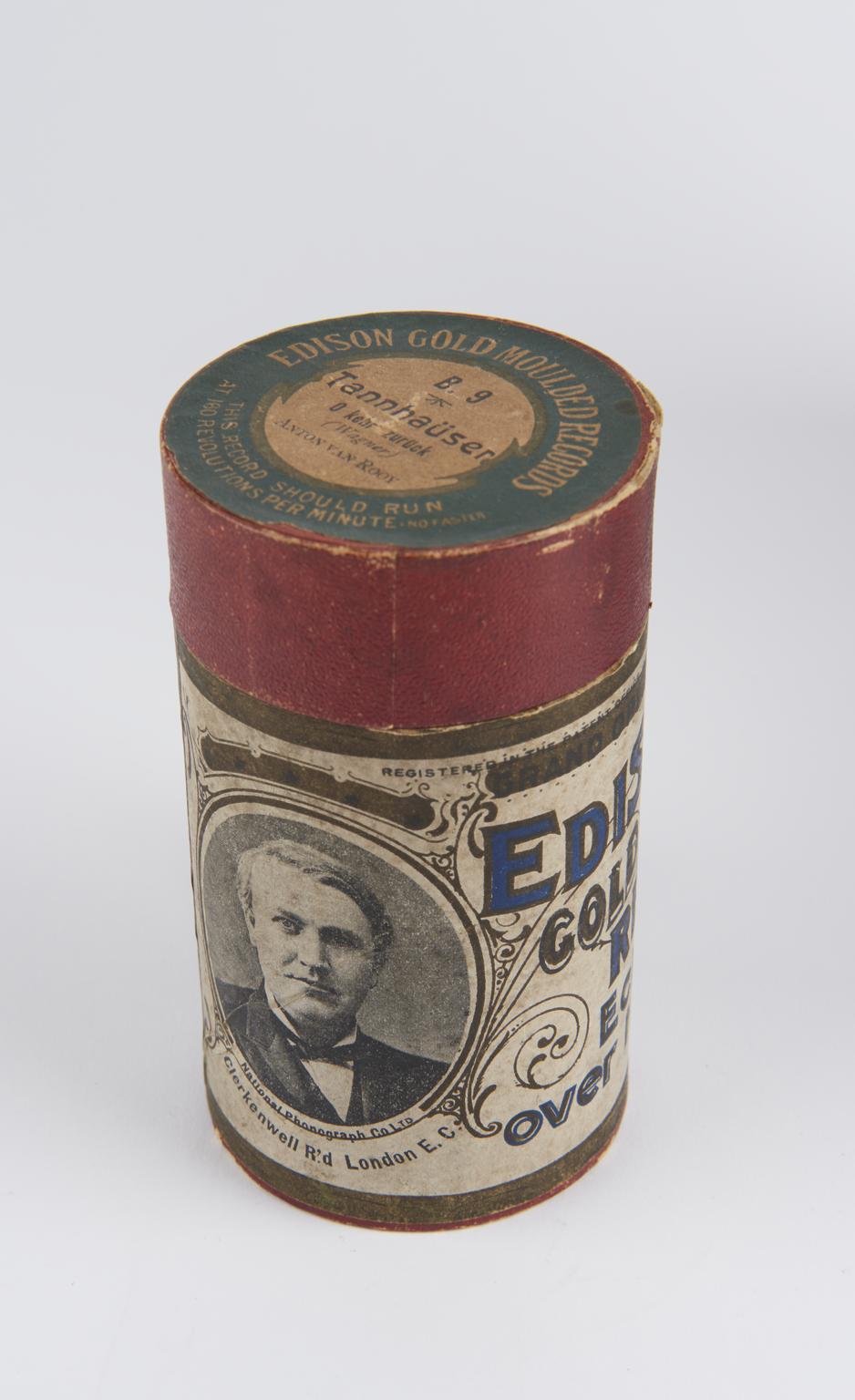
Two-minute phonograph cylinder containing ‘Oh kehr zuruck (Tannhauser Wagner)’ by Anton van Rooy, associated with an Edison 'Amberola' phonograph, 1880-1912
Two-minute phonograph cylinder containing ‘When we listened to the chime of the old Church Bells’ by Manuel Romain, associated with an Edison 'Amberola' phonograph, 1880-1912
Royal Purple Amberol phonograph cylinder containing ‘Valse Sentimentale (Sohubert – Frank)’ by Albert Spalding and André Benoist, Issue Number 29058, associated with an Edison ‘Amberola’ phonograph, 1920