Starship Technologies Self-Driving Delivery Robot
- Made:
- 2017 in San Francisco
Starship Technologies Self-Driving Delivery Robot with battery removed
The Starship Technologies battery powered delivery robot delivers food and packages in pre-mapped neighbourhoods, sharing the pavement with pedestrians. It uses similar technologies to those found in self-driving cars, such as cameras, GPS, and ultrasonic sensors, to avoid obstacles and navigate to its destination. The robot travels at around average walking speed (6kmph or 3.7mph), and can deliver to customers within a 6km radius of the point of origin. It is also fitted with speakers, allowing it to communicate with people around it. The top of the robot is a hinged lid covering an internal storage compartment which can hold up to 9.1kg of goods. The two rear pairs of wheels on the robot are height adjustable, allowing the robot to lift itself up onto kerbs, and it can assess oncoming traffic to safely cross roads. To protect the privacy of customers and passers-by, the robot’s cameras only ‘look’ up to knee height as they navigate. It has been tested in over 100 locations around the world. Now, fleets of these robots complete thousands of commercial deliveries every week.
Customers place their orders using the Starship Deliveries smartphone app; a platform through which partnered companies can sell their goods for delivery, similar to third-party food delivery platforms such as Deliveroo. Customers can track the robot using the app and receive a notification once it arrives. They then must go outside to meet it at the agreed pickup point. Once within range of the robot, an ‘unlock’ button becomes available on the app, allowing the customer to open the lid and retrieve their delivery.
The last mile of a delivery journey accounts for 50% of delivery costs. Robots like this do not get stuck in road traffic or need to find a parking spot, allowing them to get deliveries to customers more quickly and efficiently. They also do not contribute to road traffic or pollution, making them more eco-friendly alternatives for the local area. In Summer 2020, during the Covid-19 pandemic, Starship operations were expanded to meet the surge in demand for contactless delivery options, particularly for essentials to those self-isolating. The company also waived delivery fees for NHS workers for a limited time as a gesture of support.
Starship’s autonomous delivery fleet was first trialled in various locations around UK in 2016, in partnership with takeaway platforms Just Eat and Pronto, and courier firm Hermes. The robots were then commercially launched in 2018, starting with suburban areas of Milton Keynes, becoming the first autonomous delivery robots to be deployed in the UK on a commercial scale. In March 2020, the Milton Keynes fleet was expanded to cover the city centre, making it the first city centre in the UK served by autonomous delivery robots.
Starship Technologies have been actively involved in the development of legislation governing the use of delivery robots in various regions across Europe and North America to ensure their technologies are compliant. In the cases of the Milton Keynes and Northampton fleets, as well as the UK trial locations pre-launch, terms were specifically agreed with local councils prior to deployment.
However, concerns have been raised relating to the use of pedestrian infrastructure by this sort of robot. In San Francisco, where Starship Technologies is based and their robots were first deployed, lawmakers have now introduced strict regulations on numbers and locations of delivery robots after complaints from local residents about congestion and accessibility issues. The city now has a dedicated Office of Emerging Technology to engage with companies developing new systems and technologies as early as possible in the hopes of preventing such issues in future.but not limited to robotics and autonomous vehicles, green technology, the governance of technology, and the Covid-19 pandemic.
Details
- Category:
- Human Robotics
- Object Number:
- 2026-27
- Materials:
- plastic (unidentified), metal (unknown) and rubber (unidentified)
- Measurements:
-
(h) 1187 w/o flagpole 571mm (w) 569mm (l) 697mm Flag height 831mm, weight with flagpole 25kg
- type:
- starship delivery robot
- credit:
- Starship Technologies
Related Objects
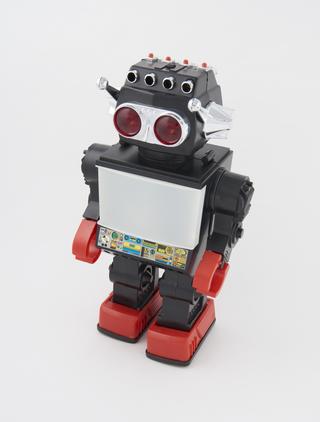
Instruction sheet for Kinsman Robot Machine
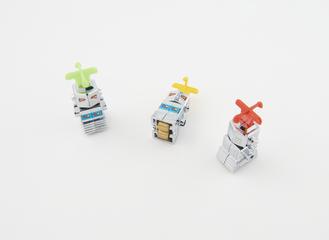
Three silver mini-robots for Kinsman Robot Machine
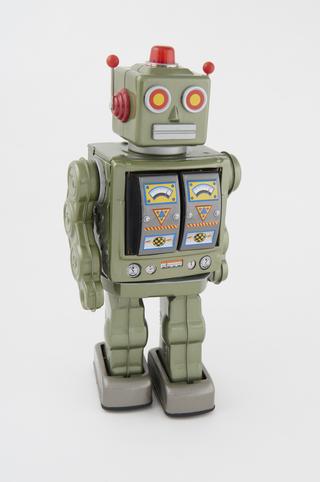
Star Strider Robot

4 small missiles for Saturn TV Robot