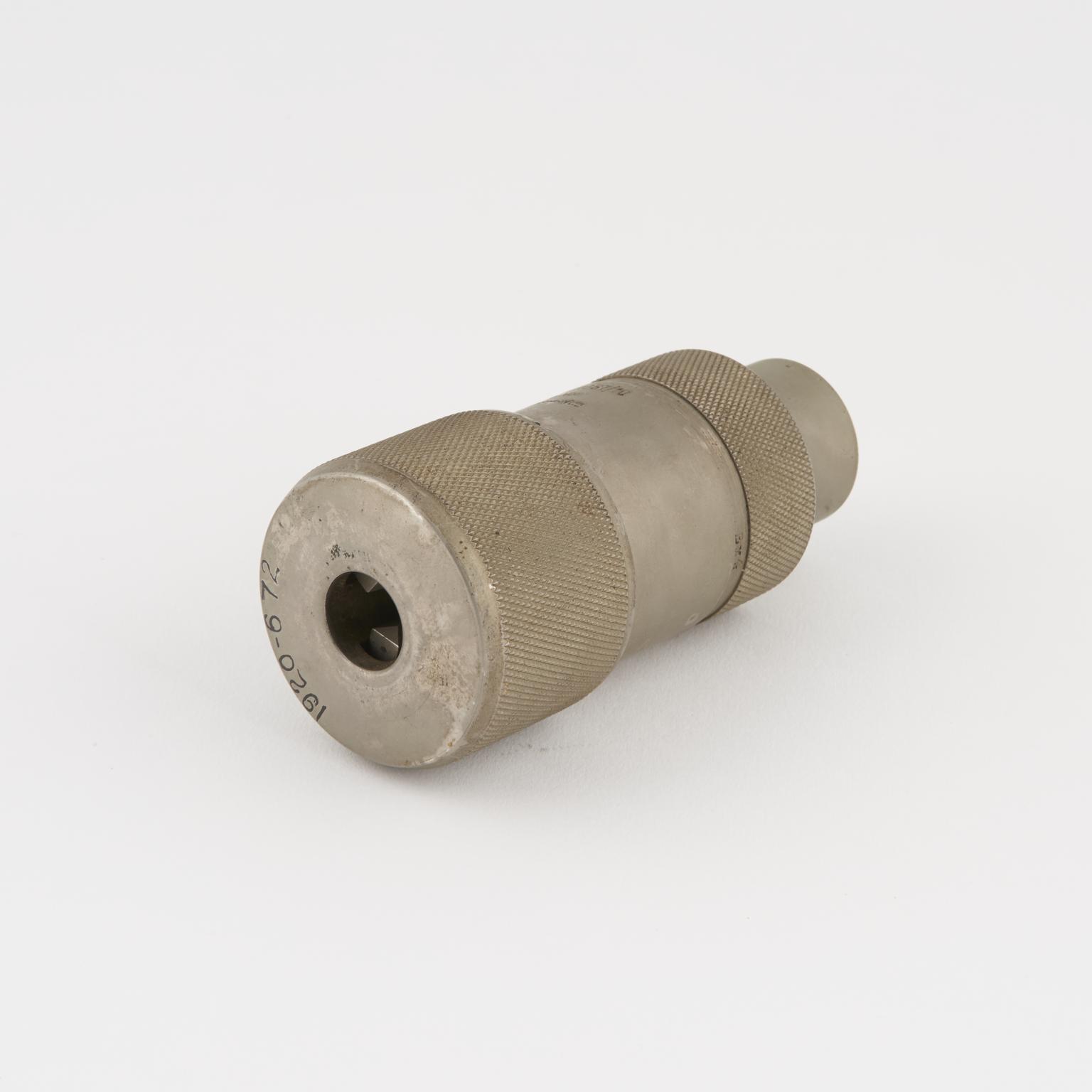
"Marvel" automatic drill chuck No. 102 complete

Made:
c. 1910

"Marvel" automatic drill chuck No. 102 complete, and one "Marvel" automatic drill chuck No. 103 disassembled, with mahogany stand

This drill chuck, the main features of which are its accessibility and the ease and rapidity with which drills may be removed and replaced, was patented by F. W. Kupke in 1910.

The drill shank is gripped by three jaws, whose back faces are inclined and bear against the cone-shaped inner surface of a steel ring, which fits freely in the recessed portion of the body. The jaws are pressed upwards into the cone, and so closed, by a cup or boss made integral with the spindle of the chuck, which is screwed into the body with a coarse square-threaded screw. The jaws are held vertically in position by three guiding slots cut through the spindle.

The upward thrust is transmitted from the jaws to the cone, and from thence through a ball race to a washer resting on a shoulder in the recess of the body. There is thus no thrust on the spindle, and no binding of the threads, and the drill may be released without stopping the machinery, by a quick blow on the boss in the direction in which the chuck is turning. By the action of the cone any increase in the upward pressure of the drill causes the jaws to grip more tightly. The chuck is assembled without screws, two spring rings being all that is required to keep the parts together.

Details

Category:
Hand and Machine Tools
Object Number:
1920-672
Materials:
metal (unknown)
type:
chuck
credit:
Wearden and Guylee (London) Ltd.

Parts

Section of Drill Chuck

Section of Drill Chuck

Section of "Marvel" automatic drill chuck No. 102

More

This drill chuck, the main features of which are its accessibility and the ease and rapidity with which drills may be removed and replaced, was patented by F. W. Kupke in 1910.

The drill shank is gripped by three jaws, whose back faces are inclined and bear against the cone-shaped inner surface of a steel ring, which fits freely in the recessed portion of the body. The jaws are pressed upwards into the cone, and so closed, by a cup or boss made integral with the spindle of the chuck, which is screwed into the body with a coarse square-threaded screw. The jaws are held vertically in position by three guiding slots cut through the spindle.

The upward thrust is transmitted from the jaws to the cone, and from thence through a ball race to a washer resting on a shoulder in the recess of the body. There is thus no thrust on the spindle, and no binding of the threads, and the drill may be released without stopping the machinery, by a quick blow on the boss in the direction in which the chuck is turning. By the action of the cone any increase in the upward pressure of the drill causes the jaws to grip more tightly. The chuck is assembled without screws, two spring rings being all that is required to keep the parts together.

Materials:
metal (unknown)
Object Number:
1920-672/1
type:
chuck
Image ©
The Board of Trustees of the Science Museum
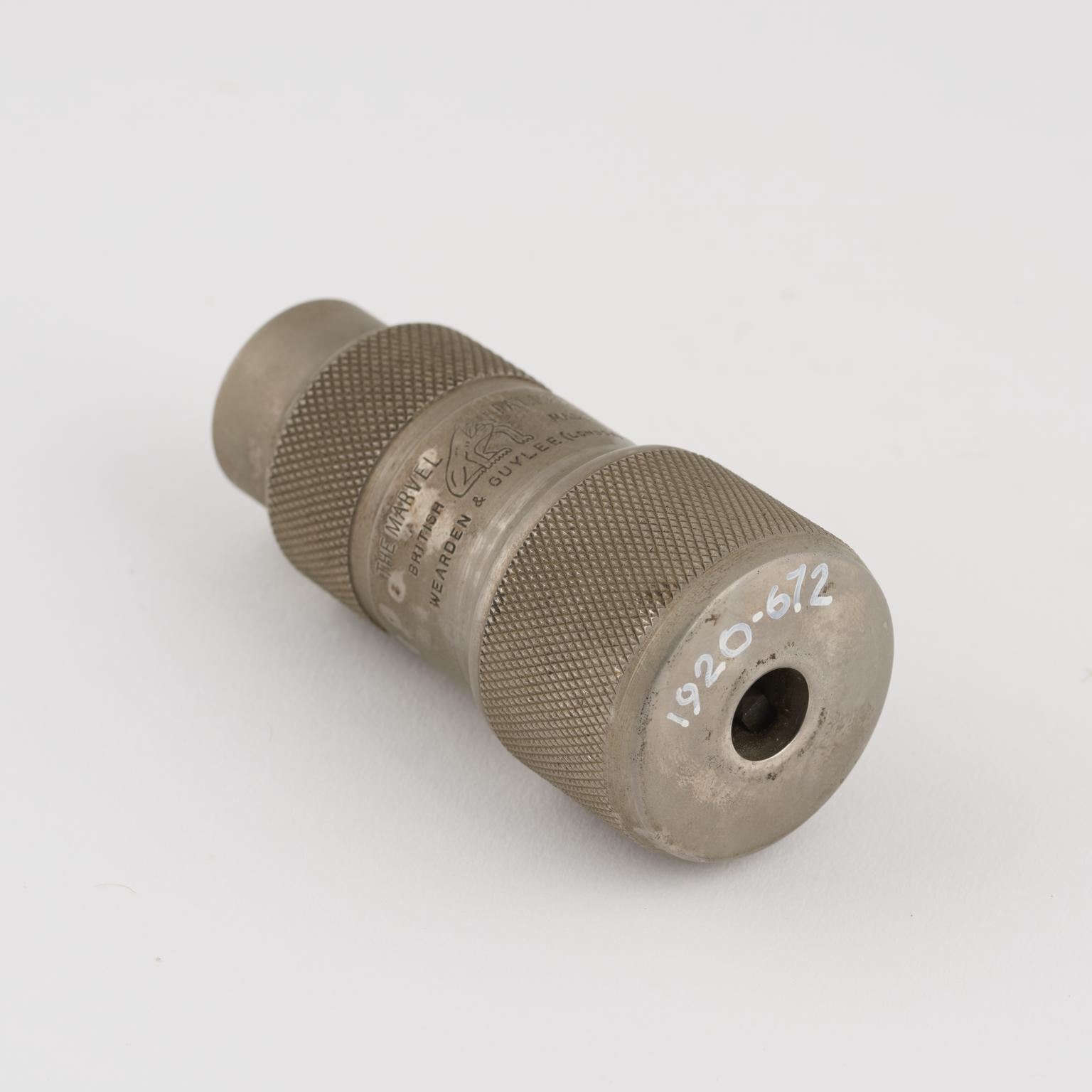
Section of Drill Chuck

Section of Drill Chuck

Section of "Marvel" automatic drill chuck No. 102

More

This drill chuck, the main features of which are its accessibility and the ease and rapidity with which drills may be removed and replaced, was patented by F. W. Kupke in 1910.

The drill shank is gripped by three jaws, whose back faces are inclined and bear against the cone-shaped inner surface of a steel ring, which fits freely in the recessed portion of the body. The jaws are pressed upwards into the cone, and so closed, by a cup or boss made integral with the spindle of the chuck, which is screwed into the body with a coarse square-threaded screw. The jaws are held vertically in position by three guiding slots cut through the spindle.

The upward thrust is transmitted from the jaws to the cone, and from thence through a ball race to a washer resting on a shoulder in the recess of the body. There is thus no thrust on the spindle, and no binding of the threads, and the drill may be released without stopping the machinery, by a quick blow on the boss in the direction in which the chuck is turning. By the action of the cone any increase in the upward pressure of the drill causes the jaws to grip more tightly. The chuck is assembled without screws, two spring rings being all that is required to keep the parts together.

Materials:
metal (unknown)
Object Number:
1920-672/2
type:
chuck
Image ©
The Board of Trustees of the Science Museum
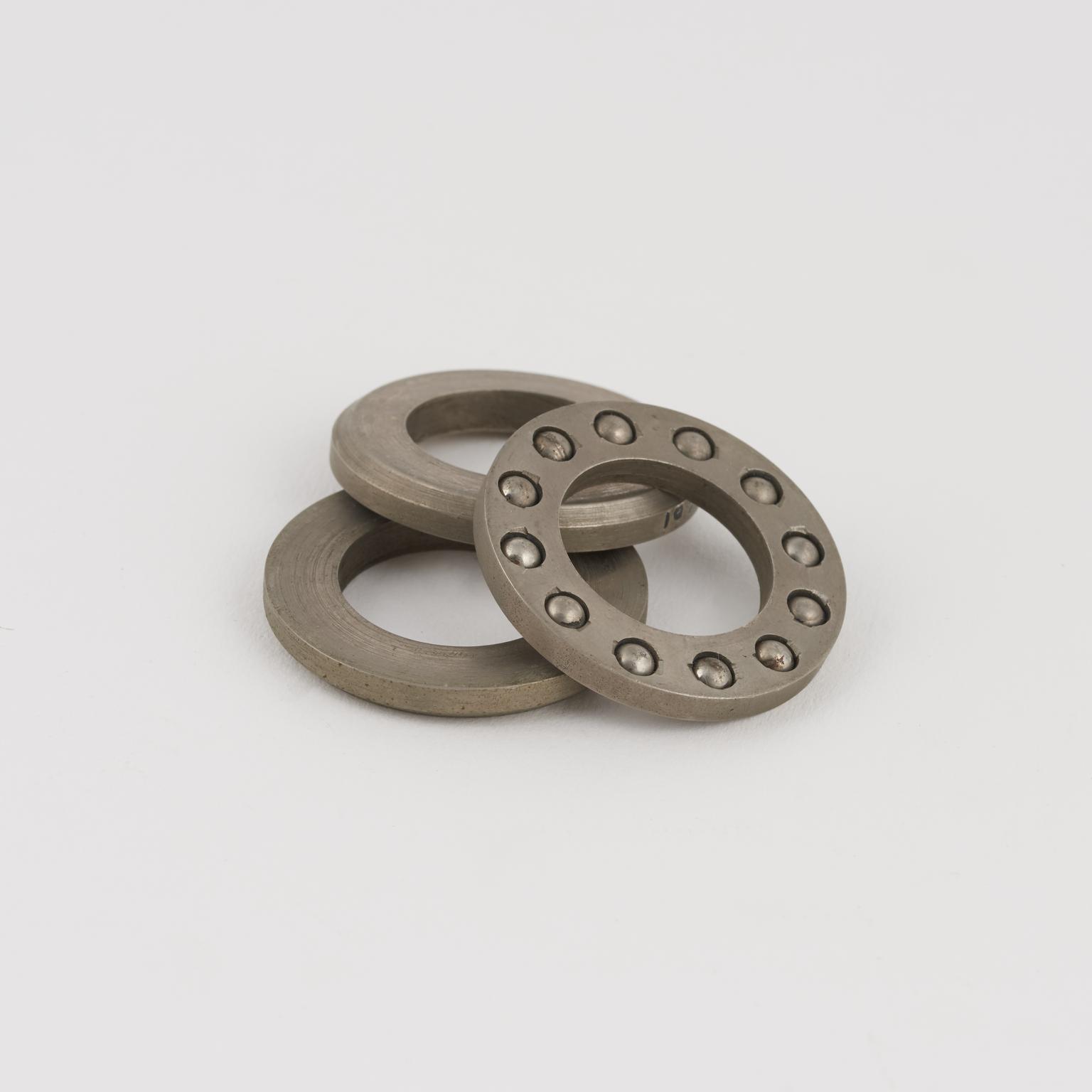
Washers from "Marvel" Drill Chuck

Washers from "Marvel" Drill Chuck

Two standard washers and a washer with 12 ball bearing inserts from "Marvel" automatic drill chuck No. 102

More

This drill chuck, the main features of which are its accessibility and the ease and rapidity with which drills may be removed and replaced, was patented by F. W. Kupke in 1910.

The drill shank is gripped by three jaws, whose back faces are inclined and bear against the cone-shaped inner surface of a steel ring, which fits freely in the recessed portion of the body. The jaws are pressed upwards into the cone, and so closed, by a cup or boss made integral with the spindle of the chuck, which is screwed into the body with a coarse square-threaded screw. The jaws are held vertically in position by three guiding slots cut through the spindle.

The upward thrust is transmitted from the jaws to the cone, and from thence through a ball race to a washer resting on a shoulder in the recess of the body. There is thus no thrust on the spindle, and no binding of the threads, and the drill may be released without stopping the machinery, by a quick blow on the boss in the direction in which the chuck is turning. By the action of the cone any increase in the upward pressure of the drill causes the jaws to grip more tightly. The chuck is assembled without screws, two spring rings being all that is required to keep the parts together.

Materials:
metal (unknown)
Object Number:
1920-672/3
type:
washers
Image ©
The Board of Trustees of the Science Museum