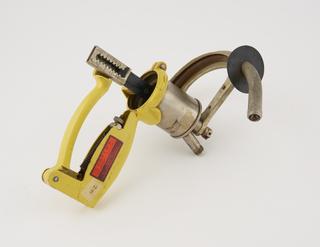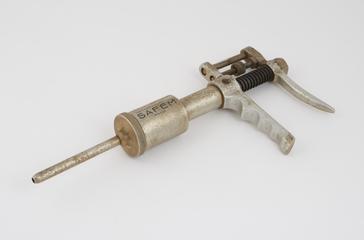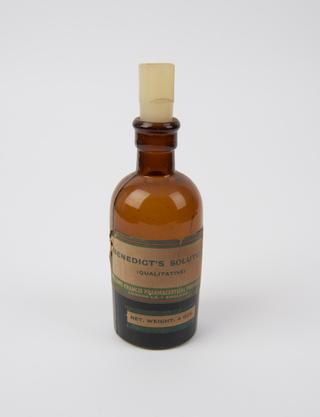
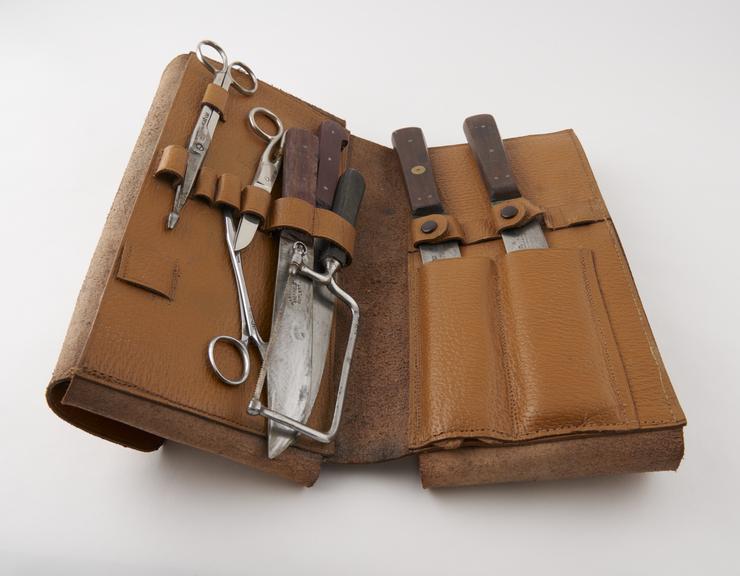

Sub-group of veterinary instruments

Sub-group of veterinary instruments Sub-group of veterinary instruments

Creative Commons LicenseThis image is released under a CC BY-NC-SA 4.0 Licence

License this image for commercial use at Science and Society Picture Library

License

Creative Commons LicenseThis image is released under a CC BY-NC-SA 4.0 Licence

License this image for commercial use at Science and Society Picture Library

License

Science Museum Group
© The Board of Trustees of the Science Museum

Science Museum Group
© The Board of Trustees of the Science Museum

Sub-group of veterinary instruments

Details

Category:
Veterinary Medicine
Object Number:
1987-297/16
type:
instruments

Parts

Pugh's veterinary post mortem scissors

Pugh's veterinary post mortem scissors

Pugh's veterinary post mortem scissors, nickel plated steel, by Arnold and Sons, London, 1920-1940

Measurements:
length 192 mm
width 54 mm
Materials:
steel (nickel plated)
Object Number:
1987-297/16 Pt1
type:
post mortem scissors
Spencer Well's artery forceps

Spencer Well's artery forceps

Spencer Well's artery forceps, stainless steel, by Arnold and Sons, London, 1950-1970

More

Artery forceps are used to control bleeding from blood vessels by clamping down on the artery. A locking mechanism at the handle keeps them in place. Helped by surgical instrument makers, surgeons developed their own tools, often naming them after themselves. Thomas Spencer Wells (1818-1897) was an English surgeon who became surgeon to Queen Victoria between 1863 and 1896. He developed the rachet locking mechanism holding the forceps in position. His second design had shorter jaws to increase compression and were ridged to improve grip. By being held closed, they could also not get trapped in the body's tissues or muscles. Prior to Spencer Wells' designs, an assistant had to hold the forceps closed.

Measurements:
length 129 mm
width 59 mm
Materials:
steel (stainless)
Object Number:
1987-297/16 Pt2
type:
artery forceps
Small amputation saw

Small amputation saw

Small amputation saw, steel with ebony handle, English, 1880-1910

Measurements:
length 233 mm
width 59 mm
Materials:
saw, steel and handle, ebony
Object Number:
1987-297/16 Pt3
type:
amputation saws
Carving knife

Carving knife

Carving knife, steel with wooden handle, by Redge, Sheffield, England, 1890-1930.

Materials:
blade, steel and handle, wood
Object Number:
1987-297/16 Pt4
type:
knives
Carving knife

Carving knife

Carving knife, steel with wooden handle, Sheffield, 1890-1930

Measurements:
length 248 mm
width 27 mm
Materials:
blade, steel and handle, wood
Object Number:
1987-297/16 Pt5
type:
knives
Carving knife

Carving knife

Carving knife, with wooden handle, by George Wostenholm and Son, Sheffield, England, 1890-1930.

Measurements:
length 294 mm
width 34 mm
Materials:
blade, steel and handle, wood
Object Number:
1987-297/16 Pt6
type:
knives
Carving knife

Carving knife

Carving knife, steel, with wooden handle, by Christopher Johnson and Co., Sheffield, England, 1890-1930.

Measurements:
length 290 mm
width 39 mm
Materials:
blade, steel and handle, wood
Object Number:
1987-297/16 Pt7
type:
knives