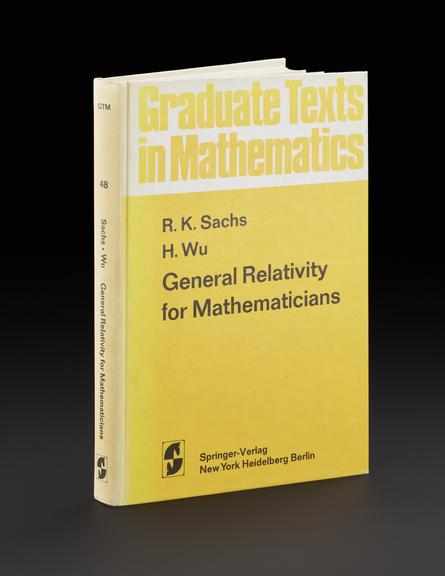
Book: first textbook on general relativity for mathematicians, influenced by the contributions of Stephen Hawking's generation
- Made:
- 1977



 This image is released under a CC BY-NC-SA 4.0
Licence
This image is released under a CC BY-NC-SA 4.0
Licence
License this image for commercial use at Science and Society Picture Library
LicenseThis image is released under a CC BY-NC-SA 4.0
Licence
License this image for commercial use at Science and Society Picture Library
LicenseThis image is released under a CC BY-NC-SA 4.0
Licence
License this image for commercial use at Science and Society Picture Library
License
Science Museum Group
© The Board of Trustees of the Science Museum
Science Museum Group
© The Board of Trustees of the Science Museum
Science Museum Group
© The Board of Trustees of the Science Museum
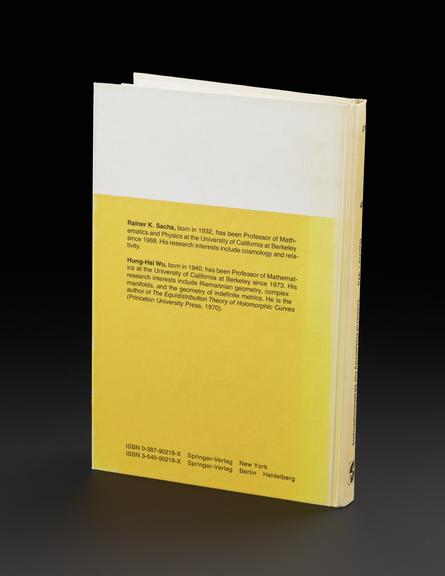
Sachs, R.K., Wu, H., General relativity for mathematicians, Springer, 1977.
This book is considered one of the first to introduce general relativity for mathematicians written after the key developments of the 1960s such as the formulation of singularities, black holes, and in particular the geometrical approaches of Roger Penrose and Stephen Hawking. Stephen Hawking's first book with George Ellis, "The Large Scale Structure of Space-Time" is one of the most referenced works in the textbook.
For a description of this book's importance, written at the time of its publication, see the review by: John A Thorpe in the Bulletin of the American Mathematical Society in 1978:
https://www.ams.org/journals/bull/1978-84-06/S0002-9904-1978-14570-4/S0002-9904-1978-14570-4.pdf
Stephen Hawking's office contained more than 300 books, all located on the bookshelves above the kitchen counter. They date as early as his student years, and the bulk corresponds to his long professional career from the 1960s to the 2010s. From the 1990s onwards Stephen would have used digital versions increasingly, so the books in his bookcases were a select subset. While some items are rare copies -like the dissertations he advised or book drafts- most of the library contents are rather standard prints. The majority contain significant individual marks, and even for those that do not, the connection to Hawking is evident. Books by friends and colleagues often contain inscriptions and inserts that evidence their relationship. Others remind of places he visited, conferences he attended, or relate to having become a celebrity and inspiration throughout the world. Of the books that he authored, there are usually multiple versions, translations, and occasionally draft versions. A good portion of the books also contain inserts such as notes by the authors or editors, receipts, and occasionally unrelated material that found its way into them around the time of their acquisition. A portion of them has also been bookmarked with post-its by Stephen's assistants pointing to the sections most relevant to show visitors.
Details
- Category:
- Stephen Hawking Office
- Collection:
- Stephen Hawking’s Office
- Object Number:
- 2021-561/234
- Materials:
- paper (fibre product)
- Measurements:
-
overall: 240 mm x 160 mm x 22 mm, .665 kg
- type:
- book
- credit:
- Accepted in lieu of Inheritance Tax by H M Government from the Estate of Stephen Hawking and allocated to the Science Museum, 2021