


 This image is released under a CC BY-NC-SA 4.0
Licence
This image is released under a CC BY-NC-SA 4.0
Licence
License this image for commercial use at Science and Society Picture Library
LicenseThis image is released under a CC BY-NC-SA 4.0
Licence
License this image for commercial use at Science and Society Picture Library
LicenseThis image is released under a CC BY-NC-SA 4.0
Licence
License this image for commercial use at Science and Society Picture Library
LicenseThis image is released under a CC BY-NC-SA 4.0
Licence
License this image for commercial use at Science and Society Picture Library
LicenseThis image is released under a CC BY-NC-SA 4.0
Licence
License this image for commercial use at Science and Society Picture Library
LicenseThis image is released under a CC BY-NC-SA 4.0
Licence
License this image for commercial use at Science and Society Picture Library
LicenseThis image is released under a CC BY-NC-SA 4.0
Licence
License this image for commercial use at Science and Society Picture Library
License
Science Museum Group
© The Board of Trustees of the Science Museum
Science Museum Group
© The Board of Trustees of the Science Museum
Science Museum Group
© The Board of Trustees of the Science Museum
Science Museum Group
© The Board of Trustees of the Science Museum
Science Museum Group
© The Board of Trustees of the Science Museum
Science Museum Group
© The Board of Trustees of the Science Museum
Science Museum Group
© The Board of Trustees of the Science Museum
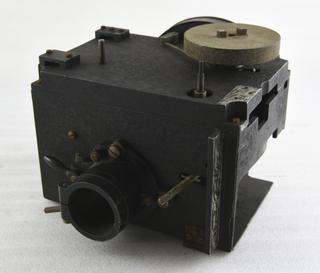
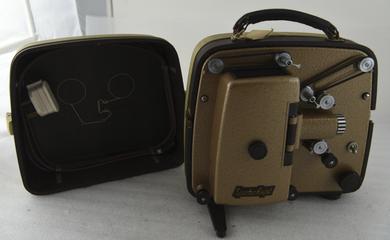
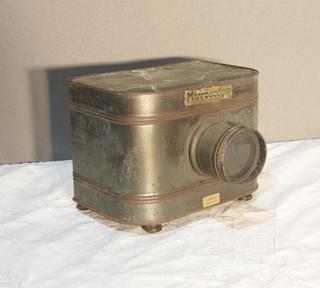
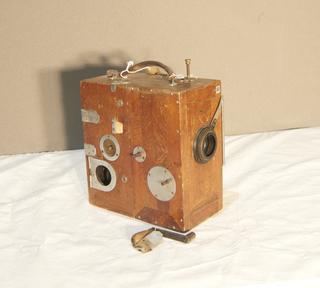
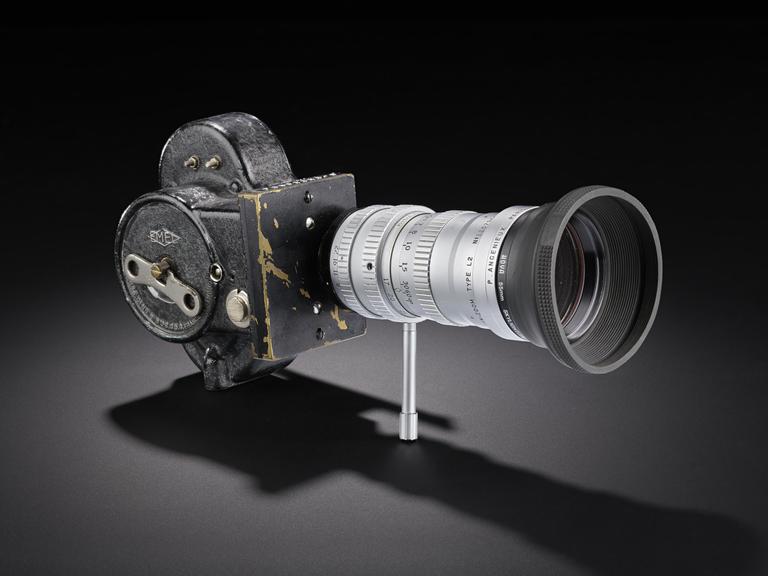
Panascope camera. Part of the Widescreen Association Collection.
In 1960, the French company Emel presented its new Panascope camera, which was able to film in both 8mm and double-8 Panascope, similar to the Dimaphot systerm, also aimed at amateur film makers. The designers took advantage of the fact that a standard 8mm camera uses ordinary 16mm film that is reperforated with twice as many sprocket holes to allo the smaller 8mm frame height to be obtained. The film rusn thorugh the camera twice, the film then sliced won the middel to make one continuous 8mm print. If the film is not sliced, it remains 16mm wide, with two 8mm images side by side. If these images could be exposee together as one across the width of the film, then a reframed image would apperar similar to the Dimaphot widescreen format.
to enable shooting of both 'normal' and widescreen pictures the Panascope system had a dual format arrangement. A vertical two position mask was built into the gate, through which the image is framed, enabling the user to select the format required.
Details
- Category:
- Cinematography
- Object Number:
- 2024-414
- Materials:
- glass and metal (unknown)
- type:
- cine camera
- credit:
- Widescreen Association