






 This image is released under a
 Original cardboard box for Duckiebot differential drive wheeled autonomous robot
Original cardboard box for Duckiebot differential drive wheeled autonomous robot, with DB18 configuration, part of Duckiebot Kit made by Frazzoli Laboratory, ETH Zurich, Switzerland, used for educational and demonstrative purposes in classes as part of the Duckietown Project, 2018-2019.
More
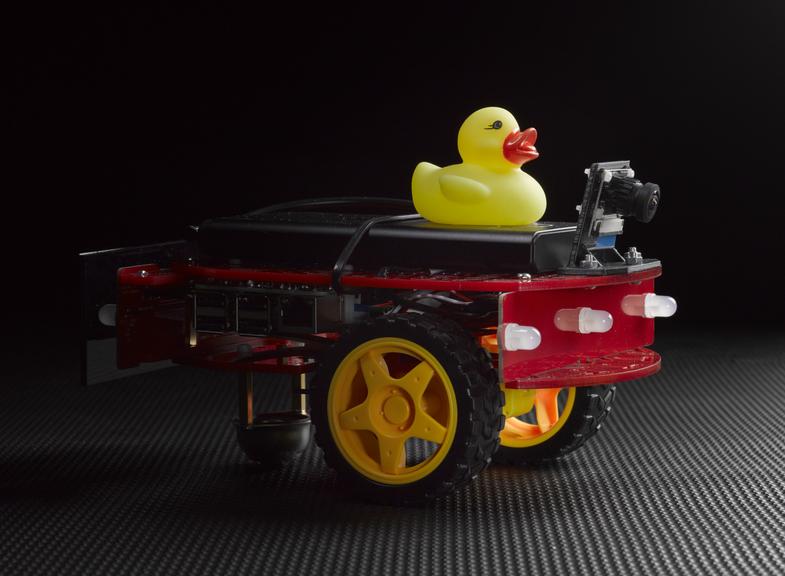
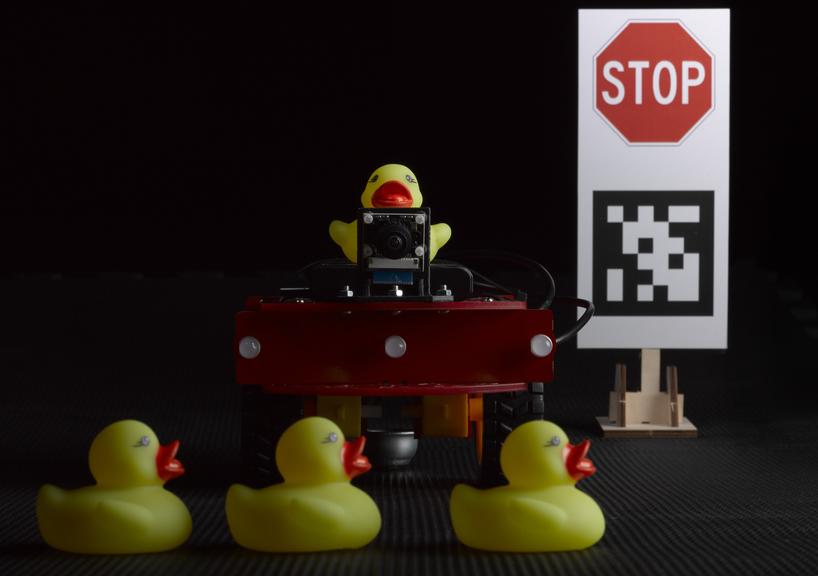
This autonomous ‘Duckiebot’ robot is part of the interdisciplinary ‘Duckietown’ project that aims to make research into robotics, AI sand self-driving technologies accessible, tangible, and fun. The project uses miniature Duckietown cities to explore the real-world challenges of developing autonomous vehicles that use artificial intelligence to guide themselves.
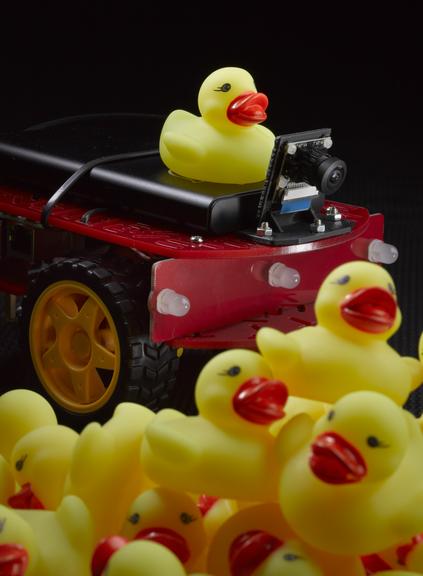
In Duckietowns, Duckiebots operate as autonomous taxis that provide transportation to rubber duck citizens. Duckiebots, like this DB18 model, are low-cost mobile robots that are built almost entirely from off-the-shelf parts. Equipped with a small camera and onboard Raspberry Pi computer, they navigate through cities like self-driving cars would – stopping at intersections, yielding the right of way, and bracing when they encounter traffic. Duckietowns consist of roads and signage and can be transformed into smart cities by adding traffic lights and watchtowers.
The Duckietown project originated from a graduate class at MIT in Massachusetts in 2016 and has since developed into a huge open-source learning platform used by students and researchers world-wide. In 2012, its free massive online open course (MOOC) called ‘Self-driving cars with Duckietown' was attended by 7000 learners from over 170 countries. The project’s aim is to break preconceptions of what robotics is, share knowledge and make the development of future AI and self-driving car technologies accessible to a wide range of people.
Autonomous vehicles that use artificial intelligence to guide themselves are one of the most transformative emerging technologies of the 21st century. Their development and questions around how they might impact our mobility, cities, and societies of the future are an important field of contemporary research. While Duckietown is a simplified environment that is not as complex as the real world, it is still advanced enough to explore real world challenges and help find answers to these questions.
- Measurements:
-
Duckiebot: 130 mm x 260 mm x 135 mm,
Raspberry Pi box: 95 mm x 70 mm x 25 mm,
Boxed flat ribbon cable: 115 mm x 50 mm x 25 mm,
Stickers: 55 mm x 80 mm
Bagged SD card: 70 mm x 50 mm
Bagged screws: 80 mm x 110 mm
Philips screwdriver: 100 mm x 10 mm
Business cards: 85 mm x 55 mm
Flat head screwdriver: 85 mm x 5 mm
Postcard: 115 mm x 150 mm
Bagged usb cable: 145 mm x 115 mm
Bagged ethernet cable: 210 mm x 270 mm
- Materials:
- cardboard
- Object Number:
- 2023-216/1
- type:
- box