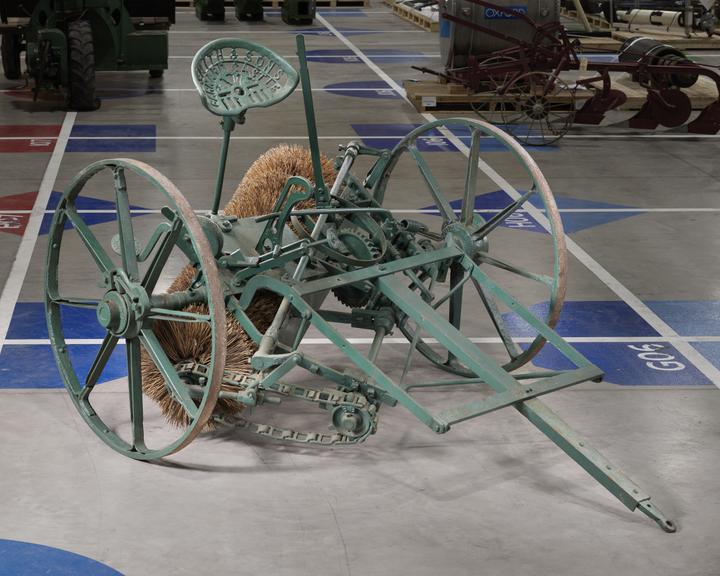

Horse-drawn road sweeper

Horse-drawn road sweeper

Creative Commons LicenseThis image is released under a CC BY-NC-SA 4.0 Licence

License this image for commercial use at Science and Society Picture Library

License

Science Museum Group
© The Board of Trustees of the Science Museum

This Horse-drawn road sweeper was built in around 1912 by William Smith & Sons in Barnard Castle, Durham.

This one-horse machine has two wheels with a basic axle and frame design including a column seat fixed between the wheels, a hand lever controlling the clutch and gear system, and a chain driven roller brush system. As the wheels of the machine turned with the horse’s movement, the chain drive would turn the brushes along the floor below the axle and drivers’ seat between the wheels. The horse was directly via a pair of leather reins.

Perhaps the last surviving example of the original designs of road sweepers left in the UK, this machine was invented and patented in 1830 by William Smith & Sons (founded that same year). The road sweeping machines such as this one would push debris to the sides of the roads into the gutters, which themselves were then swept by a ‘linesman’ who followed closely behind the machine.

This two-wheeled road sweeper design was made with wrought iron frames and fitted with wheels made of wood (and later iron). William Smith & Sons fitted their sweeping machines with patented screw regulating gear, patented self-lining swivel bearings, both of which reducing the drag of the machine when being moved and improved its reliability. Some later models of road sweepers came with water tanks as part of their design. These machines were eventually replaced by motor traction machines in around 1914.

Whilst William Smith & Sons would also develop some of the first patents for other clever machines such as grass cutters and lathers, the company sold most of these patents to Bamfords Limited in the late 1840s and focused their attention to the development and manufacture of road sweepers. William Smith & Sons still operates today as the William Smith group, and whilst they continued to make road sweepers until the 1980s, by this point they had diversified into one of the UK’s largest suppliers of adhesive products, graphics materials and signage.

Details

Category:
Road Transport
Object Number:
1984-442
Materials:
metal (unknown)
Measurements:
overall: 1770 mm x 2900 mm x 2900 mm,
type:
street sweeper
credit:
Lakeland Motor Museum

Parts

This Horse-drawn road sweeper was built in around 1912 by William Smith & Sons in Barnard Castle, Durham.

Horse-drawn road sweeper

This Horse-drawn road sweeper was built in around 1912 by William Smith & Sons in Barnard Castle, Durham.

This one-horse machine has two wheels with a basic axle and frame design including a column seat fixed between the wheels, a hand lever controlling the clutch and gear system, and a chain driven roller brush system. As the wheels of the machine turned with the horse’s movement, the chain drive would turn the brushes along the floor below the axle and drivers’ seat between the wheels. The horse was directly via a pair of leather reins.

More

Perhaps the last surviving example of the original designs of road sweepers left in the UK, this machine was invented and patented in 1830 by William Smith & Sons (founded that same year). The road sweeping machines such as this one would push debris to the sides of the roads into the gutters, which themselves were then swept by a ‘linesman’ who followed closely behind the machine.

This two-wheeled road sweeper design was made with wrought iron frames and fitted with wheels made of wood (and later iron). William Smith & Sons fitted their sweeping machines with patented screw regulating gear, patented self-lining swivel bearings, both of which reducing the drag of the machine when being moved and improved its reliability. Some later models of road sweepers came with water tanks as part of their design. These machines were eventually replaced by motor traction machines in around 1914.

Whilst William Smith & Sons would also develop some of the first patents for other clever machines such as grass cutters and lathers, the company sold most of these patents to Bamfords Limited in the late 1840s and focused their attention to the development and manufacture of road sweepers. William Smith & Sons still operates today as the William Smith group, and whilst they continued to make road sweepers until the 1980s, by this point they had diversified into one of the UK’s largest suppliers of adhesive products, graphics materials and signage.

Measurements:
overall: 1770 mm x 2900 mm x 2900 mm,
Materials:
metal (unknown)
Object Number:
1984-442/1
type:
street sweeper
Two brush sections from Horse-drawn road sweeper, c. 1912. Made by William Smith & Sons, Barnard Castle

Brush Sections from Horse-drawn Road Sweeper

Two brush sections from Horse-drawn road sweeper, c. 1912. Made by William Smith & Sons, Barnard Castle

More

Perhaps the last surviving example of the original designs of road sweepers left in the UK, this machine was invented and patented in 1830 by William Smith & Sons (founded that same year). The road sweeping machines such as this one would push debris to the sides of the roads into the gutters, which themselves were then swept by a ‘linesman’ who followed closely behind the machine.

This two-wheeled road sweeper design was made with wrought iron frames and fitted with wheels made of wood (and later iron). William Smith & Sons fitted their sweeping machines with patented screw regulating gear, patented self-lining swivel bearings, both of which reducing the drag of the machine when being moved and improved its reliability. Some later models of road sweepers came with water tanks as part of their design. These machines were eventually replaced by motor traction machines in around 1914.

Whilst William Smith & Sons would also develop some of the first patents for other clever machines such as grass cutters and lathers, the company sold most of these patents to Bamfords Limited in the late 1840s and focused their attention to the development and manufacture of road sweepers. William Smith & Sons still operates today as the William Smith group, and whilst they continued to make road sweepers until the 1980s, by this point they had diversified into one of the UK’s largest suppliers of adhesive products, graphics materials and signage.

Measurements:
overall:
Object Number:
1984-442/2
type:
brush