Queen Victoria's personal Victoria carriage. Design descends from the French Milard carriage, brought to England by the Prince of Wales, Queen Victoria’s son, for his mother in 1869. The English version was named Victoria in the Queen’s honour and became one of the most popular carriages of the 19th Century. Key feature is its low body and lack of doors for easy access. This was the last carriage to be used by Victoria on a journey to Osborne before her death. It was donated in 1936 by HM King Edward VIII with several other Victorian carriages. Queen Victoria's 'Victoria' carriage
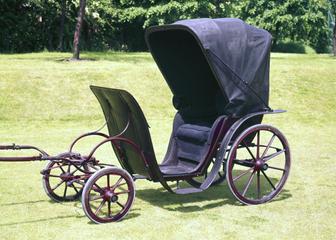
Head for pony bath chair built by Cheverton, Isle of Wight for Queen Victoria in 1893. Pony Bath chair (four wheels) for a single pony. With a single seat, the carriage has an angular cut-under body and convex back panel and still has its original fitted leather apron. The sockets on the waist rails and bolts on back of the body for the leather head have been removed. The 8 and 10 spoke English pattern wheels have rubber tyres and elliptic springs are fitted front and back. The very simple forecarriage is made of iron and attached to the body by two elegant curved stays. Painted in maroon, lined bright red, and with a royal cypher on the side panels. Head for Queen Victoria's pony bath chair
Bath chair (without hood) built by Cheverton, Isle of Wight for Queen Victoria in 1893. Pony Bath chair (four wheels) for a single pony. With a single seat, the carriage has an angular cut-under body and convex back panel and still has its original fitted leather apron. The sockets on the waist rails and bolts on back of the body for the leather head have been removed. The 8 and 10 spoke English pattern wheels have rubber tyres and elliptic springs are fitted front and back. The very simple forecarriage is made of iron and attached to the body by two elegant curved stays. Painted in maroon, lined bright red, and with a royal cypher on the side panels. Queen Victoria's pony bath chair