Norman Heatley 1911 - 2004
Norman Heatley was a British biochemist and a key member of the Oxford team that developed penicillin, the first antibiotic. He is often called the "unsung hero" of the penicillin story because he devised the crucial methods to purify the drug and produce enough for early human trials.
Heatley was born in suffolk, and studied in Cambridge before moving to Oxford University to work on tumour development as an assistant to the scientist Ernst Chain. Heatley was incredibly talented at problem solving biochemical challenges - frequently designing and building scientific apparatus to carry out experimental research.
Heatley was recruited by Howard Florey, who was researching the clinical potential of penicillin. Penicillin was of immeasurable importance in the treatment of World War II casualties. Large-scale production began in time to save the lives of many soldiers wounded in the battles after the D-Day landings in Normandy, France. Yet Penicillium notatum (now chrysogenum) at first seemed an unpromising candidate for drug development. It was unstable, difficult to work with, and thought unsuitable for any medical purpose.
Heatley designed a reliable and sensitive assay for penicillin. Next, he devised a way to separate penicillin from its impurities using organic solvents, and to return it to aqueous solution for easier processing. The technique provided enough material to assess the biological properties of penicillin, especially its efficacy and low toxicity. These factors persuaded the Medical Research Council to make a modest grant toward the production of penicillin for animal trials. In May, 1940, tests were done on eight mice. Heatley's record of the experiment says: “After supper with some friends, I returned to the lab and met the professor to give a final dose of penicillin to two of the mice. The ‘controls’ were looking very sick, but the two treated mice seemed very well. I stayed at the lab until 3.45 am, by which time all four control animals were dead. It really looks as if penicillin may be of practical importance.”
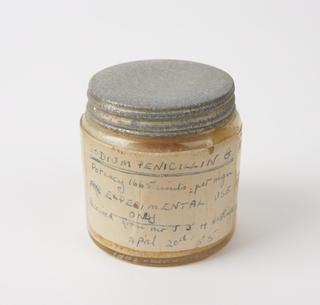
Greater quantities of penicillin were needed for the next step: human trials. Heatley scrounged all kinds of glassware and ceramic containers in which to grow the mould. He discovered that porcelain bedpans were the best production unit; but they were in short supply. So he designed his own version and had 170 made. A year after the mouse trials, sufficient penicillin was harvested for tests in people; the success of these trials was recorded in a paper modestly entitled Further observations on penicillin, published in The Lancet in August, 1941.