
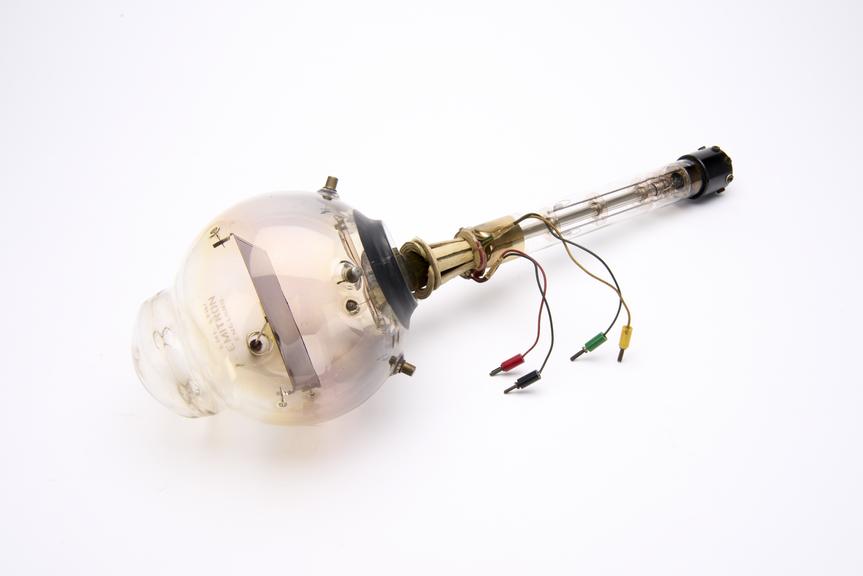
Emitron television camera tube
- maker:
- EMI Electronics Limited
 This image is released under a CC BY-NC-SA 4.0
Licence
This image is released under a CC BY-NC-SA 4.0
Licence
License this image for commercial use at Science and Society Picture Library
License
Science Museum Group
© The Board of Trustees of the Science Museum
Television camera tube, cylindrical. Printed paper label attached to body with sellotape: EMITRON CPS Type No.5954. Serial No. (manuscript) R134 2
The Emitron camera tube was developed as an all-electronic alternative to John Logie Baird's mechanical television apparatus of the 1920s, and is the real ancestor of modern television systems. Electric and Musical Industries Ltd. (EMI) began work on the Emitron in 1932, basing it on experimental work by James McGee and William Tedham. Cameras developed for the BBC by the Marconi-EMI Television Co. Ltd. were used for the start of the world's first regular high-definition television service in 1936. This tube is from an early production run.
Details
- Category:
- Television
- Object Number:
- 1985-5063
- Materials:
- glass, plastic (unidentified) and metal (unknown)
- Measurements:
-
overall: 200 mm x 662 mm x 235 mm, 1.078 kg
- type:
- television camera tube
- credit:
- Bradford University. Dept. of Electrical