Horse Drawn Hearse
- Made:
- 1894 in Leicestershire
- maker:
- Unknown
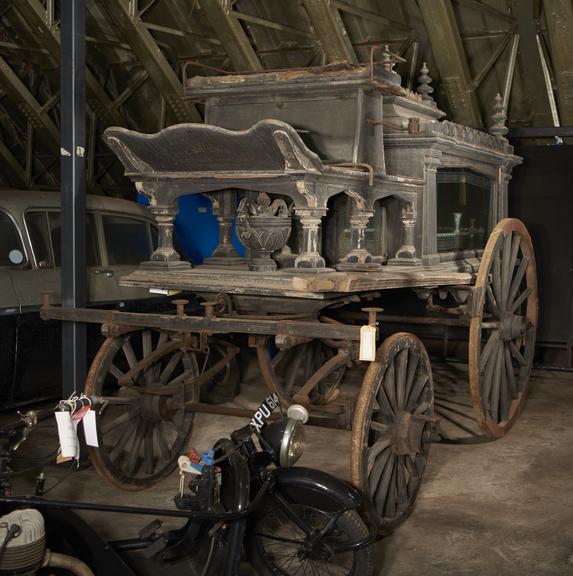
This Horse-drawn hearse was built in 1894. It has two large rear wheels with two smaller front steering wheels which are pulled by either one or two horses. Wooden spoon brakes extend to the rear wheels and are controlled by a hand level on the right-side of the driver’s seat. The driver would sit on a high raised open seat at the front of the carriage, capable of seating two.
The rear of the carriage is taken up by an ornate wood and glass case which would house the coffin of the deceased, which could be accessed by a rear facing door.
The word ‘hearse’ has its origins in the 17th Century; however the horse-drawn hearse or funeral coach became increasingly important in the Victorian era. Cemeteries were more commonly located on the outskirts of towns and they were the most convenient way to transport the coffin. It was also during this time that the funeral coach began to become more elaborate as the size and splendour of a funeral reflected social standing. Horse-drawn hearses are still used in large funerals today, though they began to phase out of general use in the early 1900s. The first motorised hearses were electric with a petrol-powered hearse soon following in 1909.
Details
- Category:
- Road Transport
- Object Number:
- 1979-702
- Materials:
- wood, copper (alloy), textile, glass, iron, leather and horse hair
- Measurements:
-
overall: 2400 mm x 1780 mm x 3330 mm,
- type:
- hearse
- credit:
- Museum of English Rural Life (Reading University)