


 This image is released under a CC BY-NC-SA 4.0
Licence
This image is released under a CC BY-NC-SA 4.0
Licence
License this image for commercial use at Science and Society Picture Library
License
Science Museum Group
© The Board of Trustees of the Science Museum
Science Museum Group
© The Board of Trustees of the Science Museum
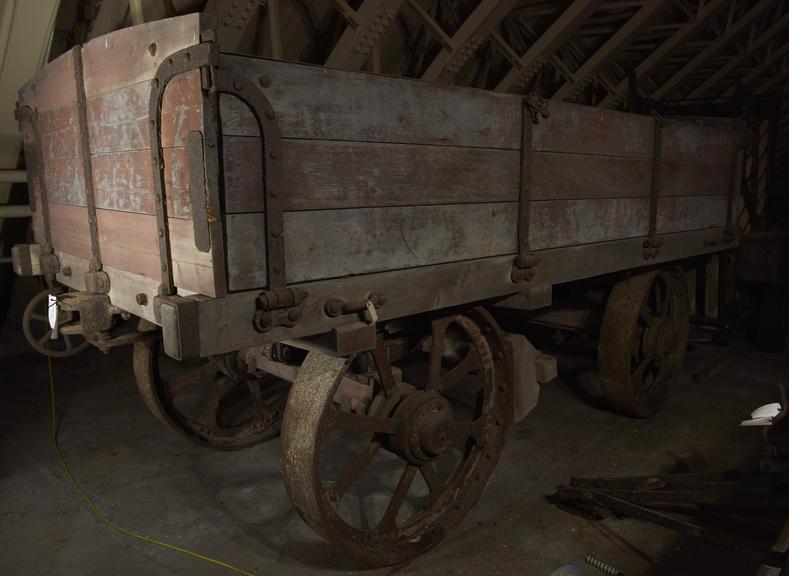
This Fowler traction wagon was built in around 1900 by John Fowler and Company in Leeds, England.
The wagon frame, which has a potential 6-ton capacity, is made of season oak held together with iron tongs, hinges and sockets, with sides and ends made of pitch pine.
The main drawbar is fitted with powerful buff and pull spring arrangements which reduces shock and jarring when the vehicle ascends and descends hills, allowing the engine to start without delay with a full load. The wagon is pulled by horse attached to a slayed jaw dragbar and its wrought iron wheels are put on suspensory springs.
Traction engines are steam-powered vehicles designed to pull bulky or heavy loads such as those produced on farms like grain, fruit, flour, cotton, wool and other high-volume, low-density goods. Traction engines could be used on roads and rails. Accompanying traction engines are traction wagons, built to the same specifications as railway wagons, and designed to be large, robust and with strong suspension.
This example was built by the John Fowler and Company in Leeds, patented and advertised as the ‘Improved Rigid or Spring Mounted Traction Wagons – For up to 10 tons’. As suggested, this model came in five variants of increasing size, being able to carry up to 10 tons.
This model of traction wagon was first advertised from 1892 until around 1902 and came with several innovative features to improve its utility. This includes a slayed jaw dragbar to improve coupling with the traction engine, and an additional triangular dragbar for coupling with trains or other wagons. This model also came with Fowles patented self-acting suspensory springs which reduce accidents when coupling and uncoupling from a train.
This example was Fowler traction wagon was originally owned and operated at the Youngsbury Farm, which continued to use steam engines into the mid-20th century. It was eventually bought and stored and preserved by the Max Wright Limited at Thundridge, Hertfordshire in 1968.
Details
- Category:
- Road Transport
- Object Number:
- 1989-24
- Materials:
- metal (unknown) and wood (unidentified)
- Measurements:
-
overall: 1970 mm x 2020 mm x 4050 mm,
- type:
- wagon
- credit:
- Max Wright Ltd.
Related Objects