The Z37 Cmelak 'Bumble-bee', c 1967.

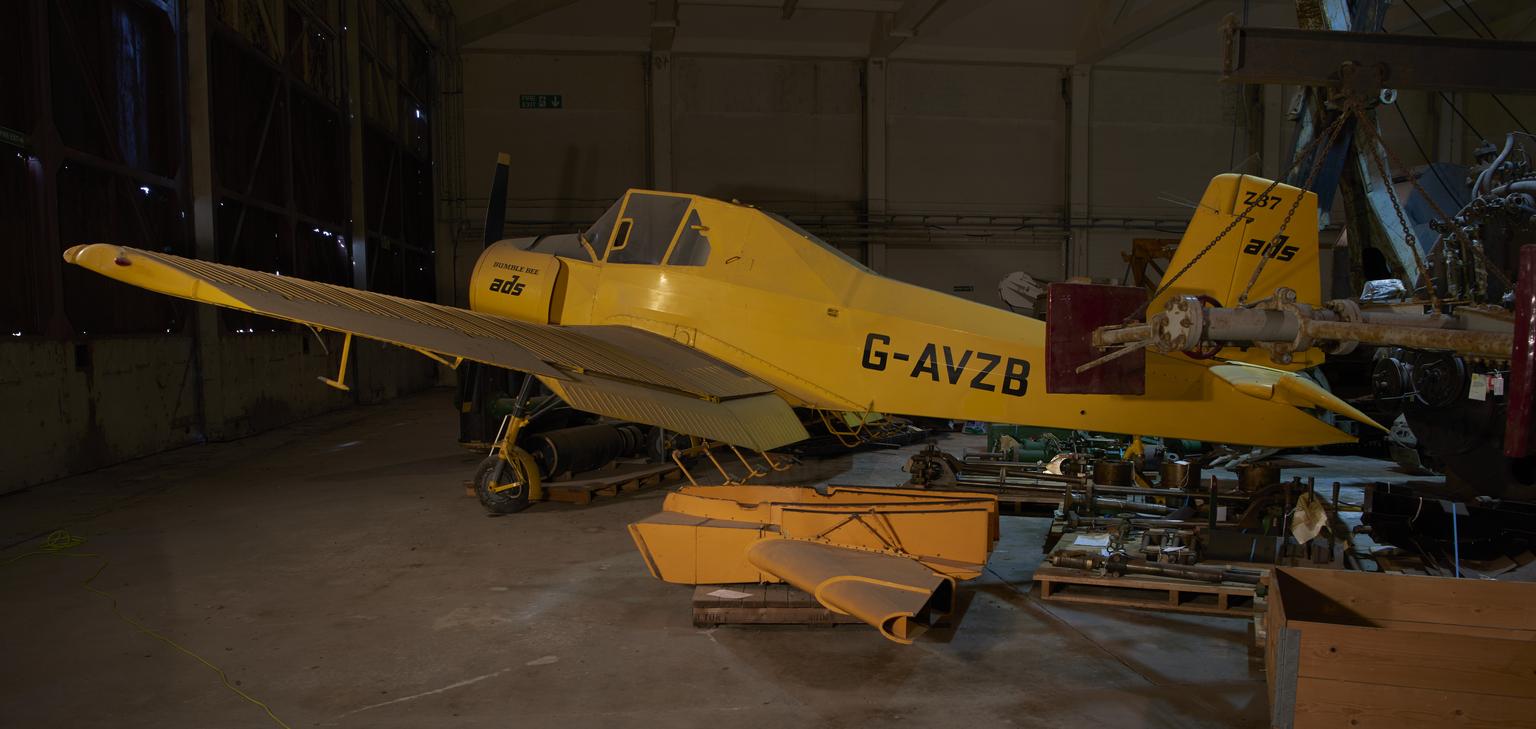
Z.37 Cmelak (Bumble-bee) agricultural aircraft, built by LET narodni podnak, Kunovice, Czechoslovakia, 1967. Serial no. 0408, registration G-AVZB

This Z. 37 Cmelak ‘Bumble-bee’ agricultural aircraft was built in 1967 by the LET company in Kunovice in Czechslovakia (now Czech Republic). It was purchased by the Southend-based A.D.S (Aerial) Limited in 1968 and is has played a key role in the development of aerial crop spraying practices which emerged in the post-war period.

A.D.S (Aerial) Limited was started by Ladislav Marmol, a pilot born in Czechoslovakia, with an exceptional story leading through the Second World War, the iron curtain, to becoming one of the pioneers of post-war agricultural aviation. Ladislav Marmol was born in 1920 and quickly aimed to become an aviator, putting his dream on hold during the annexation and of Czechoslovakia by Nazi Germany in 1938. Escaping a Nazi-German labour camp, he fled to Vichy France and was imprisoned and pressed into the French Foreign Legion heading to North Africa. Escaping a second time he crossed the Pyrenees to Franco’s Spain, and imprisoned. Escaping a third time, Ladislav made it to Gibraltar, and via the Royal Navy, escorted to England where he joined the Czech Air Force (in exile) as a Wellington bomber pilot for the rest of the war.

Post-war, Ladislav attempted to return home, but was quickly arrested in 1948 alongside some of the reporter friends in Prague by the Soviet Union for alleged spying. For a fourth and final time, Ladislav escaped imprisonment into West Germany, and moved long-term to England, having been sentenced in absentia by the Communist Czech Government.

In England Ladislav Marmol became a pioneer of early agricultural aircraft, helping to prototype the E.P.9, the first purely agricultural aeroplane, and took a leading role in the 1957-58 weekly potato praying trials in the Fens and Essex.

Every year since 1955 he has top-dressed and sprayed thousands of acres of farmland in Britain, notably in the Lake District, building a business for himself which grew to include a diverse fleet of 22 aeroplanes, and took international contracts in South America, Canada, Suden, Borneo, Indonesia, East Pakistan, Central Africa, Sumatra and Persia, supporting the growing of cotton, barley, bananas, coffee, rubber, citrus fruit, sorghum and even timber. He later became an aviation consultant for CIBA, the Swiss-based international chemical company, and is not considered one of the grandfathers of crop spraying, and of agricultural aviation.

Ladislav Marmol used this Z. 37 Bumble-bee from 1968 to 1988, notably in the Lake District throughout the 1970s, as one of around 20 agricultural aeroplanes, and was the last example left on the UK register by the end of its service. Ladislav personally flew this plane on its final voyage in June 1988, handing it over to the SMG in Wroughton.

As one of the first plane’s purpose built for crop spraying, the Z. 37 Cmelak was a pioneering design of low-wing monoplane, sporting a Type M 462-RF 315 horsepower single air-cooled radial nine-cylinder supercharged piston engine with a V 520 constant-speed propeller. This model had a max speed of around 200 Km/hr, a max altitude of around 4050 meters, a wind span of 12.2 meters, and a 600 Kg solid/liquid chemical storage capacity.

Details

Category:
Aeronautics
Object Number:
1988-540
type:
aircraft, agricultural aircraft and aeroplanes
credit:
A.D.S. (Aerial) Ltd.

Parts

Two switch buttons for The Z37 Cmelak 'Bumble-bee', c 1967.

Two switch buttons for The Z37 Cmelak 'Bumble-bee', c 1967.

Z.37 Cmelak (Bumble-bee) agricultural aircraft: Two switch buttons on right-hand side.

More

This Z. 37 Cmelak ‘Bumble-bee’ agricultural aircraft was built in 1967 by the LET company in Kunovice in Czechslovakia (now Czech Republic). It was purchased by the Southend-based A.D.S (Aerial) Limited in 1968 and is has played a key role in the development of aerial crop spraying practices which emerged in the post-war period.

A.D.S (Aerial) Limited was started by Ladislav Marmol, a pilot born in Czechoslovakia, with an exceptional story leading through the Second World War, the iron curtain, to becoming one of the pioneers of post-war agricultural aviation. Ladislav Marmol was born in 1920 and quickly aimed to become an aviator, putting his dream on hold during the annexation and of Czechoslovakia by Nazi Germany in 1938. Escaping a Nazi-German labour camp, he fled to Vichy France and was imprisoned and pressed into the French Foreign Legion heading to North Africa. Escaping a second time he crossed the Pyrenees to Franco’s Spain, and imprisoned. Escaping a third time, Ladislav made it to Gibraltar, and via the Royal Navy, escorted to England where he joined the Czech Air Force (in exile) as a Wellington bomber pilot for the rest of the war.

Post-war, Ladislav attempted to return home, but was quickly arrested in 1948 alongside some of the reporter friends in Prague by the Soviet Union for alleged spying. For a fourth and final time, Ladislav escaped imprisonment into West Germany, and moved long-term to England, having been sentenced in absentia by the Communist Czech Government.

In England Ladislav Marmol became a pioneer of early agricultural aircraft, helping to prototype the E.P.9, the first purely agricultural aeroplane, and took a leading role in the 1957-58 weekly potato praying trials in the Fens and Essex.

Every year since 1955 he has top-dressed and sprayed thousands of acres of farmland in Britain, notably in the Lake District, building a business for himself which grew to include a diverse fleet of 22 aeroplanes, and took international contracts in South America, Canada, Suden, Borneo, Indonesia, East Pakistan, Central Africa, Sumatra and Persia, supporting the growing of cotton, barley, bananas, coffee, rubber, citrus fruit, sorghum and even timber. He later became an aviation consultant for CIBA, the Swiss-based international chemical company, and is not considered one of the grandfathers of crop spraying, and of agricultural aviation.

Ladislav Marmol used this Z. 37 Bumble-bee from 1968 to 1988, notably in the Lake District throughout the 1970s, as one of around 20 agricultural aeroplanes, and was the last example left on the UK register by the end of its service. Ladislav personally flew this plane on its final voyage in June 1988, handing it over to the SMG in Wroughton.

As one of the first plane’s purpose built for crop spraying, the Z. 37 Cmelak was a pioneering design of low-wing monoplane, sporting a Type M 462-RF 315 horsepower single air-cooled radial nine-cylinder supercharged piston engine with a V 520 constant-speed propeller. This model had a max speed of around 200 Km/hr, a max altitude of around 4050 meters, a wind span of 12.2 meters, and a 600 Kg solid/liquid chemical storage capacity.

Object Number:
1988-540 Pt1
type:
radioactive material
Artificial horizon for The Z37 Cmelak 'Bumble-bee', c 1967.

Artificial horizon for The Z37 Cmelak 'Bumble-bee', c 1967.

Z.37 Cmelak (Bumble-bee) agricultural aircraft: Artificial horizon.

More

This Z. 37 Cmelak ‘Bumble-bee’ agricultural aircraft was built in 1967 by the LET company in Kunovice in Czechslovakia (now Czech Republic). It was purchased by the Southend-based A.D.S (Aerial) Limited in 1968 and is has played a key role in the development of aerial crop spraying practices which emerged in the post-war period.

A.D.S (Aerial) Limited was started by Ladislav Marmol, a pilot born in Czechoslovakia, with an exceptional story leading through the Second World War, the iron curtain, to becoming one of the pioneers of post-war agricultural aviation. Ladislav Marmol was born in 1920 and quickly aimed to become an aviator, putting his dream on hold during the annexation and of Czechoslovakia by Nazi Germany in 1938. Escaping a Nazi-German labour camp, he fled to Vichy France and was imprisoned and pressed into the French Foreign Legion heading to North Africa. Escaping a second time he crossed the Pyrenees to Franco’s Spain, and imprisoned. Escaping a third time, Ladislav made it to Gibraltar, and via the Royal Navy, escorted to England where he joined the Czech Air Force (in exile) as a Wellington bomber pilot for the rest of the war.

Post-war, Ladislav attempted to return home, but was quickly arrested in 1948 alongside some of the reporter friends in Prague by the Soviet Union for alleged spying. For a fourth and final time, Ladislav escaped imprisonment into West Germany, and moved long-term to England, having been sentenced in absentia by the Communist Czech Government.

In England Ladislav Marmol became a pioneer of early agricultural aircraft, helping to prototype the E.P.9, the first purely agricultural aeroplane, and took a leading role in the 1957-58 weekly potato praying trials in the Fens and Essex.

Every year since 1955 he has top-dressed and sprayed thousands of acres of farmland in Britain, notably in the Lake District, building a business for himself which grew to include a diverse fleet of 22 aeroplanes, and took international contracts in South America, Canada, Suden, Borneo, Indonesia, East Pakistan, Central Africa, Sumatra and Persia, supporting the growing of cotton, barley, bananas, coffee, rubber, citrus fruit, sorghum and even timber. He later became an aviation consultant for CIBA, the Swiss-based international chemical company, and is not considered one of the grandfathers of crop spraying, and of agricultural aviation.

Ladislav Marmol used this Z. 37 Bumble-bee from 1968 to 1988, notably in the Lake District throughout the 1970s, as one of around 20 agricultural aeroplanes, and was the last example left on the UK register by the end of its service. Ladislav personally flew this plane on its final voyage in June 1988, handing it over to the SMG in Wroughton.

As one of the first plane’s purpose built for crop spraying, the Z. 37 Cmelak was a pioneering design of low-wing monoplane, sporting a Type M 462-RF 315 horsepower single air-cooled radial nine-cylinder supercharged piston engine with a V 520 constant-speed propeller. This model had a max speed of around 200 Km/hr, a max altitude of around 4050 meters, a wind span of 12.2 meters, and a 600 Kg solid/liquid chemical storage capacity.

Object Number:
1988-540 Pt2
type:
radioactive material
Z37 Cmelak 'Bumble-bee' Agricultural Aircraft

Z37 Cmelak 'Bumble-bee' Agricultural Aircraft

Z.37 Cmelak (Bumble-bee) agricultural aircraft, built by LET narodni podnak, Kunovice, Czechoslovakia, 1967. Serial no. 0408, registration G-AVZB

More

This Z. 37 Cmelak ‘Bumble-bee’ agricultural aircraft was built in 1967 by the LET company in Kunovice in Czechslovakia (now Czech Republic). It was purchased by the Southend-based A.D.S (Aerial) Limited in 1968 and is has played a key role in the development of aerial crop spraying practices which emerged in the post-war period.

A.D.S (Aerial) Limited was started by Ladislav Marmol, a pilot born in Czechoslovakia, with an exceptional story leading through the Second World War, the iron curtain, to becoming one of the pioneers of post-war agricultural aviation. Ladislav Marmol was born in 1920 and quickly aimed to become an aviator, putting his dream on hold during the annexation and of Czechoslovakia by Nazi Germany in 1938. Escaping a Nazi-German labour camp, he fled to Vichy France and was imprisoned and pressed into the French Foreign Legion heading to North Africa. Escaping a second time he crossed the Pyrenees to Franco’s Spain, and imprisoned. Escaping a third time, Ladislav made it to Gibraltar, and via the Royal Navy, escorted to England where he joined the Czech Air Force (in exile) as a Wellington bomber pilot for the rest of the war.

Post-war, Ladislav attempted to return home, but was quickly arrested in 1948 alongside some of the reporter friends in Prague by the Soviet Union for alleged spying. For a fourth and final time, Ladislav escaped imprisonment into West Germany, and moved long-term to England, having been sentenced in absentia by the Communist Czech Government.

In England Ladislav Marmol became a pioneer of early agricultural aircraft, helping to prototype the E.P.9, the first purely agricultural aeroplane, and took a leading role in the 1957-58 weekly potato praying trials in the Fens and Essex.

Every year since 1955 he has top-dressed and sprayed thousands of acres of farmland in Britain, notably in the Lake District, building a business for himself which grew to include a diverse fleet of 22 aeroplanes, and took international contracts in South America, Canada, Suden, Borneo, Indonesia, East Pakistan, Central Africa, Sumatra and Persia, supporting the growing of cotton, barley, bananas, coffee, rubber, citrus fruit, sorghum and even timber. He later became an aviation consultant for CIBA, the Swiss-based international chemical company, and is not considered one of the grandfathers of crop spraying, and of agricultural aviation.

Ladislav Marmol used this Z. 37 Bumble-bee from 1968 to 1988, notably in the Lake District throughout the 1970s, as one of around 20 agricultural aeroplanes, and was the last example left on the UK register by the end of its service. Ladislav personally flew this plane on its final voyage in June 1988, handing it over to the SMG in Wroughton.

As one of the first plane’s purpose built for crop spraying, the Z. 37 Cmelak was a pioneering design of low-wing monoplane, sporting a Type M 462-RF 315 horsepower single air-cooled radial nine-cylinder supercharged piston engine with a V 520 constant-speed propeller. This model had a max speed of around 200 Km/hr, a max altitude of around 4050 meters, a wind span of 12.2 meters, and a 600 Kg solid/liquid chemical storage capacity.

Measurements:
overall: 3350 mm x 12610 mm x 8830 mm,
Object Number:
1988-540 Pt3
type:
aircraft , agricultural aircraft and aeroplanes
Image ©
The Board of Trustees of the Science Museum
Door key for The Z37 Cmelak 'Bumble-bee', c 1967.

Door key for The Z37 Cmelak 'Bumble-bee', c 1967.

Door key for The Z37 Cmelak 'Bumble-bee', c 1967.

More

This Z. 37 Cmelak ‘Bumble-bee’ agricultural aircraft was built in 1967 by the LET company in Kunovice in Czechslovakia (now Czech Republic). It was purchased by the Southend-based A.D.S (Aerial) Limited in 1968 and is has played a key role in the development of aerial crop spraying practices which emerged in the post-war period.

A.D.S (Aerial) Limited was started by Ladislav Marmol, a pilot born in Czechoslovakia, with an exceptional story leading through the Second World War, the iron curtain, to becoming one of the pioneers of post-war agricultural aviation. Ladislav Marmol was born in 1920 and quickly aimed to become an aviator, putting his dream on hold during the annexation and of Czechoslovakia by Nazi Germany in 1938. Escaping a Nazi-German labour camp, he fled to Vichy France and was imprisoned and pressed into the French Foreign Legion heading to North Africa. Escaping a second time he crossed the Pyrenees to Franco’s Spain, and imprisoned. Escaping a third time, Ladislav made it to Gibraltar, and via the Royal Navy, escorted to England where he joined the Czech Air Force (in exile) as a Wellington bomber pilot for the rest of the war.

Post-war, Ladislav attempted to return home, but was quickly arrested in 1948 alongside some of the reporter friends in Prague by the Soviet Union for alleged spying. For a fourth and final time, Ladislav escaped imprisonment into West Germany, and moved long-term to England, having been sentenced in absentia by the Communist Czech Government.

In England Ladislav Marmol became a pioneer of early agricultural aircraft, helping to prototype the E.P.9, the first purely agricultural aeroplane, and took a leading role in the 1957-58 weekly potato praying trials in the Fens and Essex.

Every year since 1955 he has top-dressed and sprayed thousands of acres of farmland in Britain, notably in the Lake District, building a business for himself which grew to include a diverse fleet of 22 aeroplanes, and took international contracts in South America, Canada, Suden, Borneo, Indonesia, East Pakistan, Central Africa, Sumatra and Persia, supporting the growing of cotton, barley, bananas, coffee, rubber, citrus fruit, sorghum and even timber. He later became an aviation consultant for CIBA, the Swiss-based international chemical company, and is not considered one of the grandfathers of crop spraying, and of agricultural aviation.

Ladislav Marmol used this Z. 37 Bumble-bee from 1968 to 1988, notably in the Lake District throughout the 1970s, as one of around 20 agricultural aeroplanes, and was the last example left on the UK register by the end of its service. Ladislav personally flew this plane on its final voyage in June 1988, handing it over to the SMG in Wroughton.

As one of the first plane’s purpose built for crop spraying, the Z. 37 Cmelak was a pioneering design of low-wing monoplane, sporting a Type M 462-RF 315 horsepower single air-cooled radial nine-cylinder supercharged piston engine with a V 520 constant-speed propeller. This model had a max speed of around 200 Km/hr, a max altitude of around 4050 meters, a wind span of 12.2 meters, and a 600 Kg solid/liquid chemical storage capacity.

Object Number:
1988-540/4
type:
key -hardware