
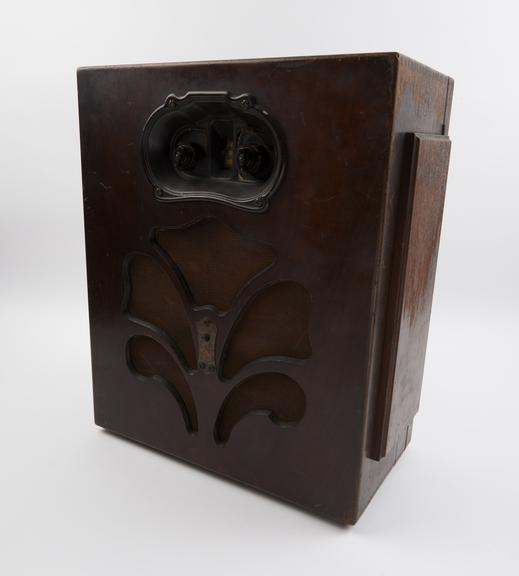
Marconiphone six-valve super-heterodyne portable broadcast radio receiver model 255
- Made:
- 1932 in Chelmsford
- maker:
- Marconiphone
 This image is released under a CC BY-NC-SA 4.0
Licence
This image is released under a CC BY-NC-SA 4.0
Licence
License this image for commercial use at Science and Society Picture Library
License
Science Museum Group
© The Board of Trustees of the Science Museum
Marconiphone six-valve super-heterodyne portable broadcast radio receiver model 255, 1932.
Described in November 1932 by the Marconiphone Company as "the finest portable [radio receiver] in the world", the Marconiphone Model 255 combined the range and selectivity of the largest all-electric console instruments with the compact convenience of an ordinary portable. The Model 255 features included: a six-valve super-heterodyne circuit; extreme sensitivity and selectivity and the highest quality reproduction with a balanced armature-type speaker. It was also low power (then described as very small H.T. and L.T. consumption) and had provision for accessories including a pick-up, extra speakers, and an aerial and earth. It featured a no-grid-bias battery and was very user friendly and simple to use and was calibrated in wavelengths. Last and not least, it was aesthetically pleasing, with the walnut cabinet being “dignified” and in the “modern style” of the early 1930s.
Details
- Category:
- Radio Communication
- Object Number:
- 1970-529
- Materials:
- wood (unidentified) and metal (unknown)
- Measurements:
-
overall: 460 mm x 375 mm x 205 mm,
- type:
- receiver
- credit:
- Wheatcroft, E.
Related Objects