

 This image is released under a CC BY-NC-SA 4.0
Licence
This image is released under a CC BY-NC-SA 4.0
Licence
License this image for commercial use at Science and Society Picture Library
LicenseThis image is released under a CC BY-NC-SA 4.0
Licence
License this image for commercial use at Science and Society Picture Library
LicenseThis image is released under a CC BY-NC-SA 4.0
Licence
License this image for commercial use at Science and Society Picture Library
License
Science Museum Group
© The Board of Trustees of the Science Museum
Science Museum Group
© The Board of Trustees of the Science Museum
Science Museum Group
© The Board of Trustees of the Science Museum
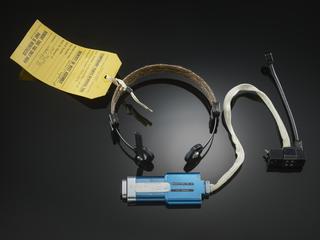
Apollo hand-held UHF survival radio, 1970.
This type of radio was part of the Apollo survival kit kept in the Command Module. It could be used if the astronauts returned to Earth off-course, landing in a remote region, or if there was a delay in their rescue and recovery. They could use this radio as a 'beacon' or for two-way communication with their rescuers. It operated at 243 MHz and was water-tight. It could operate as a beacon for up to 24 hours. It is equipped with an extendable antenna, a second battery pack, and a spacecraft connector cable. Since all Apollo missions landed mostly on-course in the Pacific Ocean, the survival radio was never needed.
Details
- Category:
- Space Technology
- Object Number:
- 1986-59
- Materials:
- metal (unknown), aluminium (metal), glass, plastic (unidentified), textile, synthetic fibre, elastic and electrical components
- Measurements:
-
overall: 200 mm x 108 mm x 60 mm, , .96kg
- type:
- radio receiver
- rights:
- National Air and Space Museum, Smithsonian Institution
- credit:
- Lent by the Smithsonian National Air and Space Museum, Washington, DC
Related Objects
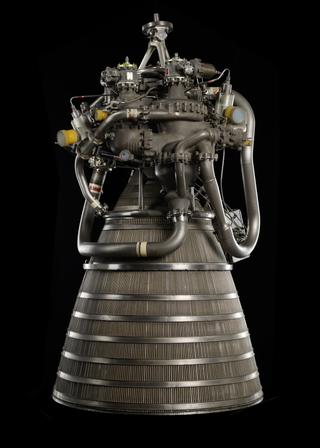
RL10 engine
Recovery Antenna for Soyuz TMA-19M descent module

Moon rock
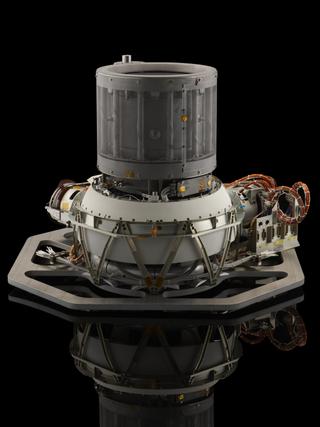
Solar-electric thruster with pointing mechanism