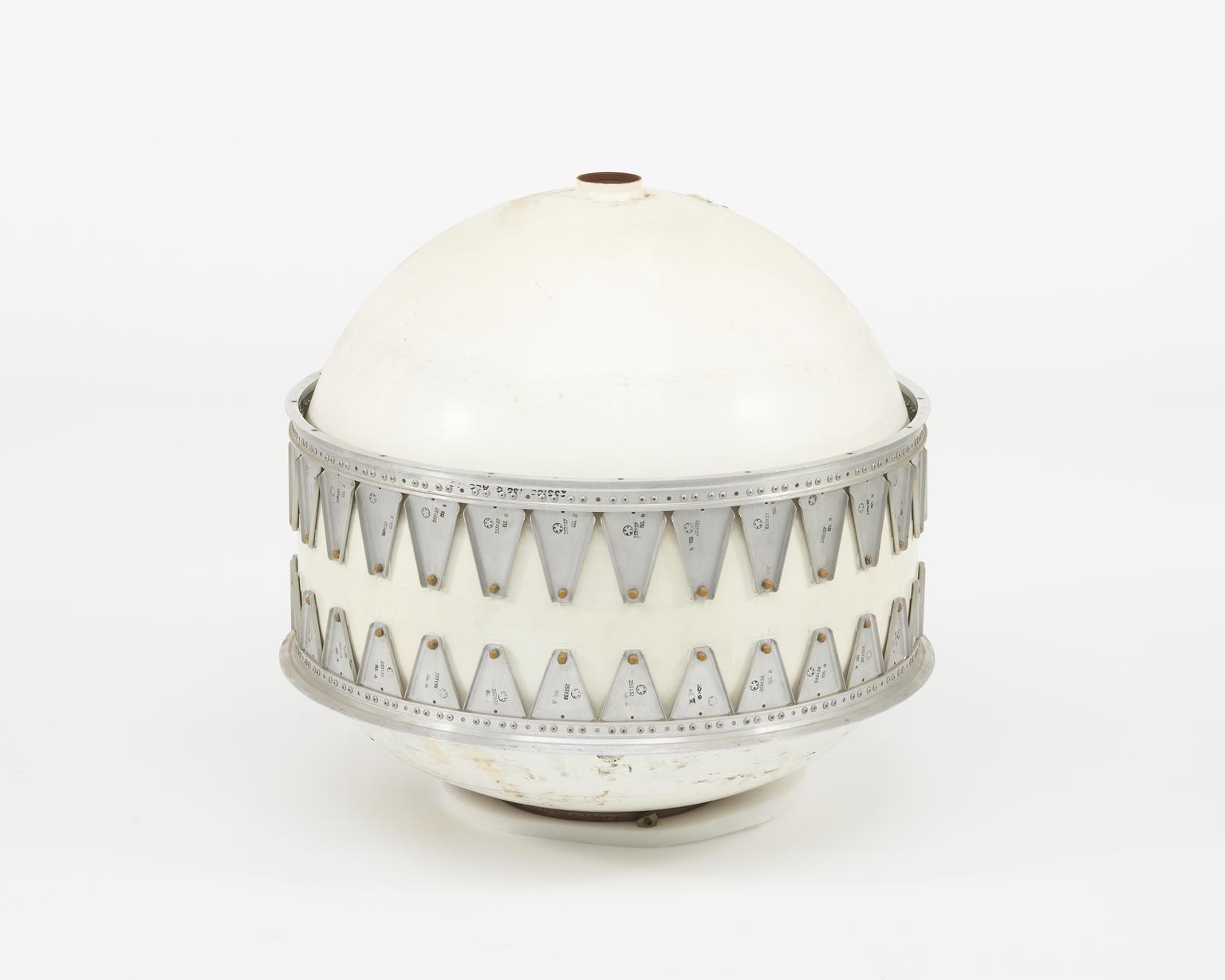
Full size Black Arrow rocket third stage booster
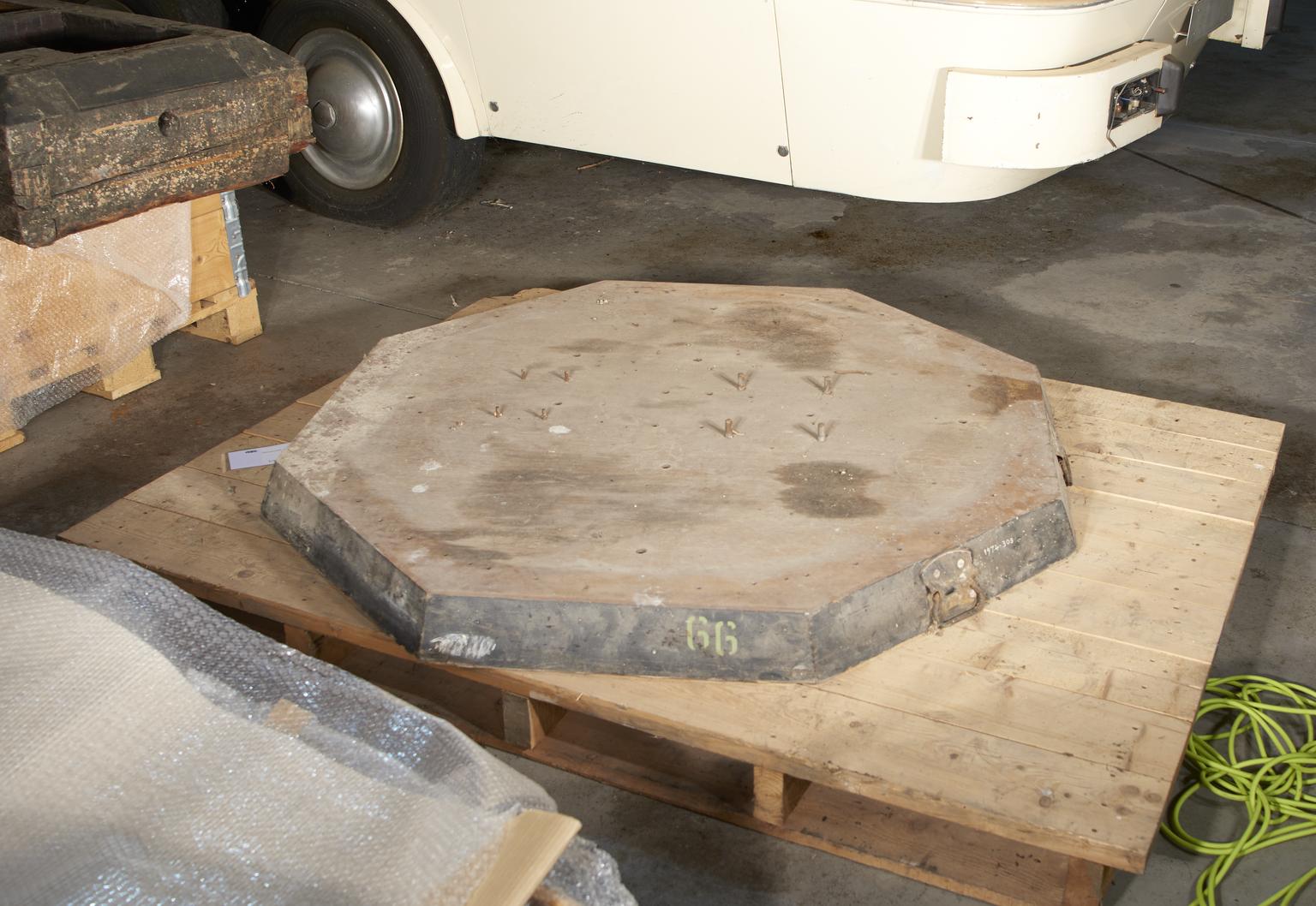
Full size Black Arrow rocket third stage booster, code named 'Waxwing', plus satellite turntable
More
The Waxwing rocket motor, named after the bird of the same name, was the first of its kind in British rocketry. its near-spherical form enabled the smallest amount of steel casing to be used for a given amount of solid propellant. Its nozzle was also gently arced in a near 'Rau' design, not previously used in Britain, to improve its performance.
The Black Arrow R3 rocket's third stage comprised a Waxwing, a turntable and the X3 (Prospero) satellite. Small Imp rocket motors set the turntable and satellite spinning at 3 revolutions per minute. This would help stabilize the satellite in space. Shortly after separation from the second stage of Black Arrow the Waxwing ignited and burned for just under one minute. This boosted the third stage to a velocity of a little under 8 km/s at an altitude of almost 620 km. When spent the Waxwing and turntable were separated from the satellite which, now in orbit, was re-named Prospero after the magician in William Shakespeare's play The Tempest.
R4 was the final Black Arrow rocket to have been built. It was never launched as the programme had been cancelled with its intended satellite payload - Miranda - orbited instead by a United States Scout rocket in 1974. The Black Arrow programme launched four times, twice succesfully including that which orbited the Prospero satellite in 1971, making the UK the sixth nation to launch its own spacecraft. The Black Arrow programme had been initiated to test new satellite technologies in space itself rather than in the laboratory. This would support UK industry in bidding for satellite contracts to be launched by the intended Europa rocket of the European Launcher Development Organisation. The Black Arrow programme never received the level of funding required to ensure swift development. By the time it was launching successfully UK government priorities had shifted in favour of purchasing launches on other nations' rockets. The UK became the only country to have developed and then abandoned a successful satellite-launching rocket.