
Safety lamp

Safety lamp, Mueseler no

Creative Commons LicenseThis image is released under a CC BY-NC-SA 4.0 Licence

License this image for commercial use at Science and Society Picture Library

License

Safety lamp, Mueseler no
Science Museum Group Collection
© The Board of Trustees of the Science Museum

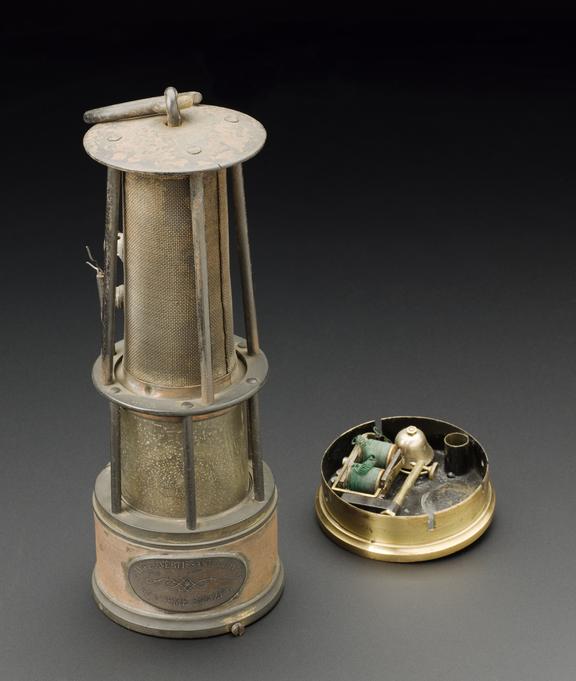
Safety lamp, Mueseler no.33, Somzee's gas detecting device, use: gas detecting, from the Royal Commission on Accidents in Mines 1879-86, marking: Lampe Avertissante du Grisou systeme Somzee, 1853, Base containing bell arrangement (see 2 stroke numbers).

Presented by The Royal Commission on Accidents in Mines.

This is of the Belgian standard pattern, but provided with additions brought out in 1883 by Mons. L. Somzée for fire triers ' use, consisting of a compound helix of steel and zinc soldered together placed in the space between the gauze and the chimney. When heated to the temperature given by the combustion of a predetermined percentage of gas, the expansion of the helix causes contact with a terminal, closing a circuit comprising a small wet cell and electric bell below the reservoir. A screw lock is fitted. In practice the lamp was found to be too easily deranged.

Details

Category:
Mining & Ore Dressing
Object Number:
1886-207
Measurements:
Weight, 3 lb.
type:
safety lamps
credit:
Geological Museum (Jermyn St.)

Parts

Safety lamp, Mueseler no.33, Somzee's gas detecting device, use: gas detecting, from the Royal Commission on Accidents in Mines 1879-86, marking: Lampe Avertissante du Grisou systeme Somzee, 1853

Safety lamp

Safety lamp, Mueseler no.33, Somzee's gas detecting device, use: gas detecting, from the Royal Commission on Accidents in Mines 1879-86, marking: Lampe Avertissante du Grisou systeme Somzee, 1853

More

Presented by The Royal Commission on Accidents in Mines.

This is of the Belgian standard pattern, but provided with additions brought out in 1883 by Mons. L. Somzée for fire triers ' use, consisting of a compound helix of steel and zinc soldered together placed in the space between the gauze and the chimney. When heated to the temperature given by the combustion of a predetermined percentage of gas, the expansion of the helix causes contact with a terminal, closing a circuit comprising a small wet cell and electric bell below the reservoir. A screw lock is fitted. In practice the lamp was found to be too easily deranged.

Object Number:
1886-207/1
type:
safety lamps
Base containing bell arrangement for gas detecting, with Safety lamp 1886-207/1

Base containing bell arrangement for gas detecting

Base containing bell arrangement for gas detecting, with Safety lamp 1886-207/1

More

Presented by The Royal Commission on Accidents in Mines.

This is of the Belgian standard pattern, but provided with additions brought out in 1883 by Mons. L. Somzée for fire triers ' use, consisting of a compound helix of steel and zinc soldered together placed in the space between the gauze and the chimney. When heated to the temperature given by the combustion of a predetermined percentage of gas, the expansion of the helix causes contact with a terminal, closing a circuit comprising a small wet cell and electric bell below the reservoir. A screw lock is fitted. In practice the lamp was found to be too easily deranged.

Object Number:
1886-207/2
type:
base