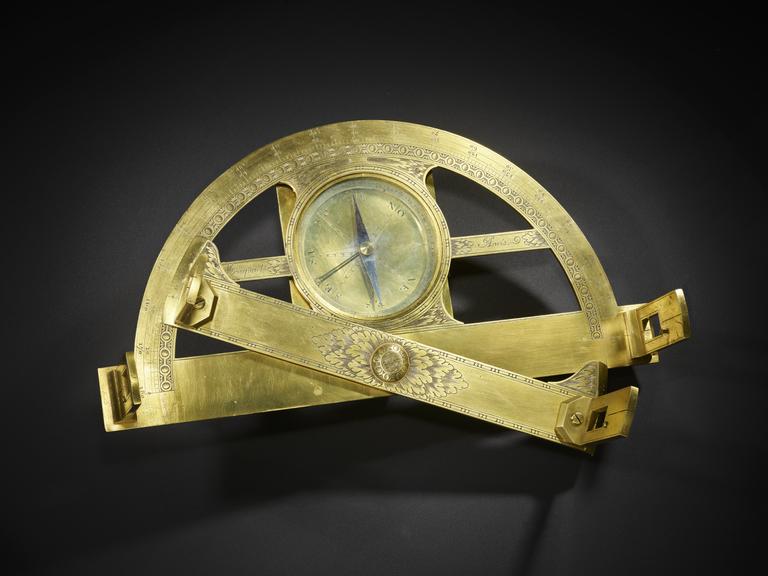
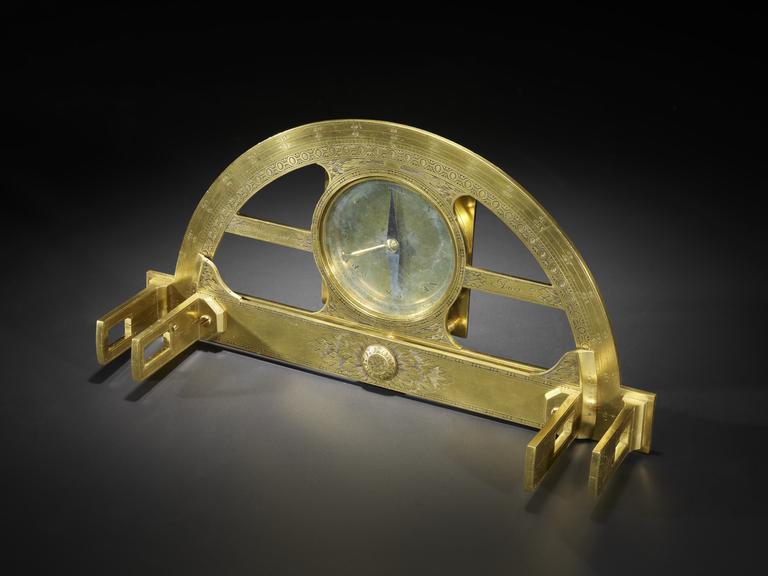
Graphometer with magnetic compass, by Henry Macquart, French, 1710-1720
- maker:
- Henry Macquart






 This image is released under a CC BY-NC-SA 4.0
Licence
This image is released under a CC BY-NC-SA 4.0
Licence
License this image for commercial use at Science and Society Picture Library
LicenseThis image is released under a CC BY-NC-SA 4.0
Licence
License this image for commercial use at Science and Society Picture Library
LicenseThis image is released under a CC BY-NC-SA 4.0
Licence
License this image for commercial use at Science and Society Picture Library
LicenseThis image is released under a CC BY-NC-SA 4.0
Licence
License this image for commercial use at Science and Society Picture Library
LicenseThis image is released under a CC BY-NC-SA 4.0
Licence
License this image for commercial use at Science and Society Picture Library
LicenseThis image is released under a CC BY-NC-SA 4.0
Licence
License this image for commercial use at Science and Society Picture Library
LicenseThis image is released under a CC BY-NC-SA 4.0
Licence
License this image for commercial use at Science and Society Picture Library
LicenseThis image is released under a CC BY-NC-SA 4.0
Licence
License this image for commercial use at Science and Society Picture Library
LicenseThis image is released under a CC BY-NC-SA 4.0
Licence
License this image for commercial use at Science and Society Picture Library
LicenseThis image is released under a CC BY-NC-SA 4.0
Licence
License this image for commercial use at Science and Society Picture Library
LicenseThis image is released under a CC BY-NC-SA 4.0
Licence
License this image for commercial use at Science and Society Picture Library
License
Science Museum Group
© The Board of Trustees of the Science Museum
Science Museum Group
© The Board of Trustees of the Science Museum
Science Museum Group
© The Board of Trustees of the Science Museum
Science Museum Group
© The Board of Trustees of the Science Museum
Science Museum Group
© The Board of Trustees of the Science Museum
Science Museum Group
© The Board of Trustees of the Science Museum
Science Museum Group
© The Board of Trustees of the Science Museum
Science Museum Group
© The Board of Trustees of the Science Museum
Science Museum Group
© The Board of Trustees of the Science Museum
Science Museum Group
© The Board of Trustees of the Science Museum
Science Museum Group
© The Board of Trustees of the Science Museum
Brass graphometer made by Henry Macquart, Paris, 1710-20. Comprising a semicircular arc with pivoting limb (alidade) and magnetic compass.
The semicircle features a sight vane at either end of its straight edge. Its arc is engraved with two scales, graduated by degrees and numbered in intervals of ten, the outer reading from 180 to 0 degrees and the inner reading the same but in reverse.
The alidade rotates about the centre of the semicircle’s straight edge. It is equipped with another pair of sights and is also engraved at either end with a vernier scale.
The compass is protected by a glass cover and mounted in the centre of the graphometer from behind. It is engraved with an eight-point compass rose, with North indicated by an arrowhead and the remaining seven bearings by their initials in French. The encircling compass ring is graduated in four quadrants every 2 and 5 degrees and numbered every 10, giving four arcs of 90 (i.e. 360 degrees in total).
A crossbar either side of the compass is engraved with the signature ‘Macquart [/] A Paris’, i.e. ‘Macquart [/] in Paris’. The crossbar, semicircle, alidade, and compass surround are also engraved with decorative details including foliage.
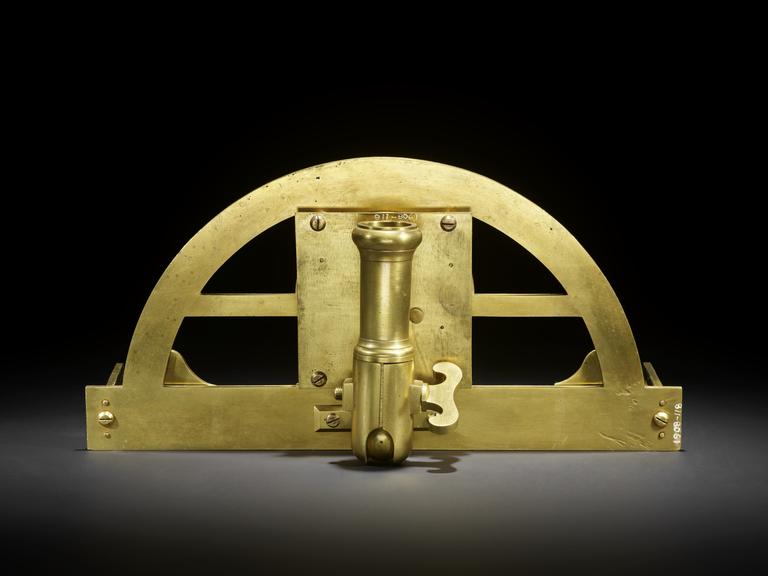
The reverse of the graphometer is plain and mounted with a ball-and-socket joint whose position can be adjusted by loosening and tightening a clamping screw.
Graphometers are surveying instruments also known as semicircumferentors or semicircles. They were invented by the French mathematical instrument-maker, Philippe Danfrie. He first described them in his 1597 publication, ‘Déclaration de l’usage du graphomètre’ (‘Description of the Use of the Graphometer’).
The graphometer was the preferred tool of French surveyors. It was typically attached to a staff or tripod via a ball-and-socket joint, and set at a horizontal, vertical, or inclined plane as needed in the field. A surveyor would position the instrument’s pivoting limb (alidade) along the semicircular arc to measure angles between two points or landmarks, using the sight vanes to ensure precise alignment. Many graphometers, including this example, also feature a compass for orientation.
This graphometer was made by Henry Macquart, who was taught by the instrument-maker Pierre Sevin. Maquart worked in Paris, often in collaboration with his son-in-law Michel Cadot. A practical but richly decorated object, this graphometer’s design illustrates a marriage of functionality and form often seen in instruments made in this period.
Details
- Category:
- Surveying
- Object Number:
- 1908-118
- Measurements:
-
overall: 149 mm x 304 mm x 135 mm, 1.76 kg
overall (alidade): 244 mm
- type:
- graphometer
- credit:
- Middleton, E.C.
Related Objects
Durafilm copy of a map prepared by the Thompson-Watts plotter
Photograph : "Antarctic" altazimuth theodolite by T. Cooke and Sons