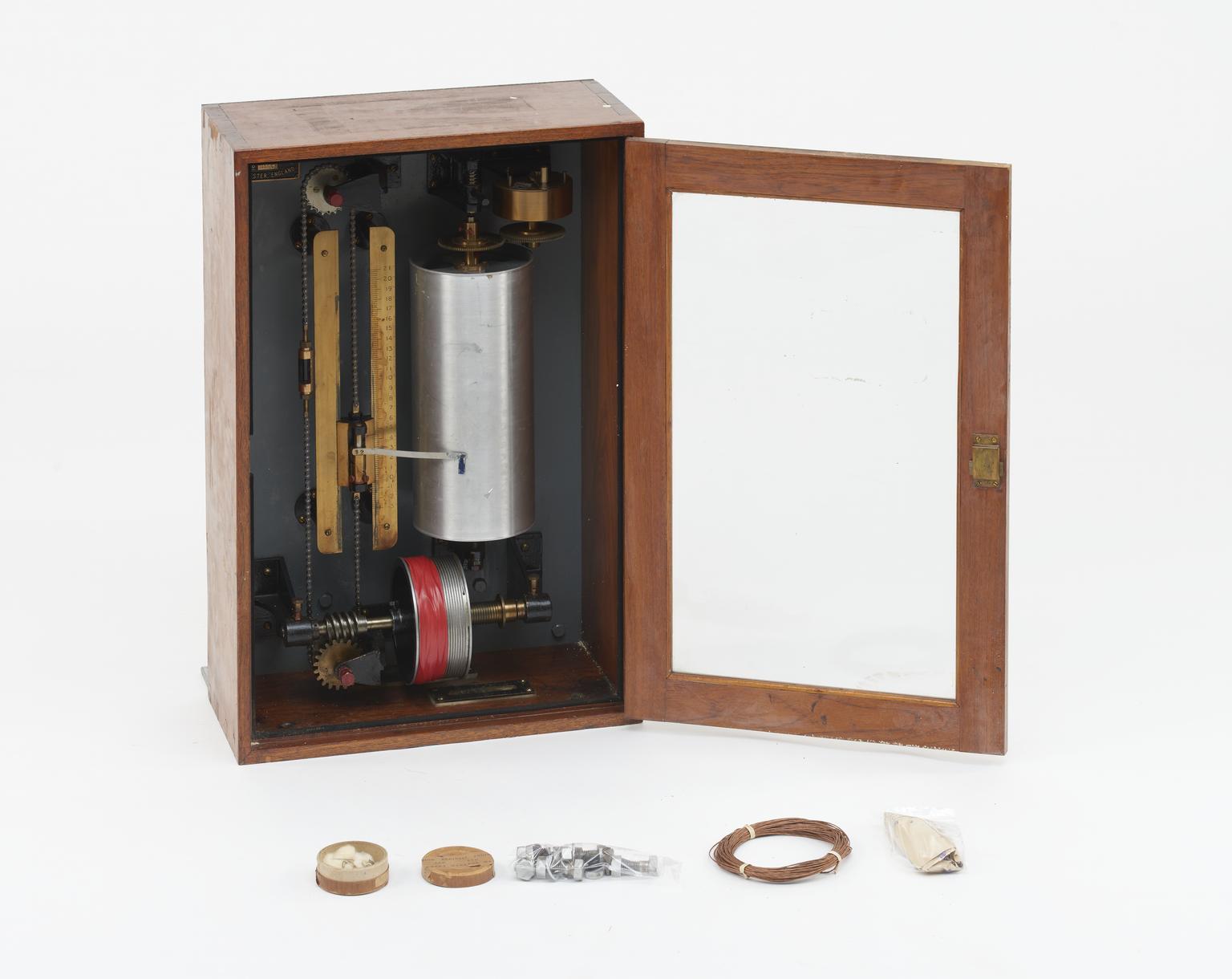
Tide Gauge by Lea Recorder Co. Ltd. of Manchester
This tide gauge was built in 1957 by Lea Recording Company Limited which was based in Manchester.
The gauge is stored securely in its original box, which is approximately 80cm wide, 40cm long and 20cm tall. The box has a glass front cover, through which the various components of the gauge can be viewed. The cylindrical recording drum is approximately 20-30cm long and 20cm in diameter and is currently has not paper chart attached. The complex weight and counterbalance wire system is also on display, which allows the pen to move in relation to the bobbing of the gauges float.
More
As the name suggests, a tide gauge (sometimes called a mareograph or limnimeter) measures the change in sea level relative to a set elevation (usually a point on land). These devices can also be used to measure bodies of freshwater such as inland seas.
Whilst various designs and types of tide gauges have been used throughout history (primarily in the form of a simple measuring pole), mechanical self-recording tide gauges were not developed until the 1830s.
This type of tide gauge, built by Lea Recorder Company Ltd, uses a float design. The gauge works by lowering a cylindrical tube called a ‘stilling well’ into the sea, within which there is a float. As sea water enters the cylindrical tube, the float will rise and indicate the current sea level.
The results are recorded using a pen which is attached to a movable wire connected to the float. As the float moves up and down on the surface of the sea, the pen will move along the wire, marking a paper recording drum which slowly rotates, creating a recording line reflecting the changing sea level over a set period.
The reliability and relative simplicity of the float gauge design resulted in them being very commonly used instruments throughout the 20th century and have become important devices in the Global Sea Observing System (GLOSS). They continue to be used today, though modern float gauges now record their results digitally rather than on paper charts.
- Measurements:
-
overall: 765 mm x 510 mm x 315 mm,
- Materials:
- wood (unidentified) , brass (copper, zinc alloy) and metal (unknown)
- Object Number:
- 1989-525 Pt1
- type:
- instrument component and tide gauge
- Image ©
- The Board of Trustees of the Science Museum