Richard Arkwright
- artist:
- Joseph Wright of
 This image is released under a CC BY-NC-SA 4.0
Licence
This image is released under a CC BY-NC-SA 4.0
Licence
License this image for commercial use at Science and Society Picture Library
License
Science Museum Group Collection
© The Board of Trustees of the Science Museum
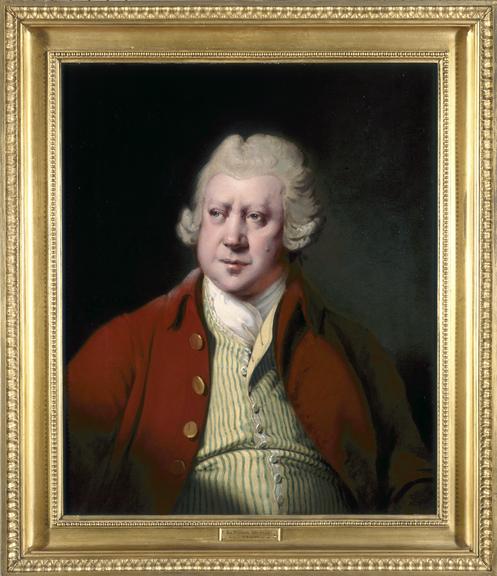
Portrait of Sir Richard Arkwright (1732-1792), by Joseph Wright of Derby (1734-1797), 1790. Oil on canvas; 76.5x64.2cm in gilt frame 80.5x93.5x6.5cm.
When Joseph Wright of Derby painted Sir Richard Arkwright in 1790, Arkwright was in his late 50s, and an immensely successful industrialist and self-made man.
Born in 1732 into a relatively modest Lancashire family, Arkwright began as a barber and wigmaker (1986-256) before turning to the cotton industry. He drew on the inventions of predecessors to develop water-powered machines for spinning cotton yarn (1860-4 and 1860-5) mechanically rather than by hand on a spinning wheel. However, it was his entrepreneurial flair for bringing together the different stages of cotton manufacture onto one site – in the cotton mill or factory – which transformed the cotton industry in Britain during the eighteenth century. Arkwright opened several factories in the 1770s and 1780s, which used cotton supplied by the slave trade, to mechanise the production of cotton.
Wright was a painter with a keen interest in scientific and industrial subjects who also painted the Midlands elite. By 1790, he had already painted Arkwright (c. 1783-85 National Portrait Gallery, London, and the Harris Museum & Art Gallery, Preston, NPG 6848), as well as members of his family, and his cotton mills. This half-length portrait was completed for Jedediah Strutt, one of Arkwright’s fellow industrialists and a business partner, after a full-length portrait Wright painted for Arkwright’s son in 1789-90 (Derby Museum and Art Gallery, L1993-449/1).
In this portrait, Wright painted the industrialist candidly, depicting Arkwright with heavy features and a shrewd gaze, and dressed in suitably rich textiles: a smart red coat with brass buttons contrasting with a striped cream and green waistcoat, creasing over his paunch. Despite a seemingly unflattering portrayal, Wright wrote that Arkwright was pleased with the painting.