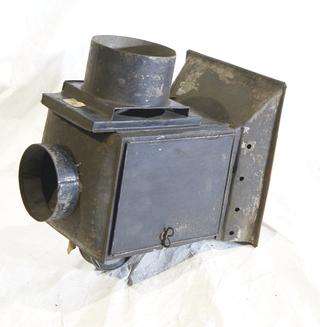
Sept cine camera case
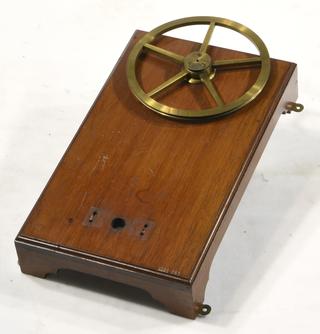
Sept cine camera case, lined. Andre Debrie.
- Object Number:
- 1990-5036/3167/1
- type:
- camera case


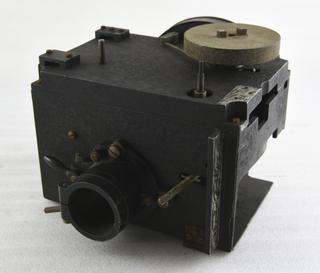
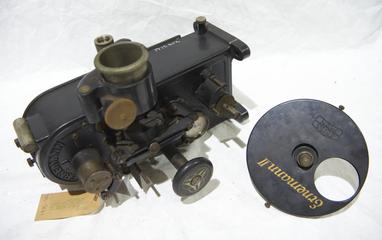
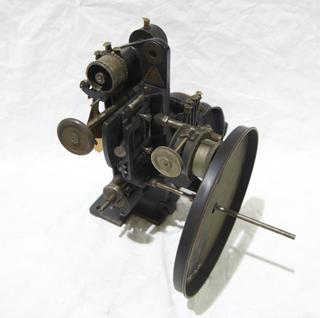
Debrie Sept cine camera for 35mm film in 10' loading chargers. Made by Etablissements Andre Debrie, 1921. Fitted with a Paris 'Huet' lens F: 5cm f/ 3.5-32, Serial No 1825, Detachable clockwork motor, rounded case, 'normal' and 'rapid' speed. With provision for single exposure T/I. Brilliant reflex finder. Front lens slides out to form optical frame finder. Helical focusing mount. Intermittent front sprocket drive. Light trapped slits for use as printer/ projector. Frame counter. Serial No E 00423. Andre Debrie. French Patent 2 June 1919. In lined case with four spare chargers.
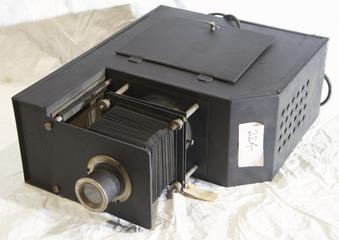
The Debrie Sept could be used to take still pictures as well as cine sequences. It could also be used as a movie projector or enlarger with the addition of a lamp house, and a printer. The chase sequence in ‘Robin Hood’ (Douglas Fairbanks, 1922) was shot using a Debrie Sept.
The camera used 35mm film sold in five metre rolls, sufficient only for 17 seconds’ filming. The film containers have light traps opened from the camera exterior. It has a detachable clockwork motor unit, square-ended, that drives an intermittent sprocket transport. The camera has a Zeiss Tessar f/3.5-32 50mm lens in a focussing helical threaded mount.
Sept cine camera case, lined. Andre Debrie.
Sept cine camera charger, four spare. Andre Debrie.
Debrie Sept cine camera for 35mm film in 10' loading chargers. Made by Etablissements Andre Debrie, 1921. Fitted with a Paris 'Huet' lens F: 5cm f/ 3.5-32, Serial No 1825, Detachable clockwork motor, rounded case, 'normal' and 'rapid' speed. With provision for single exposure T/I. Brilliant reflex finder. Front lens slides out to form optical frame finder. Helical focusing mount. Intermittent front sprocket drive. Light trapped slits for use as printer/ projector. Frame counter. Serial No E 00423. Andre Debrie. French Patent 2 June 1919.
The Debrie Sept could be used to take still pictures as well as cine sequences. It could also be used as a movie projector or enlarger with the addition of a lamp house, and a printer. The chase sequence in ‘Robin Hood’ (Douglas Fairbanks, 1922) was shot using a Debrie Sept.
The camera used 35mm film sold in five metre rolls, sufficient only for 17 seconds’ filming. The film containers have light traps opened from the camera exterior. It has a detachable clockwork motor unit, square-ended, that drives an intermittent sprocket transport. The camera has a Zeiss Tessar f/3.5-32 50mm lens in a focussing helical threaded mount.