Reel of 35mm positive film showing children walking on a beach
Reel of 35mm positive film showing children walking on a beach. Possibly by R W Paul?
Five reels of film associated with Rigg's kinematograph projector, c. 1896
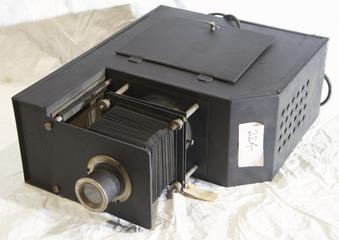
John Henry Rigg was an electrical engineer and manufacturer of telephones, phonographs and other scientific instruments. He possessed his own recording studios and made phonographs of variety artists appearing at Leeds theatres.
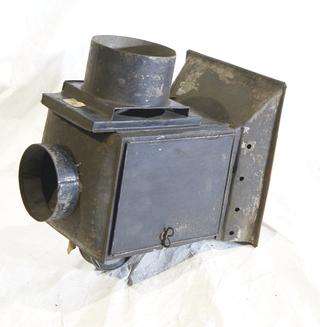
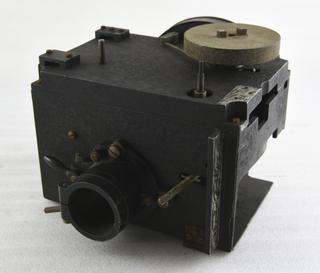
He was also manufacturer and co-patentee, with Ernest Othon Kumberg, a French engineer resident in London, of an early projector, the Kinematograph. This was the third English film projector to be publicly exhibited in Britain opening at the Royal Aquarium, Westminster, London, on 6 April 1896. Kumberg was associate with the Anglo-Continental Phonograph Company, who exploited the machine. It had a worm-gear intermittent mechanism - the subject of a patent dispute, settled in Rigg's favour - and, unusually, was driven by an electric motor.
It seems to have had some success; it was used in many of the largest halls in the provinces. Rigg converted the projector for use as a camera. Little is known about his film production, but one of his films was taken during a severe frost during the winter of 1896-7 and depicted a group of skaters. Another, 'Switchback in Operation at Shipley Glen', was made around September 1897.
Reel of 35mm positive film showing children walking on a beach. Possibly by R W Paul?
Reel of 35mm positive film showing children walking on a beach. Possibly by R W Paul?
Reel of 35mm positive film, 'Sea Waves at Dover' (also known as 'Rough Sea at Dover' by Birt Acres & R W Paul. Approx 40 feet. The last few feet are from a different film showing a mountain landscape with a river probably 'Niagra Falls No. 1: The Upper River Just Above the Falls' also by Birt Acres.
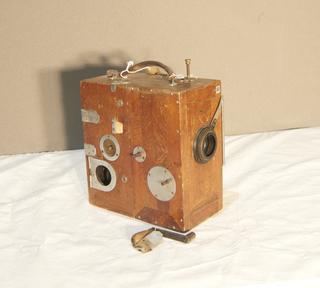
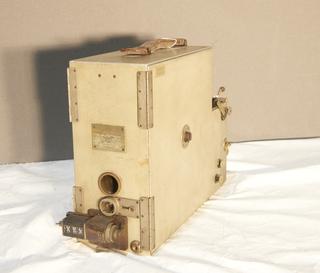
One of the oldest surviving British films, Rough Sea at Dover was shot in 1895 and intended for exhibition in peephole kinetoscopes. Birt Acres, a professional photographer, shot the film with a camera designed and built by R.W.Paul, based on Thomas Edison's invention (Paul took advantage of Edison's failure to copyright his kinetoscope in Britain).
The film received its premiere (or, to be strictly accurate, its projected premiere in front of an audience) on 14 January 1896 at the Royal Photographic Society in Hanover Street, London - the first public film screening in Britain, a month after the Lumière Brothers showed their films in Paris. It seems to have been a success, as projected screenings were subsequently a regular feature of RPS meetings.
Rough Sea at Dover subsequently crossed the Atlantic, being included in a programme shown on April 23 at Koster and Bial's Music Hall in New York, alongside films made by Edison's company. The projectionist was Edwin S Porter, who would go on to make the pioneering American films The Life of an American Fireman (1901) and The Great Train Robbery (1903).
Reel of 35mm positive film showing a seascape with rocks. Possibly by R W Paul?
Reel of 35mm positive film showing a military parade - possibly 'The Gordon Highlanders' by R W Paul?
Reel of 35mm positive film showing a horse drawn fire engine with three firemen aboard. Possibly by R W Paul.