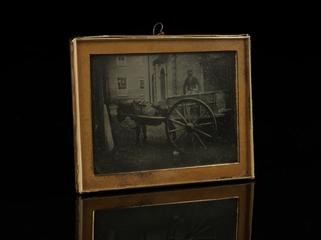
Hall of the Great Exhibition
- Made:
- 1851 in United Kingdom
- photographer:
- Thomas Augustine Malone
One of five salted paper prints by various photographers 1844-1852, exhibited at the Society of Arts Exhibition 1852. Victorian Britain witnessed a period of innnovation and industrial expansion. One of the greatest symbols of progress was the Great Exhibition of 1851. Photography was exhibited here to great aclaim beginning a chain of events that led to the founding of the Photographic Society in 1853, later to becoome the Royal Photographic Society in 1894. Of particular importance to its success was the waving of patent rights by Talbot. This allowed Society members to pursue photography as an art and science without paying fees to its inventor. These five prints were probably assembled for display in the 1874 Special Loans Exhibition at the South Kensington Museum - part of which became the Science Museum around 1911. Some years later, Alexander Barclay, the Keeper of Chemistry, would travel to Lacock Abbey with the President of the Royal Photographic society, John Dudley Johnston. The purpose of this trip was to divide the contents of Talbot's estate between the RPS and the Science Museum. In 1983 the Science Museum's photographic collection moved to Bradford to form the new national museum, and now the RPS collection is set to join it, bringing together elements from their very different but shared histories.
A salt print photograph entitled 'Hall of the Great Exhibition', taken by T A Malone in 1851. The Great Exhibition took place in London in 1851, and was designed as a showcase for industrial technology and design.
Victorian Britain witnessed a period of innnovation and industrial expansion. One of the greatest symbols of progress was the Great Exhibition of 1851. Photography was exhibited here to great aclaim beginning a chain of events that led to the founding of the Photographic Society in 1853, later to becoome the Royal Photographic Society in 1894. Of particular importance to its success was the waving of patent rights by Talbot. This allowed Society members to pursue photography as an art and science without paying fees to its inventor. These five prints were probably assembled for display in the 1874 Special Loans Exhibition at the South Kensington Museum - part of which became the Science Museum around 1911. Some years later, Alexander Barclay, the Keeper of Chemistry, would travel to Lacock Abbey with the President of the Royal Photographic society, John Dudley Johnston. The purpose of this trip was to divide the contents of Talbot's estate between the RPS and the Science Museum. In 1983 the Science Museum's photographic collection moved to Bradford to form the new national museum, and now the RPS collection is set to join it, bringing together elements from their very different but shared histories.
Details
- Category:
- Photographs
- Object Number:
- 2003-5001/2/23281/3
- Materials:
- paper
- type:
- salt print and photograph
- credit:
- The National Media Museum, Bradford
Related Objects
A collection of Dufaycolor transparency material
Yashica Atoron sub-miniature camera, 1960-1980
Silver plaque made to commemorate the re-opening of the Kodak Museum, 13 May 1980
Collection of supplimental material to the Elizabeth Mason archive