Versuche über Photographie mittelst der Röntgen'schen Strahlen

Album of X-ray photographs entitled 'Versuche über Photographie mittelst der Röntgen'schen Strahlen'. by Josef Maria Eder and Eduard Valenta, 1896.

Details

Category:
Photographs
Collection:
Kodak Collection
Object Number:
1990-5036/11279
Materials:
paper (fibre product)
Measurements:
overall: 170 mm x 345 mm
type:
photograph and x-ray photograph
credit:
The Kodak Collection at the National Media Museum, Bradford

Parts

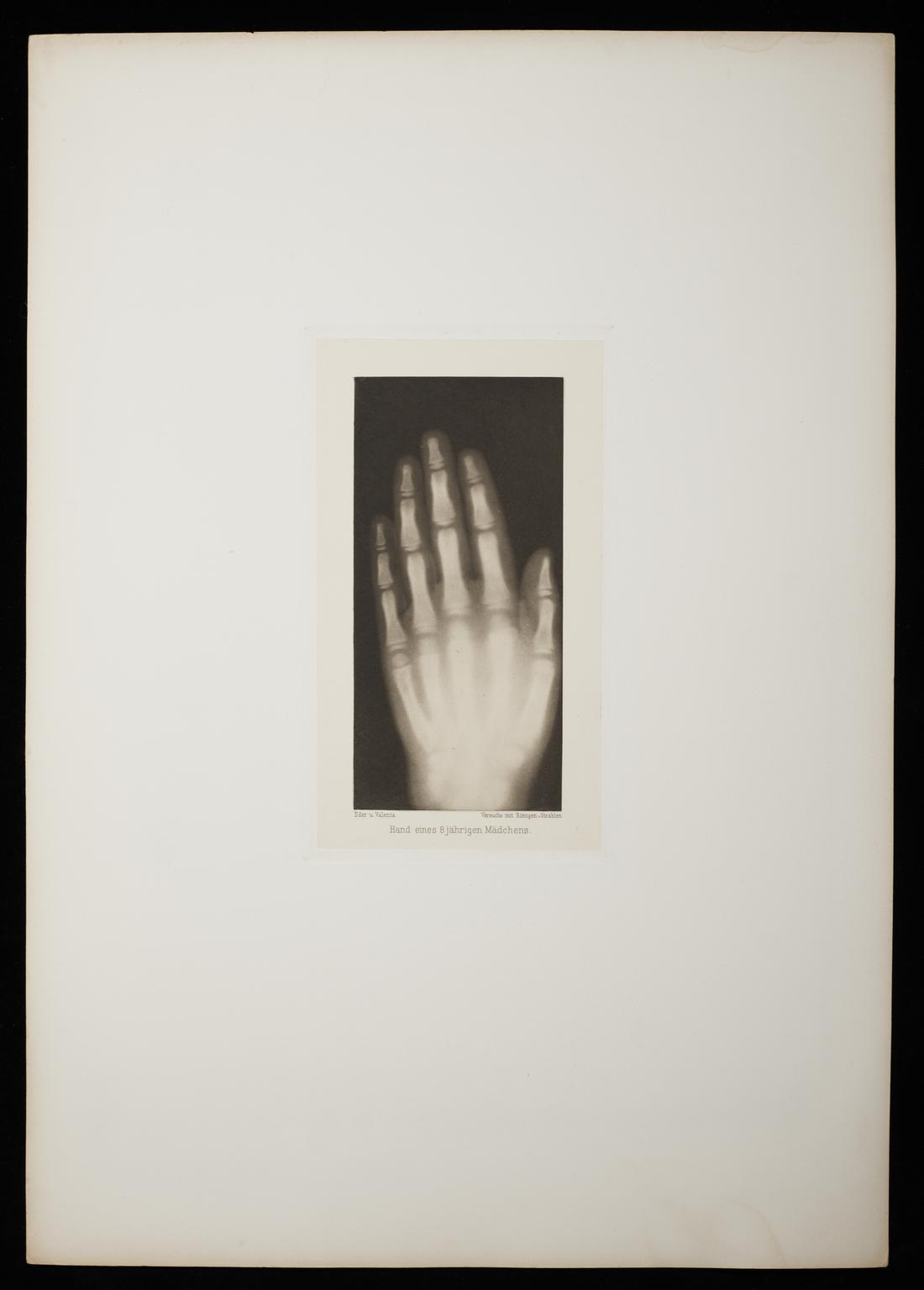
Hand Eines 8 Jährigen Mädchens, x-ray by Eder and Valenta

Hand Eines 8 Jährigen Mädchens, x-ray by Eder and Valenta

X-ray photograph entitled 'Hand Eines 8 Jährigen Mädchens' (Hand Of An 8 Year Old Girl), by Josef Maria Eder, 1896. Röntgen x-ray, a plate from the book 'Versuche über Photographie mittelst der Röntgen'schen Strahlen'.

More

Like light, X rays are a type of radiation. They are invisible to our eyes but can be revealed using photographs. Because they can pass through the soft parts of our bodies, but not our bones, they can create images of our skeletons. After they were discovered in 1895, they quickly became a useful tool for scientists and doctors.

Joseph Maria Eder was an Austrian chemist who specialised in the chemistry of photography. Working with another photochemist, Eduard Valenta, he produced a portfolio of X-ray photographs just a month after Wilhel Conrad Röntgen had published his discover of X-rays.

Measurements:
overall: 500 mm x 350 mm
image: 174 mm x 84 mm
printed area: 205 mm x 115 mm
Materials:
paper (fibre product)
Object Number:
1990-5036/11279/2
type:
photograph , x-ray photograph and photogravure
Image ©
The Board of Trustees of the Science Museum
Fuss Eines 17 Jährigen Jünglings

Fuss Eines 17 Jährigen Jünglings

X-ray photograph entitled 'Fuss Eines 17 Jährigen Jünglings' (Foot Of A 17 Year Old Boy), by Josef Maria Eder, 1896. Röntgen x-ray, a plate from the book 'Versuche über Photographie mittelst der Röntgen'schen Strahlen'.

Measurements:
overall: 211 mm x 173 mm
Materials:
paper (fibre product)
Object Number:
1990-5036/11279/4
type:
photograph , x-ray photograph and photogravure
Grüne Eidechse, x-ray by Eder and Valenta

Grüne Eidechse, x-ray by Eder and Valenta

X-ray photograph entitled 'Grüne Eidechse' (Green Lizard), by Josef Maria Eder, 1896. Röntgen x-ray, a plate from the book 'Versuche über Photographie mittelst der Röntgen'schen Strahlen'.

More

Like light, X rays are a type of radiation. They are invisible to our eyes but can be revealed using photographs. Because they can pass through the soft parts of our bodies, but not our bones, they can create images of our skeletons. After they were discovered in 1895, they quickly became a useful tool for scientists and doctors.

Joseph Maria Eder was an Austrian chemist who specialised in the chemistry of photography. Working with another photochemist, Eduard Valenta, he produced a portfolio of X-ray photographs just a month after Wilhel Conrad Röntgen had published his discover of X-rays.

Measurements:
overall: 354 mm x 500 mm
image: 93 mm x 159 mm
printed area: 125 mm x 190 mm
Materials:
paper (fibre product)
Object Number:
1990-5036/11279/7
type:
photograph , x-ray photograph and photogravure
Image ©
The Board of Trustees of the Science Museum
Zwei Seefische, Zanclus Cornutus / Acanthurus Nigros

Zwei Seefische, Zanclus Cornutus / Acanthurus Nigros

X-ray photograph entitled 'Zwei Seefische, Zanclus Cornutus / Acanthurus Nigros' (Two Fish, Zanclus Cornutus / Acanthurus Nigros), by Josef Maria Eder, 1896. Röntgen x-ray, a plate from the book 'Versuche über Photographie mittelst der Röntgen'schen Strahlen'.

More

Like light, X rays are a type of radiation. They are invisible to our eyes but can be revealed using photographs. Because they can pass through the soft parts of our bodies, but not our bones, they can create images of our skeletons. After they were discovered in 1895, they quickly became a useful tool for scientists and doctors.

Joseph Maria Eder was an Austrian chemist who specialised in the chemistry of photography. Working with another photochemist, Eduard Valenta, he produced a portfolio of X-ray photographs just a month after Wilhel Conrad Röntgen had published his discover of X-rays.

Measurements:
overall: 502 mm x 355 mm
printed area: 273 mm x 229 mm
image: 242 mm x 197 mm
Materials:
paper (fibre product)
Object Number:
1990-5036/11279/9
type:
photograph , x-ray photograph and photogravure
Image ©
The Board of Trustees of the Science Museum
Solfisch (Pleuronectes Solea)

Solfisch (Pleuronectes Solea)

X-ray photograph entitled 'Solfisch (Pleuronectes Solea)', (sole / Pleuronectes Solea) by Josef Maria Eder, 1896. Röntgen x-ray, a plate from the book 'Versuche über Photographie mittelst der Röntgen'schen Strahlen'.

Measurements:
overall: 170 mm x 345 mm
Materials:
paper (fibre product)
Object Number:
1990-5036/11279/11
type:
photograph and x-ray photograph
Frösche in Bauch - ünd Rückenlage

Frösche in Bauch - ünd Rückenlage

X-ray photograph entitled 'Frösche in Bauch - ünd Rückenlage', (Frogs in Prone and Supone Position) by Josef Maria Eder, 1896. Röntgen x-ray, a plate from the book 'Versuche über Photographie mittelst der Röntgen'schen Strahlen'.

Measurements:
overall: 228 mm x 165 mm
Materials:
paper (fibre product)
Object Number:
1990-5036/11279/12
type:
photograph and x-ray photograph
Ratte

Ratte

X-ray photograph entitled 'Ratte' (Rat), by Josef Maria Eder, 1896. Röntgen x-ray, a plate from the book 'Versuche über Photographie mittelst der Röntgen'schen Strahlen'.

Measurements:
overall: 138 mm x 248 mm
Materials:
paper (fibre product)
Object Number:
1990-5036/11279/13
type:
photograph , x-ray photograph and photogravure