
Ferranti "Lancastria" Valve radio
- Made:
- circa 1935 in Hollinwood
- maker:
- Ferranti Limited
 This image is released under a CC BY-NC-SA 4.0
Licence
This image is released under a CC BY-NC-SA 4.0
Licence
License this image for commercial use at Science and Society Picture Library
LicenseLancastria Reflex four-valve superheterodyne radio receiver
Science Museum Group Collection
© The Board of Trustees of the Science Museum
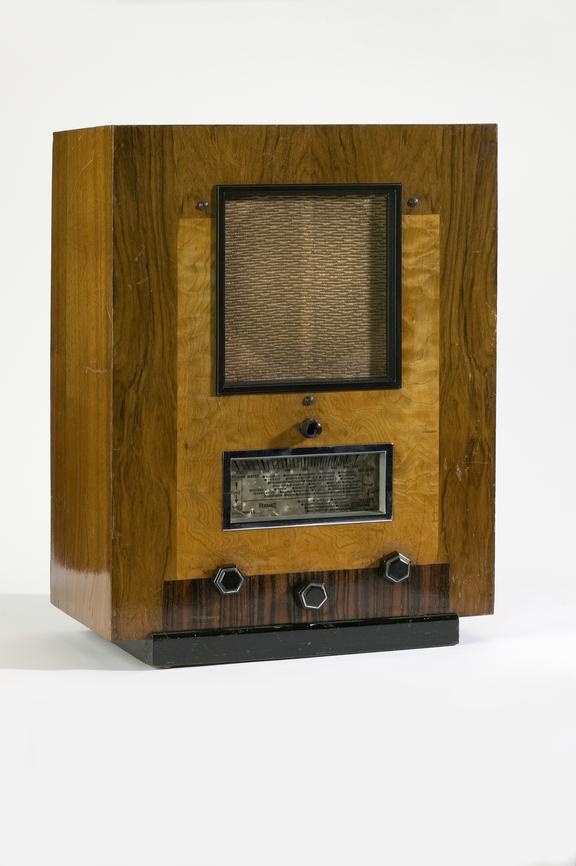
Lancastria Reflex four-valve superheterodyne radio receiver, made by Ferranti Ltd, Hollinwood, c.1935.
Established in London in the 1880s by electrical engineer Sebastian de Ferranti, the Ferranti company moved to Oldham in 1896. The firm's origins were in electricity generation and supply, but they soon diversified into manufacturing electrical instruments, components, and appliances, opening several more factories in the area around Manchester as they grew into a major company.
Public radio broadcasting in Britain began in the early 1920s and became more organised after the formation of the BBC in 1922. The BBC’s Manchester station, named 2ZY, began broadcasting in November 1922 from Trafford Park. Between the 1920s and 1950s, radio became a major feature of life in Britain, with millions tuning in to listen to news, music, sport, and entertainment. At first, people often had to build their own radio, or “wireless,” sets, but as the market grew, ready-made radios became a popular purchase.
Ferranti started making transformers for radio sets in the early 1920s and launched their first complete household radio in 1929. They opened a dedicated radio factory at Moston in 1935. Here, skilled workers, many of them women, assembled the many intricate electronic components needed to build radio receiver sets. Although Ferranti made many models of radio, it was not a very successful market for the firm, which was more focussed on high-quality engineering and new technology than cheap consumer goods. Ferranti stopped making radios directly around 1957, selling their radio business to E.K. Cole, who continued making Ferranti-branded radios at their Southend factory for some years.
The Ferranti Lancastria Reflex is four-valve superheterodyne radio receiver, made by Ferranti Ltd, Hollinwood, c.1935. For many people, the radio set became an important part of household life in the 1930s and the centrepiece of a living room. The Lancastria is housed in an attractive plywood cabinet decorated with maple and walnut, with an Art Deco-influenced design. The tuning scale is simulated mother-of-pearl with a chromium-plated surround. Despite its stylish appearance and ease of use, the Lancastria was quite low priced, at around £12 in 1935.
Details
- Category:
- Radio Communication
- Object Number:
- Y1996.10.936
- Materials:
- walnut (wood) and wood veneer (plywood)
- Measurements:
-
overall: 500 mm x 250 mm x 370 mm, 12.85
- type:
- valve radio receiver
- credit:
- Gift of Ferranti International Signal plc
Related Objects