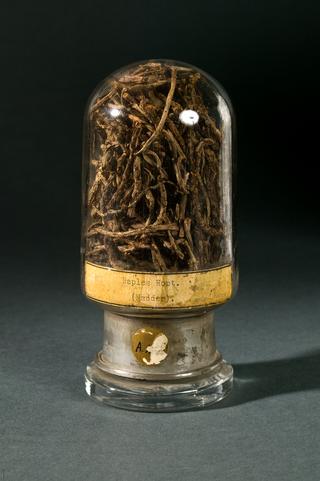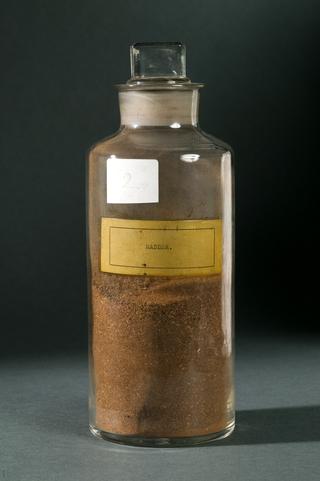
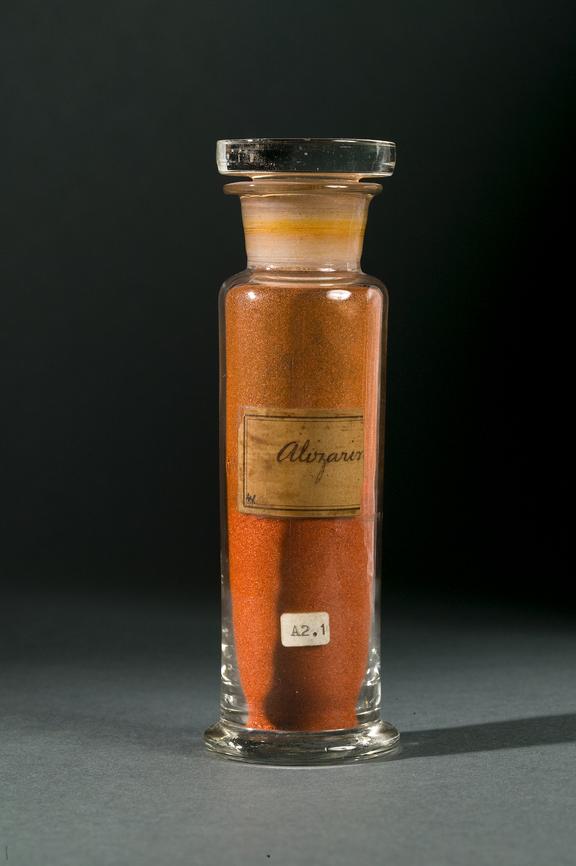
Dye Sample; Alizarin


 This image is released under a CC BY-NC-SA 4.0
Licence
This image is released under a CC BY-NC-SA 4.0
Licence
License this image for commercial use at Science and Society Picture Library
LicenseThis image is released under a CC BY-NC-SA 4.0
Licence
License this image for commercial use at Science and Society Picture Library
LicenseThis image is released under a CC BY-NC-SA 4.0
Licence
License this image for commercial use at Science and Society Picture Library
License
Science Museum Group
© The Board of Trustees of the Science Museum
Science Museum Group
© The Board of Trustees of the Science Museum
Alizarin
Science Museum Group Collection
© The Board of Trustees of the Science Museum
Alizarin, a sample chemical from Edward Schunck's research on natural dyes and plant products, 1840s-1900.
For thousands of years, and in cultures all over the world, people have been using plant and animal products to colour textiles. As Manchester’s textiles industry took hold in the early 1800s, the need for quality dyes that were consistent and stable became a subject of considerable commercial interest. Dr. Henry Edward Schunck (1820-1903), born in Manchester, the second son of a wealthy German textile merchant, undertook important research on natural dyestuffs.
During his studies at universities in Berlin and Giessen in Germany, Schunck investigated lichens that produce violet dyes and the colouring properties of aloe plants. When he returned to England in 1846 became Chemical Manager of the family calico printing firm, Schunck, Souchay & Co.
He began investigating the colouring properties of the globally important madder plant (Rubia tinctorum), which had long been used to produce red dye. Schunck's breakthrough was the isolation of the yellow dyestuff from madder, known as alizarin. He invented a way of purifying alizarin for commercial use, patenting the product as Pincoffine. He also isolated a second colouring matter called purpurin.
In the 1850s, Schunck began investigating indigo blue, which he extracted from the woad plant (Isatis tinctoria). He succeeded in isolating the precursor of indigo, called indican, as a complex but unstable compound. He also studied indigo in urine and the Tyrian purple dye, derived from shellfish, which he found was also an indigo derivative.
His experiments with natural dyes were used by the textile and emerging chemical industry to develop dyes. By the time of his death, Schunck had become a prominent figure in the field of science in Manchester. In his will, he bequeathed the value of £20,000, along with the contents of his library and his collection of chemical samples, to the University of Manchester (formerly the Victoria University of Manchester) to advance chemical research. The collection of samples was gifted to the care of the Science and Industry Museum in the 1960s.
Details
- Category:
- Industrial Chemistry
- Object Number:
- Y1997.7.1.10
- Materials:
- glass and powder pigments
- Measurements:
-
165 mm 55 mm,
- type:
- dye sample
- credit:
- Gift of The University of Manchester