
A power loom weft auto stop device



 This image is released under a CC BY-NC-SA 4.0
Licence
This image is released under a CC BY-NC-SA 4.0
Licence
License this image for commercial use at Science and Society Picture Library
License
Science Museum Group
© The Board of Trustees of the Science Museum
A power loom weft auto stop device
Science Museum Group Collection
© The Board of Trustees of the Science Museum
A power loom weft auto stop device
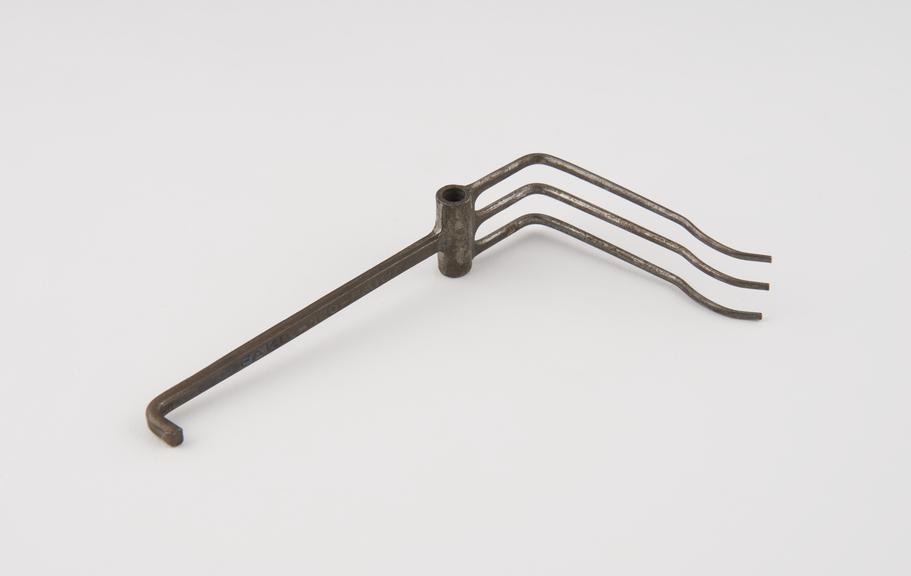
This is an example of a power loom weft auto-stop device, also known as a weft fork, as it is fork shaped. It is part of an arrangement for stopping a loom if the weft thread breaks.
If the weft thread broke or ended unexpectedly, the prongs went through the grid, and a notch caught the hook at the other end of the fork. This triggered the stopping lever to shift, throwing the driving belt, which was powering the loom, onto a loose pulley, removing the power supply. The process also applied a brake. The loom, therefore, came to a stop. Once the machine had stopped, the thread could be reattached, and the loom could continue to weave the cloth. This ensured that the cloth was even and consistent.
Automating the stopping of looms when threads break meant fewer people could manage more machines across a factory floor.
Details
- Category:
- Textile Industry
- Object Number:
- Y2006.35.30
- Materials:
- metal (unknown)
- Measurements:
-
overall: 20 mm x 70 mm x 115 mm,
Related Objects

neck tie