ABC Wax copper roller
- PART OF:
- ABC Wax Collection
- Made:
- Hyde


 This image is released under a CC BY-NC-SA 4.0
Licence
This image is released under a CC BY-NC-SA 4.0
Licence
License this image for commercial use at Science and Society Picture Library
LicenseThis image is released under a CC BY-NC-SA 4.0
Licence
License this image for commercial use at Science and Society Picture Library
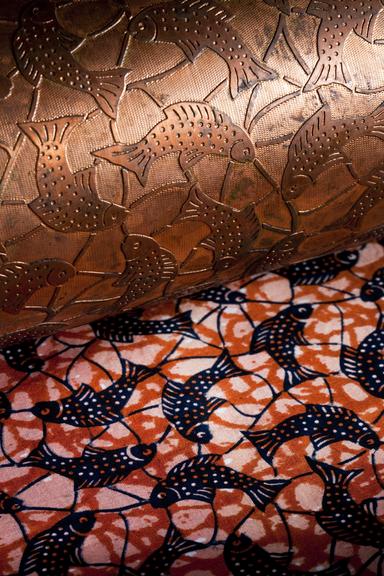
LicenseCopper roller (cut-down).Fish design.For handling collection
Science Museum Group Collection
© The Board of Trustees of the Science Museum
Science Museum Group Collection
© The Board of Trustees of the Science Museum
Copper roller (cut-down) made by ABC Wax, Manchester. Fish design .
Y2013.17.20
Copper roller (cut-down) made by ABC Wax. Fish design
What’s in this box?
This is a section of copper roller, designed and made by ABC Wax, used for printing patterns onto textiles.
Historical Background
Historically, wax printing originated in Java as batik print. Traditional wax printing was a slow process so European, particularly Dutch, firms tried to find ways of mechanising it and producing wax printed textiles on an industrial scale. In the 19th Century colourful wax printed cloth was probably introduced to West Africa by African soldiers returning home from military service in Indonesia. The colourful textiles soon became popular and European manufacturers started mass producing wax printed cloth to supply the market. The usage of this process in Manchester developed the city’s links with West African countries as the method and patterns reflected traditional motifs and appealed to tastes of consumers in these countries.
ABC Wax was established as a calico printing firm in 1812 by brothers Benjamin and Joseph Ashton. Initially the company was called F W Ashton, but in 1959 the company bought a Swiss firm named A Brunnschweiler & Co, and later became known simply as ABC Wax. The company started specialising in wax printing from 1908. Wax printed cloth was designed and manufactured at the firm’s factory in Hyde and shipped to West Africa. ABC wax printed fabrics remain popular to this day and by 2007 all production was moved to Ghana, but with a design office remaining in Hyde.
How does it work?
Designs for textile patterns are engraved onto copper rollers like these. The rollers are then used to print a waxy resin paste onto both sides of cotton cloth to create a wax print. The cloth was then dyed, but the resin stops the dye sticking to the places it covers. The resin was then removed, leaving a pattern on the cloth where the wax had been.