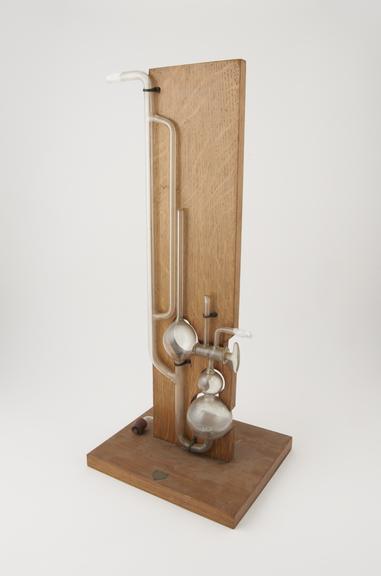
Horlicks Mcleod gauge
- Made:
- Unknown date in Slough
- maker:
- Unknown
 This image is released under a CC BY-NC-SA 4.0
Licence
This image is released under a CC BY-NC-SA 4.0
Licence
License this image for commercial use at Science and Society Picture Library
License
Science Museum Group
© The Board of Trustees of the Science Museum
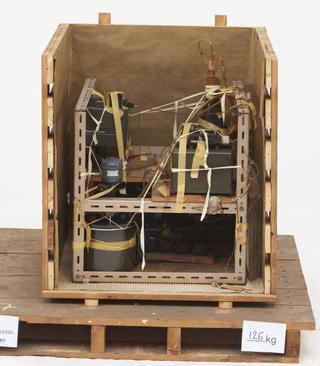
Mcleod gauge used to measure low pressure in the laboratory at the Horlicks Factory in Slough.
This object comes from the Horlicks Factory in Slough, which was built in 1908 on a greenfield site. From then until June 2018 it was the main production site of Horlicks in the UK. Sold to the company that eventually became GlaxoSmithKline (GSK), this was an important site within the context of south-eastern food production. There were several chemical laboratories that were operational at the site from 1908 until the last few decades of the twentieth century when product testing and research was moved to GSK’s other laboratories.
Horlicks has a global history. With its lightweight, non-perishable properties, Horlicks became popular amongst explorers, supporting the polar expeditions of Roald Amundsen and Richard Byrd – the latter named the Antarctic Horlick Mountains after his sponsor. During the First World War, Horlicks also made its way to the Western Front -- a tablet form was produced for soldiers at the Slough factory from 1915; and, to India, with returning soldiers from the British Indian Army taking it home, where it was adopted as a status symbol drink. Horlicks has been marketed as a café drink in the US, UK, Hong Kong and elsewhere. Today, India is its largest market, the product reformulated with buffalo milk.
Details
- Category:
- Experimental Chemistry
- Object Number:
- 2019-441
- Materials:
- glass, metal (unknown) and wood (unidentified)
- Measurements:
-
H420mm x W160mm
- type:
- pressure gauge
- credit:
- GlaxoSmithKline
Related Objects
Hilger & Watts Ltd, H800 Infrared Spectrophotometer
Audio oscillator in a purpose built wooden case
HPP computer
Technicon ninhydrin reaction apparatus