Reel of 9.5mm Duplex-Monoplex film by Pathescope
- maker:
- Pathescope Limited


 This image is released under a CC BY-NC-SA 4.0
Licence
This image is released under a CC BY-NC-SA 4.0
Licence
License this image for commercial use at Science and Society Picture Library
LicenseThis image is released under a CC BY-NC-SA 4.0
Licence
License this image for commercial use at Science and Society Picture Library
LicenseThis image is released under a CC BY-NC-SA 4.0
Licence
License this image for commercial use at Science and Society Picture Library
LicenseThis image is released under a CC BY-NC-SA 4.0
Licence
License this image for commercial use at Science and Society Picture Library
License
Science Museum Group
© The Board of Trustees of the Science Museum
Science Museum Group
© The Board of Trustees of the Science Museum
Science Museum Group
© The Board of Trustees of the Science Museum
Science Museum Group
© The Board of Trustees of the Science Museum
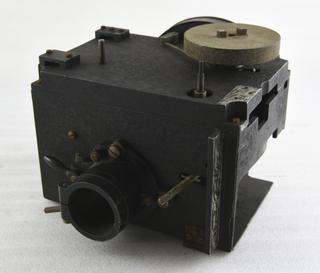
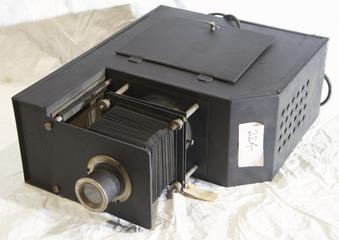
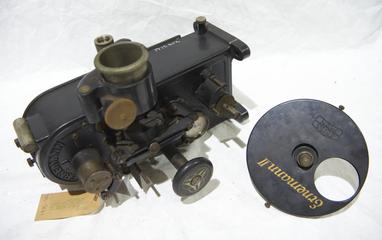
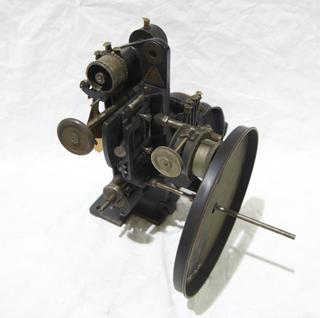
Reel of 9.5mm Duplex-Monoplex film by Pathescope, a 'mini VistaVision' film. Part of the Widescreen Association Collection.
In 1956, two years after the appearance of VistaVision, Pathescope introduced a 'mini VistaVision' widescrren system for their 9.5mm gauge, called Duplex-Monoplex. The camera coudl be operated in two ways depending on the format required. For 'normal' pictures, it was held upright in the usual way, but was turned over on its side for the horizontally running widescreen format. The Duplex-Monoplex filmstock differed slightly from conventional 9.5mm, the latter having a single perforation per frame set centrally in the frameline offset from centre. In order to run both types of film in the new camera, the claw had to be decentred by means of a small lever that simultaneously brought in to position a mask to cover half the gate aperture. The reason for the mask was that, unlike VistVision in using a laterally enlarged frame to obtain additional width, Pathe decide to expose only half the fiml area for the widescreen picture. This made economic sense for the amateur in being able to gain twice the normal running time in widescreen than before.
The film was treated similarly to standard 8mm in that it was double run. After being run through the camera once, the charger was then turned over and run thorugh a second time. After processing it was then split into two ribbons and spliced end to end for projection.
Details
- Category:
- Cinematography
- Object Number:
- 2024-420
- Materials:
- cardboard and cellulose acetate
- type:
- film reel
- credit:
- Widescreen Association