Three-crank two-stage vertical reciprocating compressor and associated components

Three-crank two-stage vertical reciprocating compressor and associated components

License this image for commercial use at Science and Society Picture Library

License

Science Museum Group
© The Board of Trustees of the Science Museum

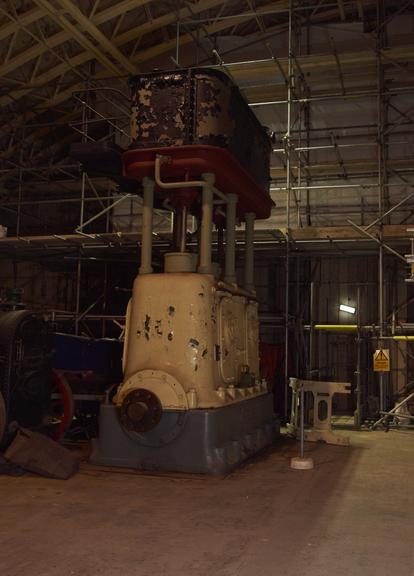
Three-crank two-stage vertical reciprocating ammonia compressor and associated components. The ammonia compressor was built in 1918 by the Peterborough-based Peter Brotherhood Ltd and installed at the No.2 plant in the Billingham manufacturing plant.

The compressor is approximately 7.6 metres tall, 2 metres wide, and 1 metre long. The compressor has a bottom and lower section connected by a set of three pistons. On one side of the compressor, there is a pressure gauge measuring in pounds per square inch, and an attached DELVAC mechanical lubrication system built by the Vacuum Oil Company Ltd from London.

The compressor has the logo of the Peter Brotherhood Ltd company, as well as the company name and located marked on the sides of the machine.

This compressor was designed and built by Peter Brotherhood in 1918 and was one of the earliest compressors in use at the Billingham manufacturing plant, one of the most important factories in the UK for the producing of industrial chemicals, especially fertiliser for use in agriculture.

When it was originally installed, Billingham was operating as part of the Ministry of Munitions to produce explosives during the First World War. Following the end of the war Billingham was acquired by Brunner Mond Limited, and this compressor became part of their ‘No. 2 Plant’. In 1924, Brunner Mond merged with British Dyestuffs Corporation, Nobel’s Explosive Limited and the United Alkali Company to form Imperial Chemical Industries, one of the largest industrial conglomerates in the world.

For the first decade of it use, the compressor struggled with mechanical problems, but by 1926 the compressor started to reliably produce an average of 62-65 tons of artificial ammonia a day through the Haber-Bosch process which involves compressing atmospheric nitrogen and hydrogen at high temperature and pressures. However, by this point multiple other large and more advanced ammonia plants were being built at Billingham, leading to No. 3 and its compressors to be re-engineered and altered in 1932/33 to produce liquid and solid CO2 called Drikold or ‘dry ice’, which can be made from by-products of the Haber-Bosch process. This re-engineering was performed by Peter Brotherhood and involved replacing much of the internal mechanisms such as the cylinders, pistons and piston rods, and well replacing the original steam engine with an electric motor. This re-designed three-crank 2-stage CO2 compressor would produce CO2 into the late 1960s until, after 50 years of operation, it was eventually replaced by new designs of CO2 plants.

Details

Category:
Industrial Chemistry
Object Number:
1982-1494
Measurements:
Ammonia compressor: 2000 mm x 4300 mm,
type:
vertical reciprocating compressor
credit:
ICI Agricultural Division

Parts

This three-crank two-stage vertical reciprocating ammonia compressor was built in 1918 by the Peterborough-based Peter Brotherhood Ltd and installed at the No.2 plant in the Billingham manufacturing plant.

Three-crank two-stage vertical reciprocating compressor

This three-crank two-stage vertical reciprocating ammonia compressor was built in 1918 by the Peterborough-based Peter Brotherhood Ltd and installed at the No.2 plant in the Billingham manufacturing plant.

The compressor is approximately 7.6 metres tall, 2 metres wide, and 1 metre long. The compressor has a bottom and lower section connected by a set of three pistons. On one side of the compressor, there is a pressure gauge measuring in pounds per square inch, and an attached DELVAC mechanical lubrication system built by the Vacuum Oil Company Ltd from London.

The compressor has the logo of the Peter Brotherhood Ltd company, as well as the company name and located marked on the sides of the machine.

More

This compressor was designed and built by Peter Brotherhood in 1918 and was one of the earliest compressors in use at the Billingham manufacturing plant, one of the most important factories in the UK for the producing of industrial chemicals, especially fertiliser for use in agriculture.

When it was originally installed, Billingham was operating as part of the Ministry of Munitions to produce explosives during the First World War. Following the end of the war Billingham was acquired by Brunner Mond Limited, and this compressor became part of their ‘No. 2 Plant’. In 1924, Brunner Mond merged with British Dyestuffs Corporation, Nobel’s Explosive Limited and the United Alkali Company to form Imperial Chemical Industries, one of the largest industrial conglomerates in the world.

For the first decade of it use, the compressor struggled with mechanical problems, but by 1926 the compressor started to reliably produce an average of 62-65 tons of artificial ammonia a day through the Haber-Bosch process which involves compressing atmospheric nitrogen and hydrogen at high temperature and pressures. However, by this point multiple other large and more advanced ammonia plants were being built at Billingham, leading to No. 3 and its compressors to be re-engineered and altered in 1932/33 to produce liquid and solid CO2 called Drikold or ‘dry ice’, which can be made from by-products of the Haber-Bosch process. This re-engineering was performed by Peter Brotherhood and involved replacing much of the internal mechanisms such as the cylinders, pistons and piston rods, and well replacing the original steam engine with an electric motor. This re-designed three-crank 2-stage CO2 compressor would produce CO2 into the late 1960s until, after 50 years of operation, it was eventually replaced by new designs of CO2 plants.

Measurements:
overall: 2000 x 4300 mm
Object Number:
1982-1494/1
type:
vertical reciprocating compressor
Cuboid-shaped metal component for a three-crank two-stage vertical reciprocating ammonia compressor, built in 1918 by Peter Brotherhood Ltd and installed at the No. 2 plant of the Billingham manufacturing site.

Metal component for three-crank two-stage vertical reciprocating compressor

Cuboid-shaped metal component for a three-crank two-stage vertical reciprocating ammonia compressor, built in 1918 by Peter Brotherhood Ltd and installed at the No. 2 plant of the Billingham manufacturing site.

The upper section of the component is painted grey, while the lower section remains unpainted, exposing the base metal. The lower surface of the object includes a guide feature.

Three pipe connectors are present on two surfaces of the object. In addition, a pipe is visible extending from one side of the component. These connectors and the pipe would have been connected to the back of the main unit of the ammonia compressor and to the associated piping section.

More

This compressor was designed and built by Peter Brotherhood in 1918 and was one of the earliest compressors in use at the Billingham manufacturing plant, one of the most important factories in the UK for the producing of industrial chemicals, especially fertiliser for use in agriculture.

When it was originally installed, Billingham was operating as part of the Ministry of Munitions to produce explosives during the First World War. Following the end of the war Billingham was acquired by Brunner Mond Limited, and this compressor became part of their ‘No. 2 Plant’. In 1924, Brunner Mond merged with British Dyestuffs Corporation, Nobel’s Explosive Limited and the United Alkali Company to form Imperial Chemical Industries, one of the largest industrial conglomerates in the world.

For the first decade of it use, the compressor struggled with mechanical problems, but by 1926 the compressor started to reliably produce an average of 62-65 tons of artificial ammonia a day through the Haber-Bosch process which involves compressing atmospheric nitrogen and hydrogen at high temperature and pressures. However, by this point multiple other large and more advanced ammonia plants were being built at Billingham, leading to No. 3 and its compressors to be re-engineered and altered in 1932/33 to produce liquid and solid CO2 called Drikold or ‘dry ice’, which can be made from by-products of the Haber-Bosch process. This re-engineering was performed by Peter Brotherhood and involved replacing much of the internal mechanisms such as the cylinders, pistons and piston rods, and well replacing the original steam engine with an electric motor. This re-designed three-crank 2-stage CO2 compressor would produce CO2 into the late 1960s until, after 50 years of operation, it was eventually replaced by new designs of CO2 plants.

Measurements:
overall: 781 mm x 720 mm x 440 mm,
Object Number:
1982-1494/2
type:
component
Grey painted piping section for a three-crank two-stage vertical reciprocating ammonia compressor, built in 1918 by Peter Brotherhood Ltd and installed at the No. 2 plant of the Billingham manufacturing site. This section would have connected to the cuboid-shaped metal component associated with the ammonia compressor.

Piping for three-crank two-stage vertical reciprocating compressor

Grey painted piping section for a three-crank two-stage vertical reciprocating ammonia compressor, built in 1918 by Peter Brotherhood Ltd and installed at the No. 2 plant of the Billingham manufacturing site. This section would have connected to the cuboid-shaped metal component associated with the ammonia compressor.

More

This compressor was designed and built by Peter Brotherhood in 1918 and was one of the earliest compressors in use at the Billingham manufacturing plant, one of the most important factories in the UK for the producing of industrial chemicals, especially fertiliser for use in agriculture.

When it was originally installed, Billingham was operating as part of the Ministry of Munitions to produce explosives during the First World War. Following the end of the war Billingham was acquired by Brunner Mond Limited, and this compressor became part of their ‘No. 2 Plant’. In 1924, Brunner Mond merged with British Dyestuffs Corporation, Nobel’s Explosive Limited and the United Alkali Company to form Imperial Chemical Industries, one of the largest industrial conglomerates in the world.

For the first decade of it use, the compressor struggled with mechanical problems, but by 1926 the compressor started to reliably produce an average of 62-65 tons of artificial ammonia a day through the Haber-Bosch process which involves compressing atmospheric nitrogen and hydrogen at high temperature and pressures. However, by this point multiple other large and more advanced ammonia plants were being built at Billingham, leading to No. 3 and its compressors to be re-engineered and altered in 1932/33 to produce liquid and solid CO2 called Drikold or ‘dry ice’, which can be made from by-products of the Haber-Bosch process. This re-engineering was performed by Peter Brotherhood and involved replacing much of the internal mechanisms such as the cylinders, pistons and piston rods, and well replacing the original steam engine with an electric motor. This re-designed three-crank 2-stage CO2 compressor would produce CO2 into the late 1960s until, after 50 years of operation, it was eventually replaced by new designs of CO2 plants.

Measurements:
overall: 480 mm x 1170 mm x 355 mm,
Object Number:
1982-1494/3
type:
piping
Three rusted metal panels for a three-crank two-stage vertical reciprocating ammonia compressor, built in 1918 by Peter Brotherhood Ltd and installed at the No. 2 plant of the Billingham manufacturing site.

Three panels for three-crank two-stage vertical reciprocating compressor

Three rusted metal panels for a three-crank two-stage vertical reciprocating ammonia compressor, built in 1918 by Peter Brotherhood Ltd and installed at the No. 2 plant of the Billingham manufacturing site.

The panels are obround in shape and have a rectangular-shaped window, with ten bolt holes around the perimeter for securing the panels to the machine. The panels would have been placed inside the hatch doors of the ammonia compressor.

More

This compressor was designed and built by Peter Brotherhood in 1918 and was one of the earliest compressors in use at the Billingham manufacturing plant, one of the most important factories in the UK for the producing of industrial chemicals, especially fertiliser for use in agriculture.

When it was originally installed, Billingham was operating as part of the Ministry of Munitions to produce explosives during the First World War. Following the end of the war Billingham was acquired by Brunner Mond Limited, and this compressor became part of their ‘No. 2 Plant’. In 1924, Brunner Mond merged with British Dyestuffs Corporation, Nobel’s Explosive Limited and the United Alkali Company to form Imperial Chemical Industries, one of the largest industrial conglomerates in the world.

For the first decade of it use, the compressor struggled with mechanical problems, but by 1926 the compressor started to reliably produce an average of 62-65 tons of artificial ammonia a day through the Haber-Bosch process which involves compressing atmospheric nitrogen and hydrogen at high temperature and pressures. However, by this point multiple other large and more advanced ammonia plants were being built at Billingham, leading to No. 3 and its compressors to be re-engineered and altered in 1932/33 to produce liquid and solid CO2 called Drikold or ‘dry ice’, which can be made from by-products of the Haber-Bosch process. This re-engineering was performed by Peter Brotherhood and involved replacing much of the internal mechanisms such as the cylinders, pistons and piston rods, and well replacing the original steam engine with an electric motor. This re-designed three-crank 2-stage CO2 compressor would produce CO2 into the late 1960s until, after 50 years of operation, it was eventually replaced by new designs of CO2 plants.

Measurements:
Overall per panel: 1164 mm x 705 mm x 10 mm,
Object Number:
1982-1494/4
type:
panels
Metal ladder with round hooks designed to attach onto a three-crank two-stage vertical reciprocating ammonia compressor, built in 1918 by Peter Brotherhood Ltd and installed at the No. 2 plant of the Billingham manufacturing site.

Ladder for three-crank two-stage vertical reciprocating compressor

Metal ladder with round hooks designed to attach onto a three-crank two-stage vertical reciprocating ammonia compressor, built in 1918 by Peter Brotherhood Ltd and installed at the No. 2 plant of the Billingham manufacturing site.

More

This compressor was designed and built by Peter Brotherhood in 1918 and was one of the earliest compressors in use at the Billingham manufacturing plant, one of the most important factories in the UK for the producing of industrial chemicals, especially fertiliser for use in agriculture.

When it was originally installed, Billingham was operating as part of the Ministry of Munitions to produce explosives during the First World War. Following the end of the war Billingham was acquired by Brunner Mond Limited, and this compressor became part of their ‘No. 2 Plant’. In 1924, Brunner Mond merged with British Dyestuffs Corporation, Nobel’s Explosive Limited and the United Alkali Company to form Imperial Chemical Industries, one of the largest industrial conglomerates in the world.

For the first decade of it use, the compressor struggled with mechanical problems, but by 1926 the compressor started to reliably produce an average of 62-65 tons of artificial ammonia a day through the Haber-Bosch process which involves compressing atmospheric nitrogen and hydrogen at high temperature and pressures. However, by this point multiple other large and more advanced ammonia plants were being built at Billingham, leading to No. 3 and its compressors to be re-engineered and altered in 1932/33 to produce liquid and solid CO2 called Drikold or ‘dry ice’, which can be made from by-products of the Haber-Bosch process. This re-engineering was performed by Peter Brotherhood and involved replacing much of the internal mechanisms such as the cylinders, pistons and piston rods, and well replacing the original steam engine with an electric motor. This re-designed three-crank 2-stage CO2 compressor would produce CO2 into the late 1960s until, after 50 years of operation, it was eventually replaced by new designs of CO2 plants.

Measurements:
overall: 2400 mm x 380 mm x 130 mm,
Object Number:
1982-1494/5
type:
ladder