
Compound monocular microscope, Europe, 1681-1720

Made:
1681-1720 in Europe
maker:
Unknown
Compound monocular microscope, German or Italian, c.1700

Creative Commons LicenseThis image is released under a CC BY-NC-SA 4.0 Licence

License this image for commercial use at Science and Society Picture Library

License

Compound monocular microscope, German or Italian, c.1700
Science Museum Group Collection
© The Board of Trustees of the Science Museum

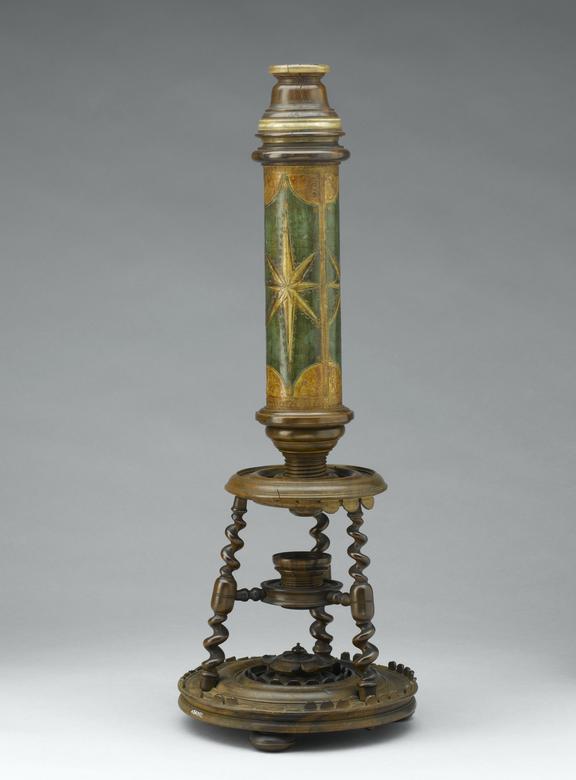
Compound monocular microscope with green, tooled leather body tube, ornate base, German or Italian, c.1700

This ornate compound microscope was made around a century after the first prototype microscopes of this type were allegedly developed by Dutch eye-glass maker Zaccharias Janssen and his son Hans – this claim is the subject of some dispute. Unlike single lens microscopes, compound microscopes contain at least two lenses.

The tube of this microscope is covered in vellum – a fine type of parchment made from the skin of a young calf or goat. The mount is made from walnut. This microscope may have been a source of entertainment and used to study a wide variety of animals, vegetables and minerals. It is only since the 1800s that microscopes have become central to medicine.

Details

Category:
Microscopy (Wellcome)
Collection:
Sir Henry Wellcome's Museum Collection
Object Number:
A56283
Materials:
lenses, glass, green, body tube, pasteboard, body tube, vellum, covered, tooled, body tube, horn, mountings, body tube, walnut and stand, walnut
Measurements:
overall: height 496 mm
body tube: length 337 mm
body tube: diameter 57 mm
stand: height 191 mm
base: diameter 188 mm
type:
monocular microscope
credit:
Wellcome Trust (Purchased from Stevens)

Parts

Body Tube for Compound monocular microscope, Europe, 1681-1720

Body Tube for Compound monocular microscope, Europe, 1681-1720

Green tooled leather body tube and lenses for compound monocular microscope, German or Italian, C.1700.

More

This ornate compound microscope was made around a century after the first prototype microscopes of this type were allegedly developed by Dutch eye-glass maker Zaccharias Janssen and his son Hans – this claim is the subject of some dispute. Unlike single lens microscopes, compound microscopes contain at least two lenses.

The tube of this microscope is covered in vellum – a fine type of parchment made from the skin of a young calf or goat. The mount is made from walnut. This microscope may have been a source of entertainment and used to study a wide variety of animals, vegetables and minerals. It is only since the 1800s that microscopes have become central to medicine.

Measurements:
overall: 337 mm 57 mm,
Materials:
glass , pasteboard , vellum , horn and walnut (wood)
Object Number:
A56283/1
type:
monocular microscope
Base for Compound monocular microscope, Europe, 1681-1720

Base for Compound monocular microscope, Europe, 1681-1720

Ornate base for compound monocular microscope, German or Italian, C.1700.

More

This ornate compound microscope was made around a century after the first prototype microscopes of this type were allegedly developed by Dutch eye-glass maker Zaccharias Janssen and his son Hans – this claim is the subject of some dispute. Unlike single lens microscopes, compound microscopes contain at least two lenses.

The tube of this microscope is covered in vellum – a fine type of parchment made from the skin of a young calf or goat. The mount is made from walnut. This microscope may have been a source of entertainment and used to study a wide variety of animals, vegetables and minerals. It is only since the 1800s that microscopes have become central to medicine.

Measurements:
overall: 191 mm 188 mm,
Materials:
walnut (wood)
Object Number:
A56283/2
type:
base - object component