

 This image is released under a CC BY-NC-SA 4.0
Licence
This image is released under a CC BY-NC-SA 4.0
Licence
License this image for commercial use at Science and Society Picture Library
LicenseThis image is released under a CC BY-NC-SA 4.0
Licence
License this image for commercial use at Science and Society Picture Library
LicenseThis image is released under a CC BY-NC-SA 4.0
Licence
License this image for commercial use at Science and Society Picture Library
LicenseThis image is released under a CC BY-NC-SA 4.0
Licence
License this image for commercial use at Science and Society Picture Library
LicenseThis image is released under a CC BY-NC-SA 4.0
Licence
License this image for commercial use at Science and Society Picture Library
License
Science Museum Group
© The Board of Trustees of the Science Museum
Science Museum Group
© The Board of Trustees of the Science Museum
Science Museum Group
© The Board of Trustees of the Science Museum
Science Museum Group
© The Board of Trustees of the Science Museum
Science Museum Group
© The Board of Trustees of the Science Museum
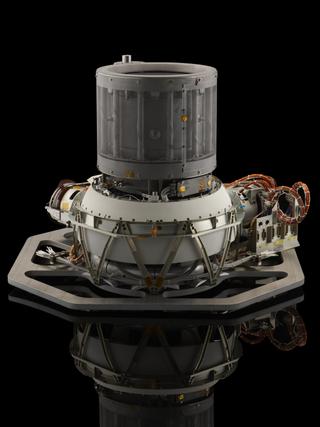
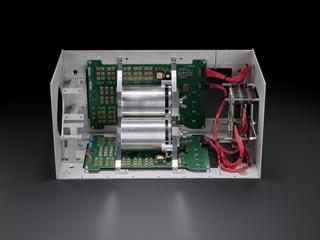
Metal propellant thruster prototype developed by Magdrive. Internally called, 'Momentary lapse in sanity'. This prototype is representative of flight hardware. This was designed to test the compact footprint and internal connectors between all of the modules. It was tested on a vibration table to see if it could stand up to a rocket launch. The team learned a lot from this model and testing and made some adjustments as a result. This prototype was also more modular to allow for easy component upgrades.
Magdrive's 'Rogue' thruster uses solid metal propellant as fuel. Rapid pulses of energy heat up the metal, turning it into a hot plasma which is then forced out using magnetic fields, generating thrust.
Metal is inert which means there are no combustable materials in the thruster, minimising risk. It also means there are no fuel pipes or tanks needed. Metal is also abundant in space, meaning that its could be possible to refuel spacecraft using space debris or even mining asteroids. The thrusters can react quickly in space, maneuvering spacecraft out of debris paths or to alter its orbit.
Details
- Category:
- Space Technology
- Object Number:
- 2025-927
- Materials:
- copper (alloy), fibreglass, aluminium (metal), tin (metal), silver (metal), copper (metal), plastic (unidentified), ceramic (unspecified), plastic ABS, PLA, PTFE, gold (trace) and steel (metal)
- Measurements:
-
overall: 100 mm x 280 mm x 100 mm, 2.06 kg
- type:
- thruster prototype
- credit:
- Magdrive
Related Objects
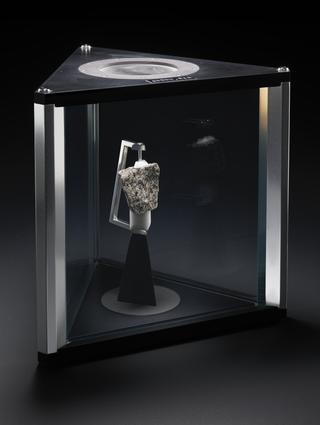
Moon rock
Mission patch for Magdrive's 'Going Rogue' test mission
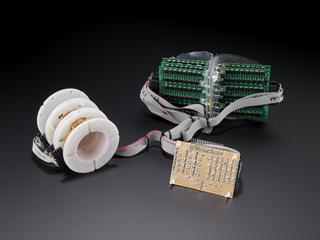
Early thruster prototype for satellites by Magdrive
Early thruster prototype for satellites by Magdrive