4 Boxes of Components and 4 Wooden Beams of Triple Prismatic Lathe by Johnson Jex
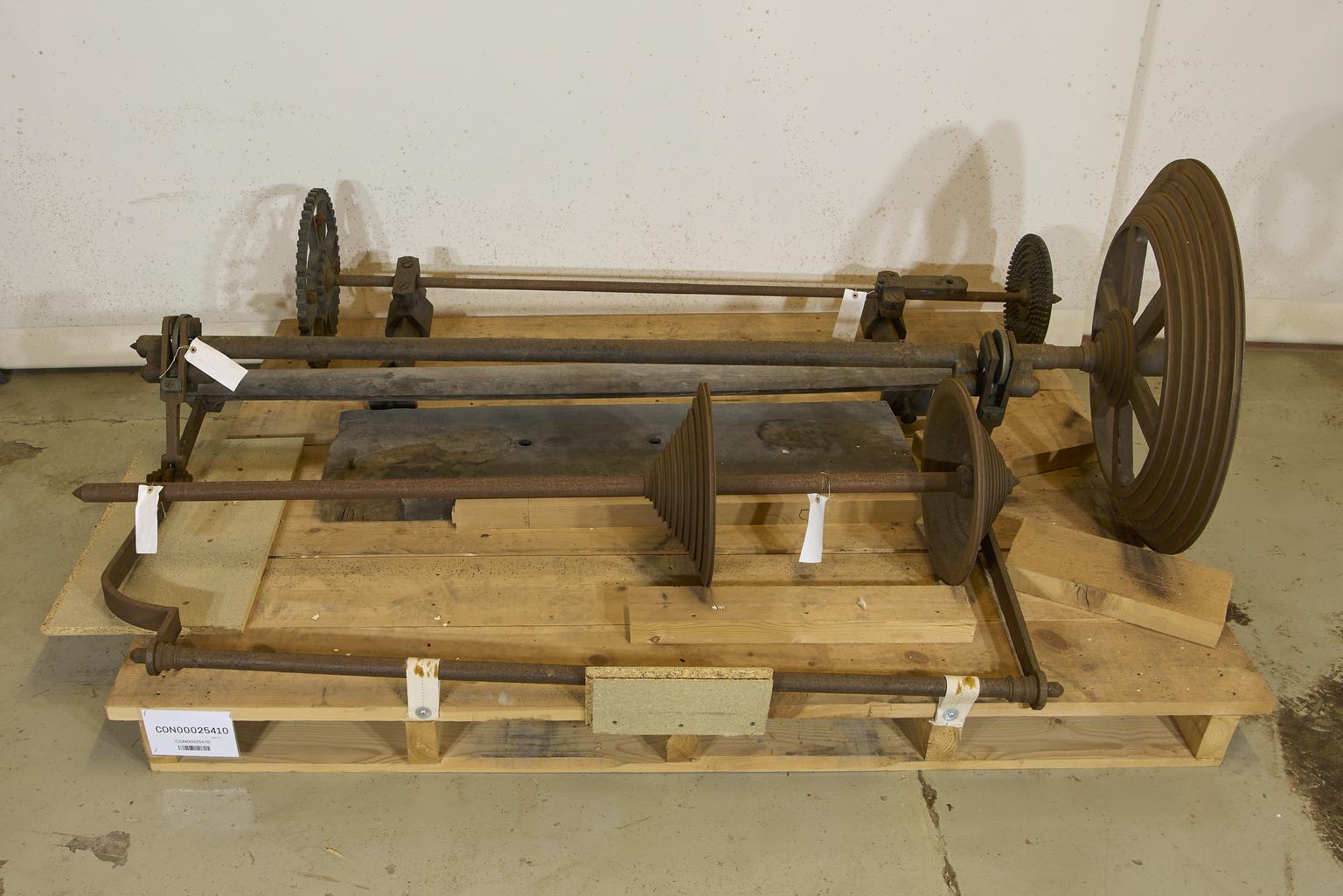
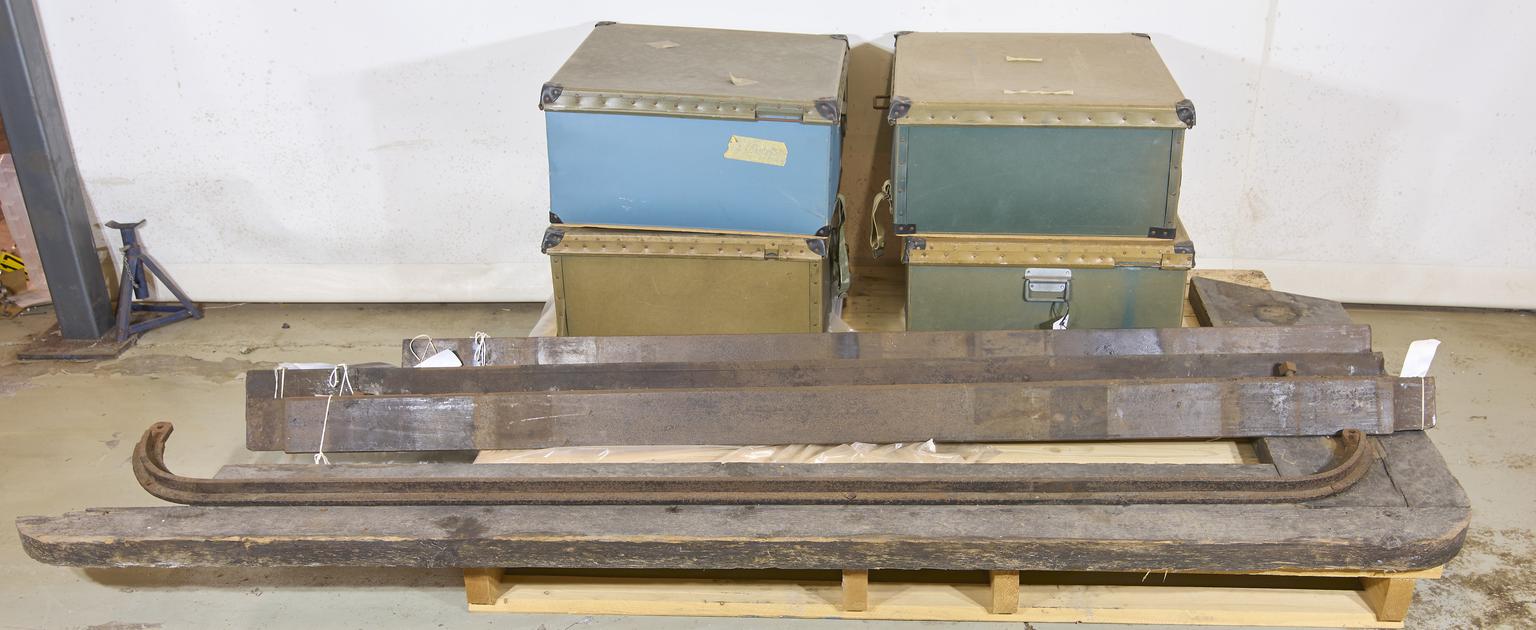
4 boxes of components and 4 wooden beams Triple prismatic lathe made and used by Johnson Jex, 1817-1822. The first box ('5 of 8' on object label) includes 2 blankets, 2 small mandrels, 2 headstock, 2 treadle rear and 2 metal components; second box ('6 of 8' on object label) includes 1 blanket, 1 plug, 1 round plate and 1 plastic component; third box ('7 of 8' on object label) includes 1 rear shaft, 2 lower back shaft bearer, 1 slide rest bearer v-pipe and 1 metal bracket with a pulley; forth box ('8 of 8' on object label) includes 1 slide rest, 1 tool to fit in slide rest and 1 metal component with a spherical wooden part on it (this component has a label attached on it, but cannot regonize the text on it.
This is a highly significant, early and interesting multi-purpose machine tool made and used by a locally prominent engineer. Johnson Jex (1778-1852) lived in the village of Letheringsett, Norfolk. He trained as a blacksmith but later acquired additional skills in horology, and tempered his considerable practical abilities with extensive reading on a range of scientific subjects. Surviving written sources indicate that Jex became self-employed c.1817, and in 1822 he advertised the capabilities of his ‘triple prismatic engine lathe’ in the Norfolk Chronicle – these two details provide us with the basis for the date of the lathe’s construction. The lathe is a triangular bar lathe: a treadle base has a column at each corner, with the pair at each end supporting a cast entablature. Between the ends sits the bed frame, consisting of three very robust triangular bars of prismatic section; the principal two of these are approximately 8’ in length. The bars give the lathe exceptional rigidity and provide an excellent mounting for slide rests, etc. The bed supports the working parts of the lathe: head and tailstock, tool rests, a very large dividing head and much else. Jex’s 1822 advertisement claimed a wide range of machining capabilities; from examining the lathe, it is clear that it was developed as a multi-purpose machine, able to be adapted to whatever job Jex had to complete.
- Measurements:
-
Archival box: 360 mm x 620 mm x 620 mm,
Wooden beam: 100 mm x 2170 mm x 100 mm,
- Materials:
- wood (unidentified) , metal (unknown) , textile and plastic (unidentified)
- Object Number:
- 2009-67/4
- type:
- lathe
- Image ©
- The Board of Trustees of the Science Museum