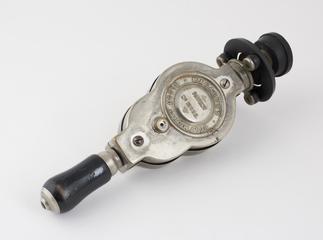
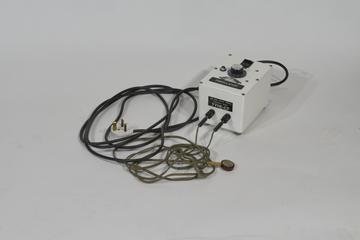
Demonstration Aurora EV-ICD™ with lead

Made:
2025

Demonstration Aurora EV-ICD™ device generator with Medtronic Epsila EV™ extravascular quadripolar lead, Medtronic, 2025

Sudden cardiac arrest is responsible for around 20% of all deaths in Europe. It has a survival rate of less than 5% without defibrillation.

An implantable cardioverter defibrillator (ICD) is a small, battery-powered device that detects and treats dangerously abnormal heart rhythms (ventricular arrythmias). Like a pacemaker, it continuously monitors the heart and can deliver small electrical impulses and shocks to correct irregular heartbeats (pacing and cardioversion) but can also deliver stronger defibrillation shocks to prevent someone from dying of an unexpected cardiac arrest.

Regular ICDs are implanted under the skin on the upper chest wall and have wires that pass down through a vein directly into the heart. The Aurora EV-ICD™ by Medtronic is a next generation system that avoids the need for any hardware to be placed inside the heart. Instead, the wire is tucked behind the breastbone, reducing the chance of complications like infection and making it easier to remove if necessary. Its small size means it can be implanted as a day case procedure with a short recovery period.

It can take longer to adjust to the emotional impact of having an ICD, particularly for those who have experienced receiving a shock. People who have been awake when it happened have compared it to being thumped or kicked in the chest. Conflicting feelings of reassurance and fear that the device has ‘gone off’ are very common. Patients only normally need to go to hospital if they continue to feel unwell or receive more than one shock. Organisations like the British Heart Foundation provide advice on learning to live with a device.

Details

Parts

Demonstration Aurora EV-ICD™ device generator, Medtronic, 2025

Demonstration Aurora EV-ICD™

Demonstration Aurora EV-ICD™ device generator, Medtronic, 2025

More

Sudden cardiac arrest is responsible for around 20% of all deaths in Europe. It has a survival rate of less than 5% without defibrillation.

An implantable cardioverter defibrillator (ICD) is a small, battery-powered device that detects and treats dangerously abnormal heart rhythms (ventricular arrythmias). Like a pacemaker, it continuously monitors the heart and can deliver small electrical impulses and shocks to correct irregular heartbeats (pacing and cardioversion) but can also deliver stronger defibrillation shocks to prevent someone from dying of an unexpected cardiac arrest.

Regular ICDs are implanted under the skin on the upper chest wall and have wires that pass down through a vein directly into the heart. The Aurora EV-ICD™ by Medtronic is a next generation system that avoids the need for any hardware to be placed inside the heart. Instead, the wire is tucked behind the breastbone, reducing the chance of complications like infection and making it easier to remove if necessary. Its small size means it can be implanted as a day case procedure with a short recovery period.

It can take longer to adjust to the emotional impact of having an ICD, particularly for those who have experienced receiving a shock. People who have been awake when it happened have compared it to being thumped or kicked in the chest. Conflicting feelings of reassurance and fear that the device has ‘gone off’ are very common. Patients only normally need to go to hospital if they continue to feel unwell or receive more than one shock. Organisations like the British Heart Foundation provide advice on learning to live with a device.

Measurements:
overall: 64 mm x 51 mm x 13 mm,
Materials:
Titanium, polyurethane, silicone rubber adhesive, silicone rubber, liquid silicone rubber
Object Number:
2026-131/1
type:
defibrillator
Medtronic Epsila EV™ extravascular quadripolar lead, designed for sensing, cardioversion, defibrillation, and pacing therapies, Medtronic, 2025

Extravascular quadripolar lead

Medtronic Epsila EV™ extravascular quadripolar lead, designed for sensing, cardioversion, defibrillation, and pacing therapies, Medtronic, 2025

More

Sudden cardiac arrest is responsible for around 20% of all deaths in Europe. It has a survival rate of less than 5% without defibrillation.

An implantable cardioverter defibrillator (ICD) is a small, battery-powered device that detects and treats dangerously abnormal heart rhythms (ventricular arrythmias). Like a pacemaker, it continuously monitors the heart and can deliver small electrical impulses and shocks to correct irregular heartbeats (pacing and cardioversion) but can also deliver stronger defibrillation shocks to prevent someone from dying of an unexpected cardiac arrest.

Regular ICDs are implanted under the skin on the upper chest wall and have wires that pass down through a vein directly into the heart. The Aurora EV-ICD™ by Medtronic is a next generation system that avoids the need for any hardware to be placed inside the heart. Instead, the wire is tucked behind the breastbone, reducing the chance of complications like infection and making it easier to remove if necessary. The device's small size means it can be implanted as a day case procedure with a short recovery period.

Measurements:
overall: 63 mm 4 mm,
Materials:
MP35N, polyurethane, titanium nitride coated platinum iridium, tantalum
Object Number:
2026-131/2
type:
wire