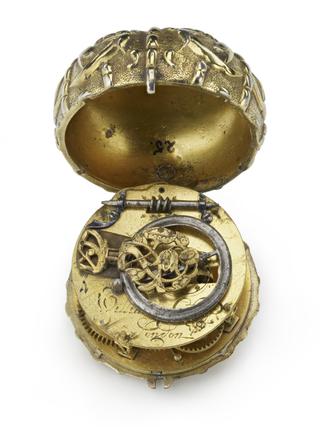
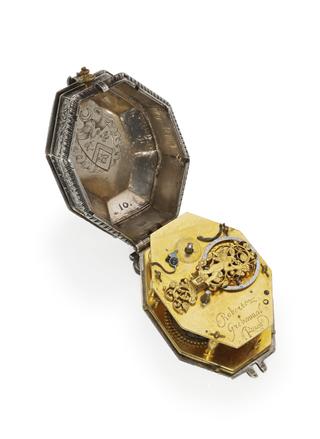
Portrait of the Reverand Edward Barlow (1636 – 1719)
- Made:
- 1670-1680 in Great Britain
 This image is released under a CC BY-NC-SA 4.0
Licence
This image is released under a CC BY-NC-SA 4.0
Licence
License this image for commercial use at Science and Society Picture Library
License
Science Museum Group
© The Board of Trustees of the Science Museum
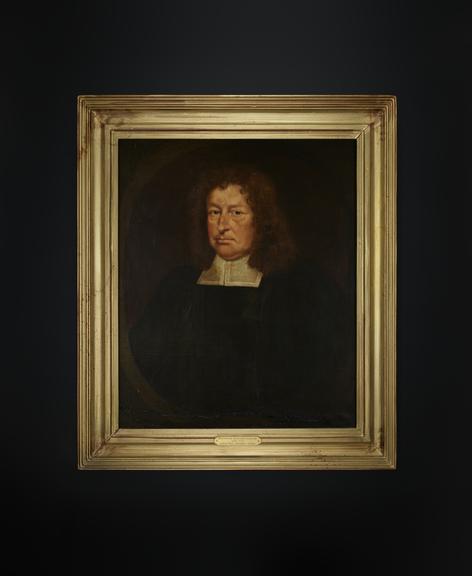
Framed oil on canvas portrait painting, depicting Edward Booth/Barlow (1636 – 1719) in clerical dress. English school, attributed to Cornelius Jonson van Ceulen (II).
The Reverand Edward Barlow (born Edward Booth) was a Catholic priest, and horologist. In 1672 he moved to the seat of the Houghton family at Park Hall, Lancashire, where he became vicar-general of the district. It was at this time that Barlow was also involved in the field of clockmaking, where great technical advancements were being made. For many years Barlow was wrongly attibuted as having invented rack-and-snail striking for clocks; an improvement from the older system of count-wheel striking. It is now accepted that he was instead involved in the development of pull repeating work for clocks and watches in around 1676. Repeating clocks were a highly advantagous development for the 17th century owner, who would have struggled to read the time at night, allowing them to hear the last hour to the nearest quarter by simply pulling a cord. Around 10 years later, Barlow developed a type of repeating watch in conjunction with Thomas Tompion. Barlow applied for a patent for the 'sole making and managing all pulling Clocks and Watches, usually called Repeating Clocks'. This patent was opposed and defeated at great expense by the Clockmakers' Company in Feb/March 1688, on the grounds that these were 'now made by severall (sic) Clockmakers'. In September 1695, Barlow, along with Thomas Tompion and William Houghton, patented for a new watch escapement which is considered the precursor to the cylinder escapement.
Details
- Category:
- Clockmakers
- Collection:
- The Worshipful Company of Clockmakers
- Object Number:
- L2026-2
- Materials:
- oil paint and canvas (textile)
- Measurements:
-
overall: 762 mm x 635 mm
- type:
- oil painting