Richard Johnson and Nephew Limited 1773 - 1973
- industry:
- Manufacturer of steel and wire products
- Nationality:
- British
The company that became Richard Johnson & Nephew Ltd began in 1773. James Howard, a wire worker and pin maker, set up a wire drawing business in Market Street, Manchester. In 1804, he moved the business to Long Millgate. By 1818, John Johnson was running the company in partnership with Thomas Sharrocks from larger premises in Withy Grove. By 1828, the company had expanded and moved premises again, to Edge Street on Shude Hill.
John Johnson's sons, Richard and William Johnson, took over the business in 1838. Richard and William changed the company name to Richard Johnson & Brother. At the time, the company carried out wire drawing in premises in Dale Street and Lees Street, Ancoats. By 1854, the company also had a wire galvanising plant in Mill Street, Ancoats, and a site in Bradford, Manchester, for the manufacture of puddled iron. The Bradford site also had a billet mill, where iron ingots were rolled into billets. The site later became known as the Bradford Iron Works.
In 1860, William Johnson died and the brothers' nephew, John Thewlis Johnson, joined the company. He became a partner in 1865, and the company's name changed to Richard Johnson & Nephew.
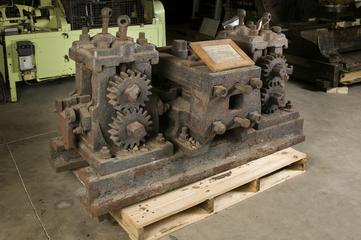
At the start of the 1860s, the company introduced two manufacturing innovations which revolutionised the wire industry. In 1860, George Bedson introduced the first continuous galvanising plant at the company’s Mill Street works. Bedson was the company's Works Manager from 1850 until 1884. In 1862, Bedson patented the world's first successful continuous rod rolling mill, which operated at the Bradford Iron Works. These machines sped up the wire-making process at a time when demand was rising rapidly.
The company supplied galvanised armouring wire for the 1851 Dover to Calais submarine cable and for the first transatlantic telegraph cable in 1857, as well as wire for use in the construction of suspension bridges. Bridges using Johnson wire included the Niagara and Cincinnati Suspension Bridges. On its construction in 1866, the Cincinnati Suspension Bridge was the longest suspension bridge in the world.
In 1904 the company began manufacturing copper wire for a local telegraph cable company, W. T. Henley. By the outbreak of the First World War, copper wire had become an important part of the business.
In 1927, Richard Johnson & Nephew purchased an American patent jointly with Rylands Bros. of Warrington, which allowed them to introduce a new method of galvanising wire. The new process involved coating wires in zinc to give better resistance to corrosion. One of the first customers for wire galvanised by this process was the Central Electricity Board, which needed steel-cored aluminium conductors for the National Grid.
During the Second World War, the company supplied galvanised armouring wire for use in the pipe line under the ocean (PLUTO). The company also produced a large proportion of the copper tape and steel armouring wire used in the first transatlantic telephone cable in 1956, almost 100 years after its involvement with the first transatlantic telegraph cable. In 1973, Richard Johnson & Nephew merged with Thomas Firth & John Brown Ltd, becoming Johnson & Firth Brown. The Bradford Works closed in 1986. The site is now part of the Sportcity complex and was excavated by archaeologists in 2010.
Related Objects
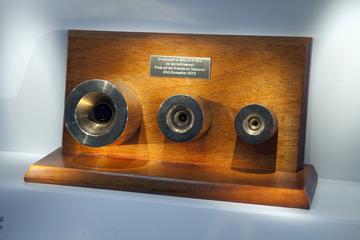
Three gold-plated cable dies
Part of Bedson-type rod rolling mill