Edward Frederick Skinner
Painter and illustrator, predominantly landscape and portrait work. Born 1865 in Lewes, Sussex, the son of a jeweller. Skinner studied at the Herkomer Art School, Bushey, and at various points in his life resided in London, Lewes, and St Ives. He contributed illustrations to the Royal Magazine and the illustrated periodical Black and White. Skinner exhibited at the Royal Academy, London; Walker Art Gallery, Liverpool; the Royal Society of British Artists (RBA); and the Royal West of England Academy (RWA). He died 1924 in Kent. Signed work E.F. Skinner.
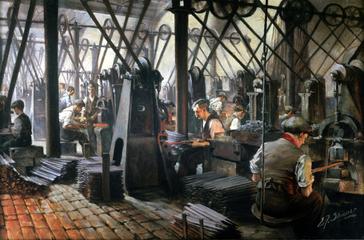
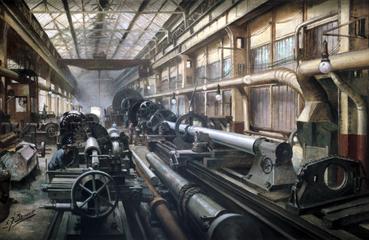
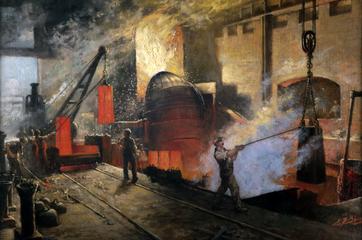
Perhaps influenced by the government-run War Artists’ Scheme, during World War I the steelmaker Cammell Laird & Co. commissioned Skinner and two other artists to produce works depicting the company's manufacture of armaments. The two other artists were both prominent marine painters: Arthur James Wetherall Burgess (1879–1957) and Charles John de Lacy (1856–1929). Skinner created a series of 12 oil paintings. Six of these, all depicting steelworks in the Sheffield area, are now in the Science Museum Group collection. Another, ‘For King and Country’, is in the collection of the Imperial War Museums, number Art.IWM ART 6513. That painting, as well as one in the SMG collection (‘File Cutters’, number 1980-1397/6), depict women steelworkers: the exigencies of war caused a significant increase in the number of women employed in the industry, from 6,000 pre-war to 42,000 by late 1918.
The commissioned paintings were reproduced as postcards by Thomas Forman of Nottingham, with profits from their sale going to the British Red Cross. Following the war, Cammell Laird continued to use reproductions of the paintings in their publicity material. The paintings themselves hung in the company’s London office until about 1946. The current whereabouts of the other commissioned paintings is not known.