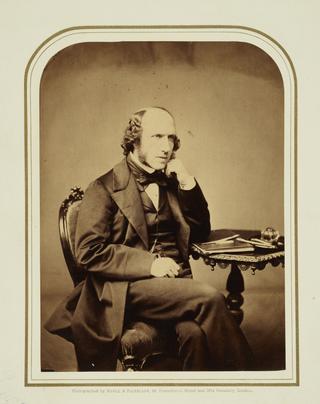
Archibald Smith 1813 - 1872
Archibald Smith was born on the 10 August 1813 at Greenhead, Glasgow. He was educated in law at Glasgow University from 1828 before moving to Trinity College, graduating with BA in 1836 and MA in 1839. In 1836 he was the top mathematics undergraduate at Cambridge and won the Smith Prize for the best examination results. He was elected a fellow of Trinity College in 1836. He began his law career the same year, completing his training on 25 January 1841. He practised for many years as a specialist in contracts, trusts and wills, and became an eminent property lawyer.
In November 1837, Smith helped to found the Cambridge Mathematical Journal. Between 1842 and 1847, at the request of General Sir Edward Sabine, he deduced from practical formulae for the correction of observations made onboard ships. This was one of many works on magnetism and its impact on navigation. In 1859 he edited the Journal of a Voyage to Australia, by William Scoresby the younger, giving in the introduction an exact formula for the effect of the iron of a ship on the compass, a problem with which Scoresby had been preoccupied, but had failed to solve. In 1862, in conjunction with Sir Frederick John Owen Evans, superintendent of the compass department of the Royal Navy, he published an Admiralty manual for ascertaining and applying the deviations of the compass caused by the iron in a ship. This work was translated into French, German, Russian, and Spanish.
In recognition of his services Smith received the honorary degree of LLD from the University of Glasgow in 1864, and in the following year was awarded a gold medal by the Royal Society, of which he had been elected a fellow on 5 June 1856. In 1872 he received a grant of £2000 from the government. In addition, he received a gold compass set with thirty-two diamonds from the tsar of Russia, and was elected a corresponding member of the scientific committee of the imperial Russian navy.
In August 1853 Smith married Susan Emma (d. 1913) They had six sons and two daughters. His fourth son, Arthur Hamilton Smith (1860–1941), was keeper of Greek and Roman antiquities at the British Museum, while his eldest son, James Parker Smith, was MP for the Partick division of Lanarkshire. Sir Henry Babington Smith was a younger son. Archibald Smith had once stood as the Liberal candidate for Glasgow but was unsuccessful. He died at his London home at Riverbank, Putney, on 26 December 1872 and was buried in Kensal Green cemetery.
Related Objects