John Cowdery Kendrew 1917 - 1997
- occupation:
- Molecular biologist
- Nationality:
- British; English
- born in:
- Oxford, Oxfordshire, England, United Kingdom
Sir John Kendrew was a pioneering biochemist and structural biologist who won the Nobel Prize in Chemistry in 1962 (shared with Max Perutz) for determining the three-dimensional structure of the protein, myoglobin. He was also a key figure in the development of molecular biology, instrumental in founding the Medical Research Council (MRC) Laboratory of Molecular Biology and the European Molecular Biology Organisation (EMBO). Later in his career, he became the first Director-General of the European Molecular Biology Laboratory (EMBL).
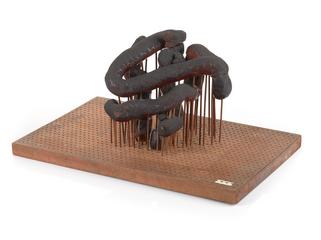
In September 1945, having been awarded an ICI research fellowship, Kendrew started research in protein crystallography in the Cavendish Laboratory, under the guidance of Max Perutz and W. H. Taylor. In 1957 Kendrew and his collaborators presented a first molecular model of myoglobin at 6 Ångström resolution. The model, the first of a globular protein ever to be built based on direct structure analysis, was remarkable for the unexpected twists the protein chain performed. It was followed two years later by a 2 Ångström resolution model, built of meccano and ‘Kendrew type’ skeletal model parts, which indicated the exact position of most of the 1200 atoms of the molecule. This work gained Kendrew, jointly with Perutz, the 1962 Nobel prize for chemistry. The crystallographic calculation for both models relied decisively on the use of the first electronic digital computers built at Cambridge, EDSAC I and II, of which Kendrew made pioneering use. Together with John Bennett of the mathematical laboratory in Cambridge he wrote the first paper on crystallographic computation with electronic digital computers, published in Acta crystallographica in 1952.