'Cold Fusion' ,apparatus used at Harwell laboratories in 1989 to replicate experiments of Fleschmann and Pons. The apparatus consists of a electrolysis apparatus (glass flask) containing a palladium electrode. 'Cold Fusion' apparatus, Harwell 1989
Box containing metal wires and working notes made by William Hyde Wollaston. Also conrtains correspondence detailing the history of the objects. Box containing metal wires and working notes made by William Hyde Wollaston 1800-1815
Items of jewellery partly manufactured, before being coated with gold or silver and having gems fitted. Palladium coating is used instead of nickel which can cause allergic reaction. Made by Ingrams, 1996 Items of partly manufactured jewellery 1996
Button of steel with 22.7% palladium, by Michael Faraday, 1820-1824 Button of steel with 22.7% palladium 1820-1824
Envelope containing specimen of palladium, representing the production range of Inco (International Nickel Co.) in 1977. Specimen of palladium 1977
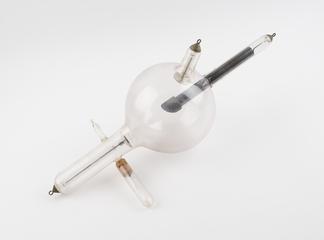
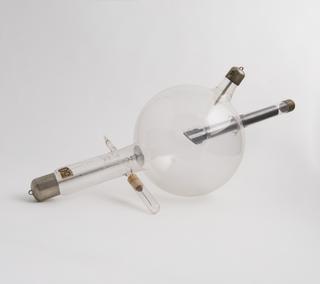
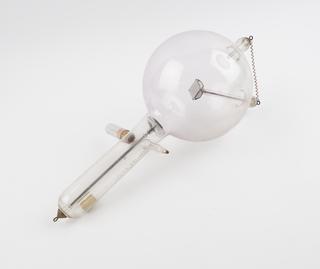
'Ideal' x-ray tube with separate anode, protecting shield round heavy anti-cathode, and palladium osmosis vacuum regulator, by Electrotechnisches Laboratorium, Aschaffenburg, Unterfranken, Bavaria, Germany, 1900-1909. 'Ideal' x-ray tube with separate anode 1900-1909
Brooch partly manufactured, before being coated with gold or silver and having gems fitted, by Ingrams, 1996 Partly manufactured brooch 1996
Palladium foil, one of two, England, 1820 Palladium foil, one of two, from Michael Faraday's chemical chest 1820
Palladium foil, one of two, England, 1820 Palladium foil, one of two, from Michael Faraday's chemical chest 1820